Air-to-Water Heat Pump System Design: 5 Key Principles for Peak Performance
Most air-to-water heat pump systems underperform because of how they're designed, not what they're made of. Here are five principles hydronic engineers should apply from the start.
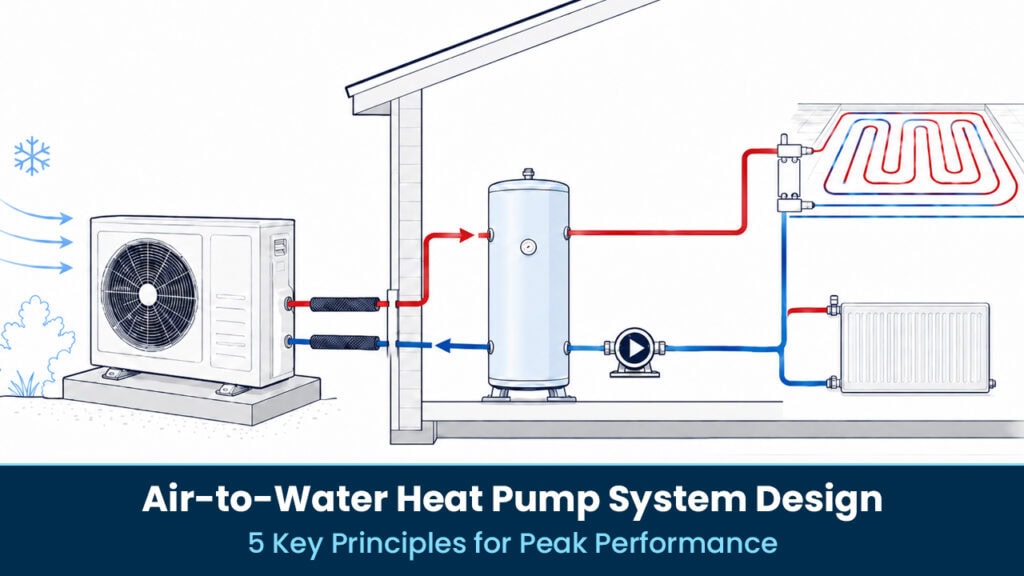
As interest in air-to-water heat pump systems grow, more hydronic engineers are curious about the types of projects that would suit these systems. More conversation is needed on designing air-to-water heat pumps (AWHPs) so they deliver on their efficiency potential. An AWHP specified without the right architecture will underperform, short-cycle, and potentially fuel broader uncertainty.
In spite of any doubt, a correctly-designed air-to-water heat pump system is one of the most efficient, low-maintenance, and comfortable heating solutions available.
Quick answer: A well-designed air-to-water heat pump system requires five things: designing the distribution system before selecting equipment, correctly sizing the buffer tank, specifying outdoor reset control, planning the defrost strategy, and matching the refrigerant technology to the climate. Get all five right, and the system will deliver on its efficiency ratings.
Here are five design principles that ensure AWHPs’ strongest performance features aren’t inhibited.
1. Design the Distribution System First Before Choosing Equipment
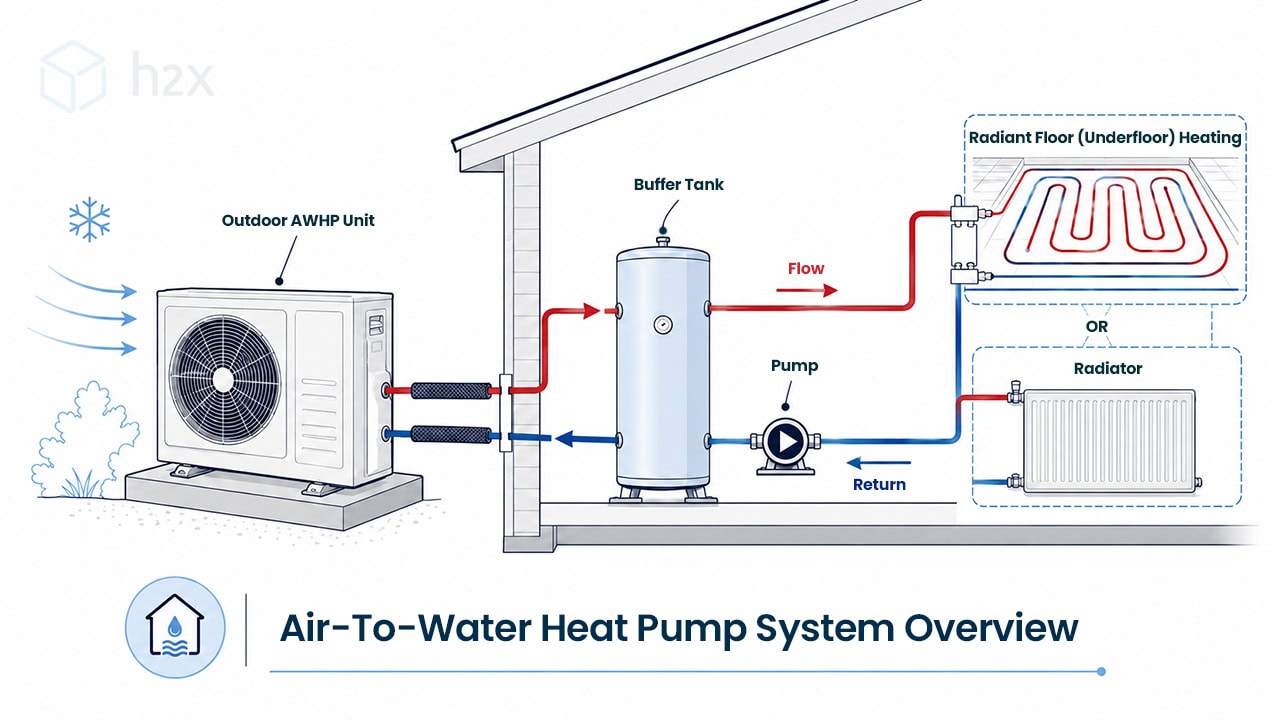
This is where many air-to-water heat pump system projects fall short. Engineers select the heat pump first, then figure out the distribution system. In reality, the process should be flipped.
The entire efficiency case for an AWHP depends on its operating at a low supply water temperature. This would be 95°F to 115°F (35°C to 46°C) for radiant floor heating (underfloor heating), and 120°F to 130°F (49°C to 54°C) for oversized hydronic emitters. Every degree reduction in supply water temperature moves the refrigerant cycle into a more efficient, beneficial operating range. This, in turn, raises the COP meaningfully.
Hydronic engineers should design the emitters to satisfy the peak heat loss at the lowest achievable supply water temperature. Then, they should select a heat pump that operates efficiently at that temperature. That sequence produces a system that thermodynamically matches the equipment and distribution. Achieving this match is the only way to capture the full efficiency potential of AWHP technology.
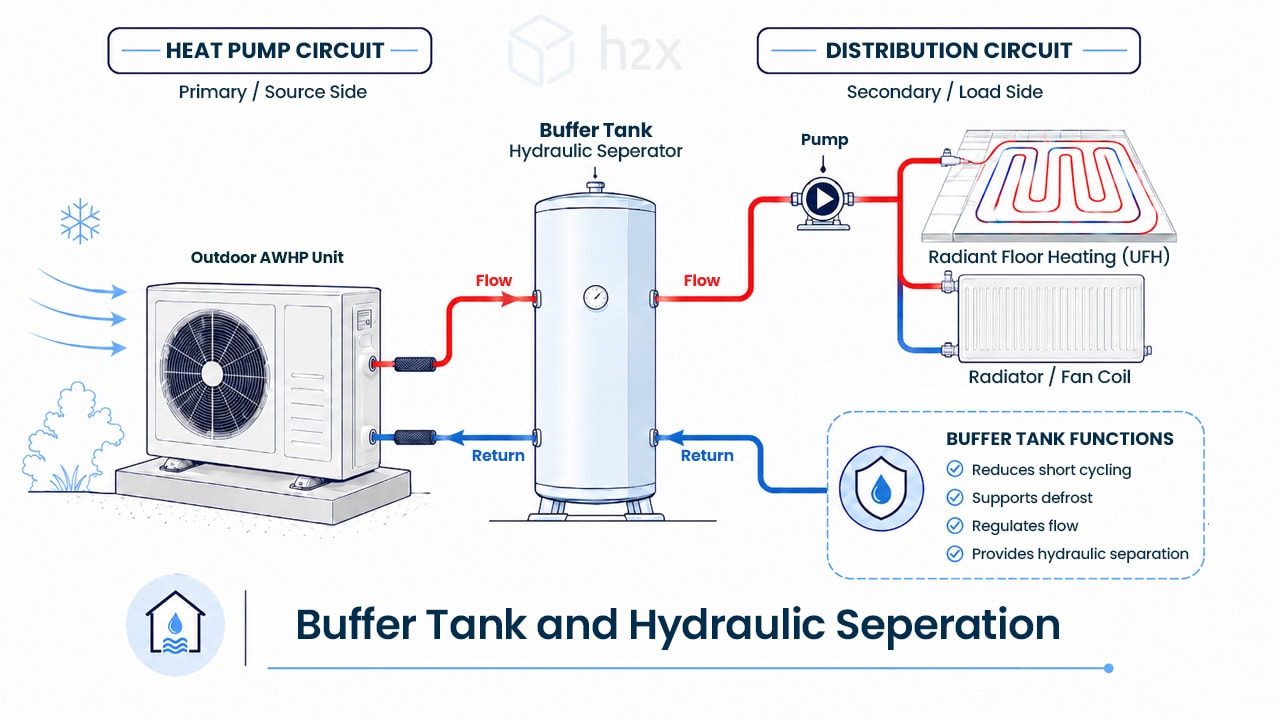
2. Size the Buffer Tank as a Major System Component, Not an Afterthought
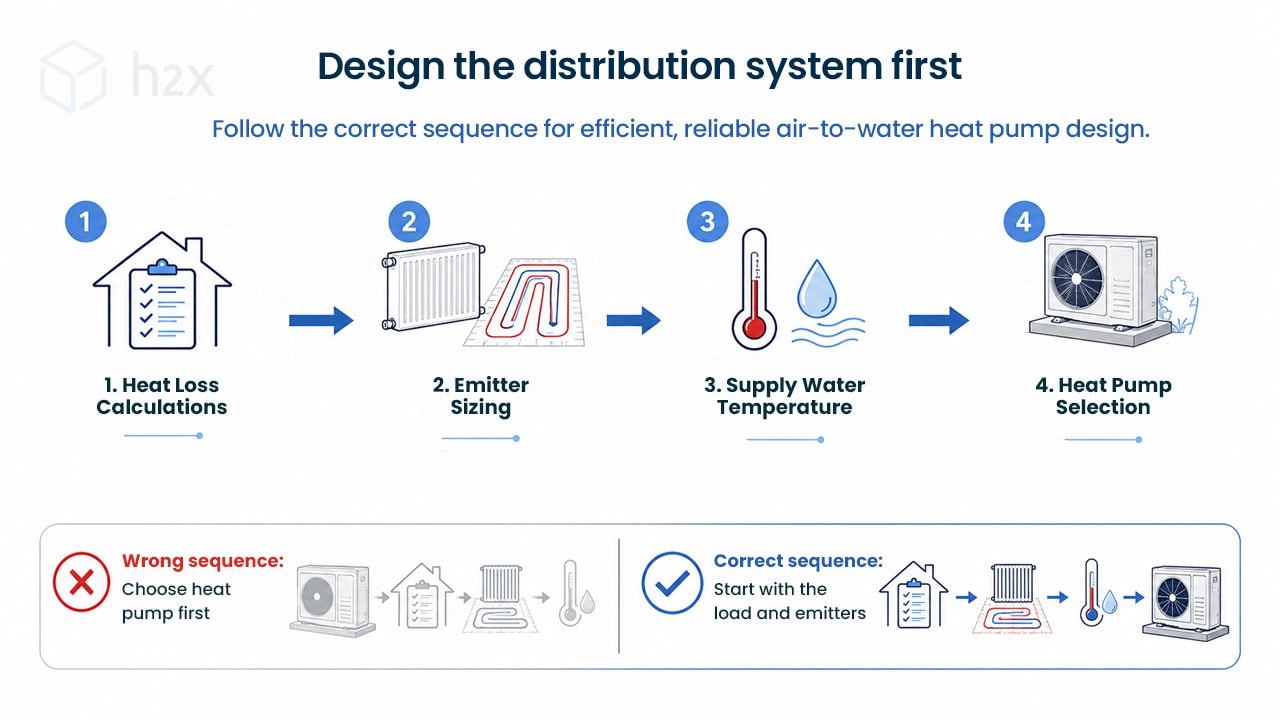
The buffer tank in an AWHP does a significant amount of engineering work. Its role includes:
- thermally decoupling the heat pump’s production cycle from the distribution system’s demand cycle,
- preventing short cycling during low-load conditions,
- and giving the control system the hydraulic flexibility to manage bivalent operation cleanly.
While the rule of thumb of 10 gallons per ton of heat pump capacity, roughly equivalent to 11 litres per kW, is a good starting point, the actual sizing calculation is based on:
- the heat pump’s minimum run time,
- its minimum modulated output at low ambient conditions,
- and the minimum zone load the system will see in shoulder season.
Undersized buffer tanks can contribute to short cycling. Short cycling degrades COP, accelerates compressor wear, and erodes the efficiency case you built in the design phase. If you size your buffer tank appropriately, you can avoid this risk.
3. Specify Outdoor Reset Control as a Non-Negotiable
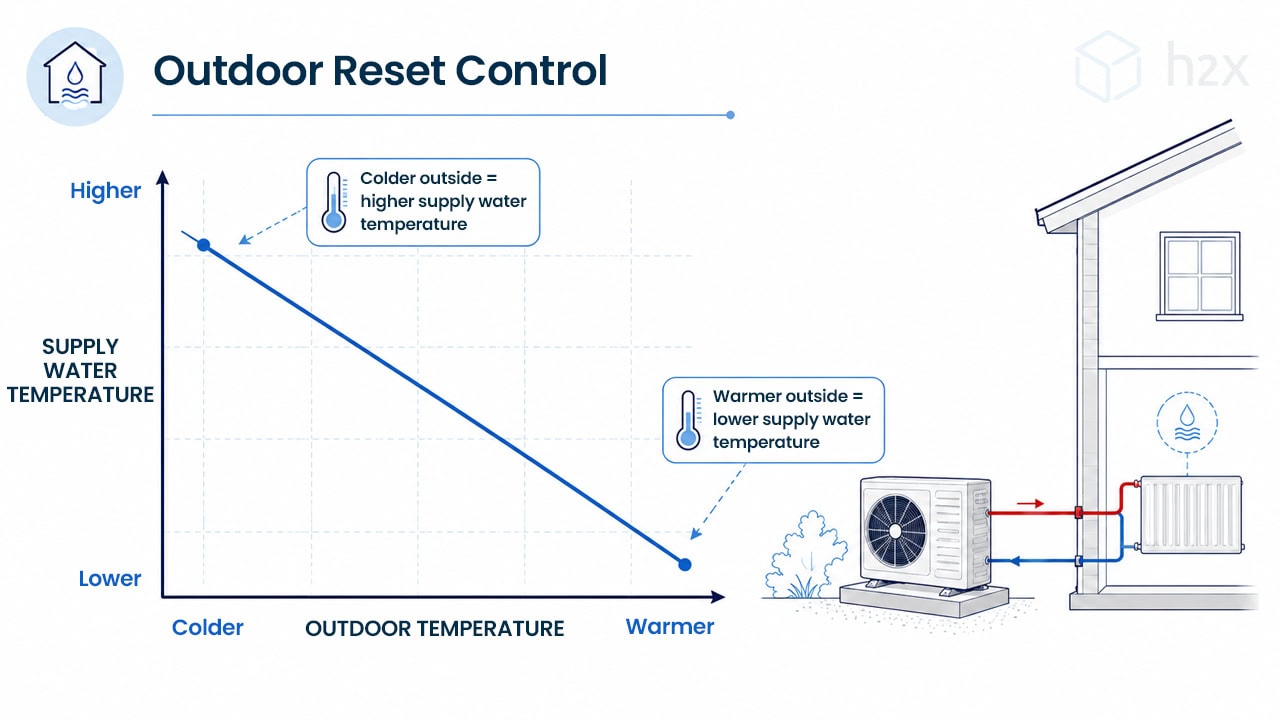
An AWHP feeding a high-mass distribution system, including radiant floor (underfloor heating) or large panel radiators, doesn’t perform well with a standard on/off thermostat. The thermal lag of the system means reactive controls will always be chasing setpoint, rather than maintaining it.
Outdoor reset solves this by modulating supply water temperature as a continuous function of outdoor ambient temperature. Doing so keeps the system in steady-state operation across the heating season, rather than cycling between oversupply and recovery.
A properly tuned outdoor reset curve keeps supply water temperature at the lowest value that satisfies load under any outdoor condition. This means the heat pump always operates at the highest COP that conditions allow. While outdoor reset is sometimes framed as a controls upgrade, it’s actually a fundamental requirement for optimal air-to-water heat pump system operation.
4. Plan the Defrost Strategy Explicitly
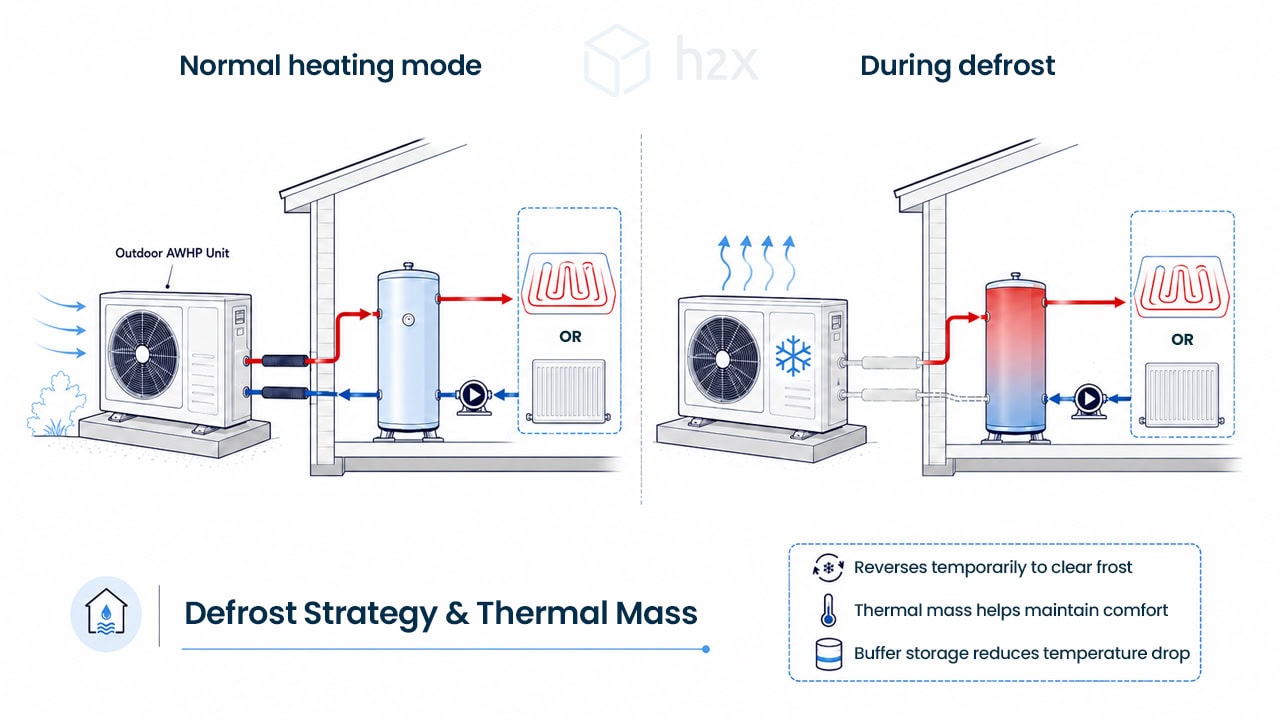
Frost accumulation on the outdoor coil at low ambient temperatures is a reality of AWHP operating conditions, but it can be anticipated with intentional design choices.
During defrost cycles, the system temporarily reverses the refrigerant cycle to clear the coil. This means the distribution system goes from adding to losing heat. In a system without adequate thermal mass, defrost events cause noticeable supply water temperature drops from which the heat pump then has to recover. Any type of recovery situation would disrupt the steady-state conditions under which the AWHP performs best.
A properly sized buffer tank can help absorb defrost events without impacting space temperature. Stratified storage tanks handle these types of conditions even more effectively. If your AWHP system does not account for the thermal impact of its defrost cycle, particularly in climates that see extended periods below 35°F (2°C), you will observe system performance below the rated data.
5. Match Refrigerant Circuit Technology to the Climate
Not all AWHPs are designed for the same operating envelope. While standard units lose capacity and COP rapidly below 20°F (-7°C), Enhanced Vapor Injection (EVI) units maintain meaningful output down to -13°F to -22°F (-25°C to -30°C), as reflected in AHRI-certified performance data. EVI units inject refrigerant at an intermediate pressure point mid-compression. This reduces the effective pressure ratio and sustains discharge temperature even in extreme conditions.
In Climate Zone 5 and colder zones, EVI is a design requirement. When designing in this zone, your heat pump-only or bivalent system must carry load through the coldest design days. Engineers must specify the unit to the climate, not the default.
Air-to-Water Heat Pump System Conclusion
A well-designed air-to-water heat pump system truly shines with thoughtful, intentional design choices. Get the distribution temperature right, size the buffer correctly, specify outdoor reset, plan for defrost, and match the refrigerant technology to the climate.
Do all five, and the performance data will back up everything the efficiency ratings promise.
h2x helps automate and enhance AWHP design by calculating heat loss, designing the system layout, and exporting the completed design to CAD.

Frequently Asked Questions About Air-to-Water Heat Pump Systems
Why do air-to-water heat pumps underperform in retrofits compared to forced-air?
The lower supply temperature in AWHPs create conditions resulting in a lower measured delta T than typical forced-air designs. However, a correctly-designed AWHP system will achieve a high level of efficiency and lower lifecycle cost. While engineers don’t use AWHPs as commonly on retrofit projects, there are a few retrofit scenarios where they would be a great fit.
Does every air-to-water heat pump system need a buffer tank?
Not every system needs the same buffer arrangement. However, buffer tanks are often used to prevent short cycling, support defrost operation, separate hydraulic circuits, and maintain stable flow through the heat pump.
What happens during an air-to-water heat pump defrost cycle?
During defrost, the heat pump temporarily reverses operation to remove frost from the outdoor coil. The system needs enough thermal mass or buffer capacity to prevent noticeable comfort issues during this process.
How do I properly size an AWHP?
A properly sized air-to-water heat pump system begins with correct calculations, including the supply temperature, delta T, and flow rate. h2x users use our software platform to size AWHP systems to achieve peak efficiency on an array of different projects.
Design air-to-water heat pump systems with the right architecture from the start.
h2x calculates heat loss, sizes your buffer tank, designs the distribution layout, and exports the completed system to CAD, so your AWHP operates at peak efficiency from day one.
Meet the author

Andrew Spencer
Andrew Spencer is a Mechanical Engineer at h2x.
Article Last Updated: June 8, 2026