CRAC vs CRAH Units for Data Center Cooling
Compare CRAC vs CRAH units and find out how each cools a data center, when to choose which, and how to size them, with a worked example.
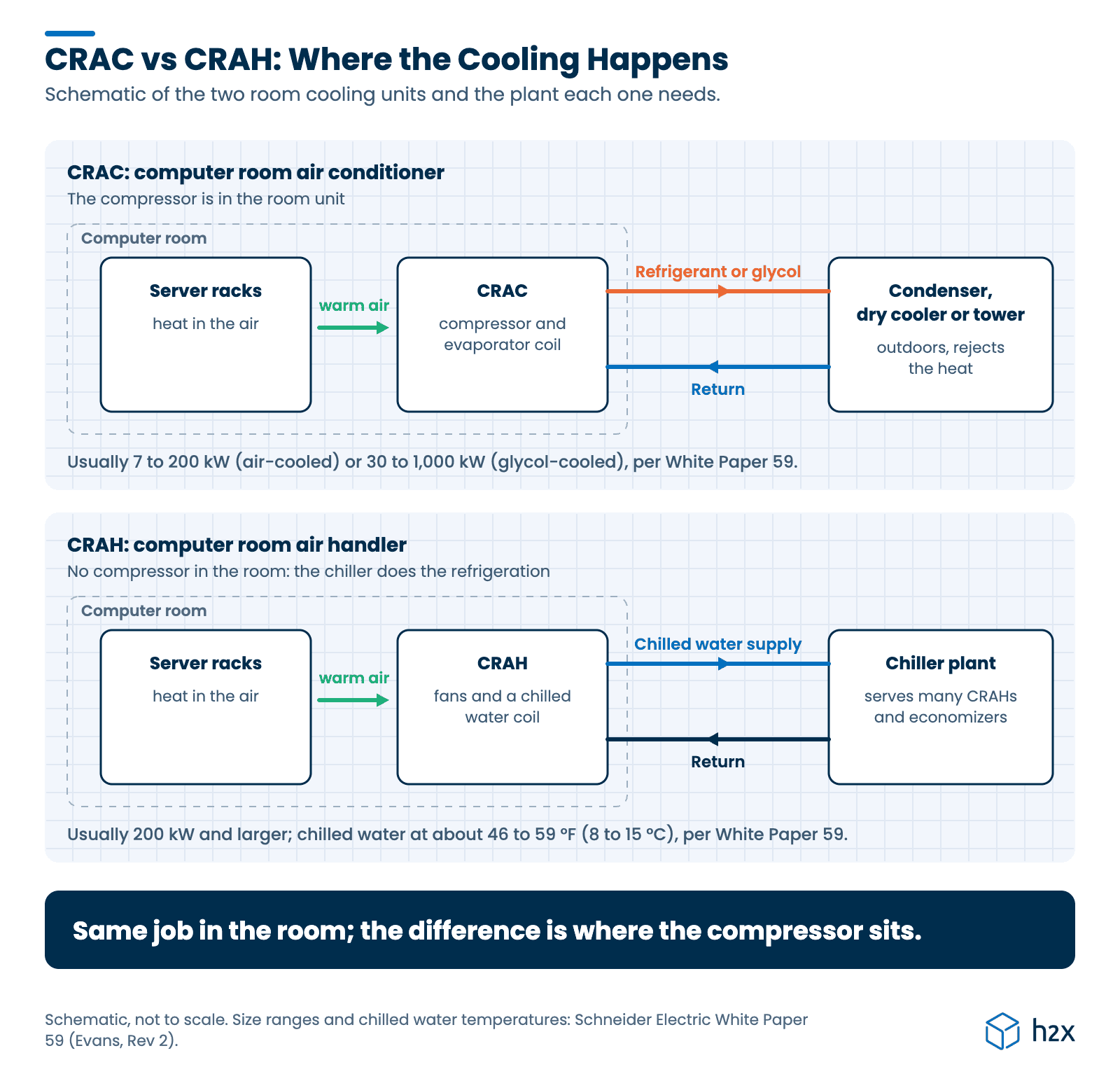
A CRAC, or computer room air conditioner, carries its own compressor and refrigerant circuit. A CRAH, or computer room air handler, has no compressor. It blows air across a chilled water coil fed by a central chiller plant. So the CRAC vs CRAH choice usually comes down to size: CRACs suit smaller rooms, and CRAHs suit large halls.
Both sit in or beside the room, and they look much the same from the outside. The difference is where the refrigeration happens, and that decides what plant they need, how big a room they suit and how much free cooling they can use. This guide compares the two, then sizes a CRAH plant for a 120-rack hall.
Quick Answer: CRAC vs CRAH comes down to the compressor. A CRAC has its own compressor and refrigerant, while a CRAH uses chilled water from a central plant. CRACs suit small rooms without chilled water. CRAHs suit larger halls, where a central plant and economizers save energy. Size either from the hall’s sensible load and airflow, with N+1 units.
What Is a CRAC Unit?
A CRAC unit is a packaged air conditioner built for computer rooms. Inside, a compressor, an evaporator coil and an expansion valve form a direct expansion (DX) refrigeration circuit. Room air passes over the cold evaporator coil, and the refrigerant carries the heat away.
Then the heat has to leave the building. Schneider Electric’s White Paper 59, “The Different Technologies for Cooling Data Centers”, describes the three common ways:
- Air-cooled: refrigerant pipes run to an outdoor condenser. It has the lowest overall cost and is the easiest to maintain, but refrigerant lines can’t run long distances, and each CRAC needs its own condenser.
- Glycol-cooled: the whole refrigeration circuit is sealed inside the CRAC, and a glycol loop carries the heat to an outdoor dry cooler. When the glycol is colder than 50 °F (10 °C), it can bypass the compressor through an economizer coil.
- Water-cooled: the circuit is also sealed in the unit, and condenser water carries the heat to a cooling tower. It needs cleaning and water treatment.
What Is a CRAH Unit?
A CRAH unit is a fan and a chilled water coil in a cabinet, with a valve to control the water flow. Warm room air passes over the coil, and the chilled water carries the heat back to a central chiller. The compressor sits in the chiller plant, not in the computer room.
So a CRAH is only half a system. It needs a chilled water supply, usually from a chiller, plus pumps and pipework. White Paper 59 calls a CRAH joined with a chiller a chilled water system. That paper puts typical chilled water at about 46 to 59 °F (8 to 15 °C). Running it at the warm end, 54 to 59 °F (12 to 15 °C), gives more hours when an economizer can cool without a compressor.
CRAC vs CRAH Differences
This table sets out CRAC vs CRAH side by side. The load ranges are White Paper 59’s typical applications, not hard limits.
| Feature | CRAC | CRAH |
|---|---|---|
| How it cools | Its own refrigerant circuit (DX) | A chilled water coil |
| Where the compressor is | In the unit or an outdoor condensing unit | In the central chiller |
| Plant it needs | Air-cooled: a condenser per unit. Glycol-cooled: a dry cooler, shared by several units. Water-cooled: a cooling tower | A chiller plant, pumps and pipework |
| Typical load | Air-cooled: 7 to 200 kW (2 to 57 tons). Glycol-cooled: 30 to 1,000 kW (8.5 to 284 tons) | 200 kW (57 tons) and up |
| Capacity for the footprint | Lower | Greater: “greater heat removal capacity than CRAC units with the same footprint” |
| Efficiency | Set by its compressor and heat rejection; glycol units can add an economizer coil | Improves with scale; economizer modes add free cooling |
| Liquid in the room | Refrigerant, glycol or condenser water | Chilled water |
| System capital cost | Lowest for small rooms | Highest below 100 kW (28 tons) |
When Should You Use a CRAC or a CRAH?
The CRAC vs CRAH choice starts with the size of the room and whether the building already has chilled water.
- Small rooms and closets: an air-cooled CRAC is usually cheapest. White Paper 59 puts air-cooled DX systems in rooms and data centers from 7 to 200 kW (2 to 57 tons).
- Mid-size rooms in cool climates: a glycol-cooled CRAC with a dry cooler adds free cooling without a chiller plant. It’s typical from 30 to 1,000 kW (8.5 to 284 tons).
- Large halls: CRAHs on a chilled water plant. White Paper 59 says chilled water is usually used from 200 kW (57 tons) upward, and has the highest capital cost below 100 kW (28 tons).
- Buildings with chilled water already: CRAHs can use the existing plant, as long as it has the capacity and redundancy the room needs.
Density also matters. Both types cool air, so neither handles the densest AI racks alone. Those need direct-to-chip cooling, and CRAHs then cool what stays on air. Our data center liquid cooling guide explains that split.
How Do You Size CRAC and CRAH Units?
Whichever way the CRAC vs CRAH choice goes, size the units from the room’s own heat load. Then add redundancy:
- Find the room’s sensible load. Take the IT load, then add lighting, people and any other internal heat gains, such as the units’ own fan heat. Our data center HVAC design guide works through it.
- Pick a unit size and count for N. Divide the load by the unit’s sensible capacity at your design conditions, and round up.
- Add one for N+1, so the plant still copes with any single unit lost or under service.
- Check the airflow. With standard air, CFM = Btu/h ÷ (1.08 × ΔT), with ΔT in °F. The 1.08 only works in US units. Each unit’s fans must move its share, even with one unit out.
- For CRAHs, size the chilled water. gpm = Btu/h ÷ (500 × ΔT), with ΔT the water’s temperature rise in °F. Like the 1.08, the 500 only works in US units. Then size the mains and branches from each section’s flow.
Worked Example
This continues the hall from our data center HVAC design guide. It has 120 racks at 8.4 kW (28,662 Btu/h) each, in 4,000 ft² (372 m²) of white space. The room units carry the IT, lighting and people: 3,458,955 Btu/h (1,014 kW), or 288 tons. The UPS losses sit in electrical rooms with their own cooling.
| Step | Calculation | Result |
|---|---|---|
| Unit size | Illustrative CRAH, 60 tons (720,000 Btu/h, 211 kW) sensible at the design conditions | |
| Units for N | 288 tons (1,014 kW) ÷ 60 tons (211 kW), rounded up | 5 |
| Units for N+1 | 5 + 1 | 6 CRAHs |
| Load per unit, all six running | 3,458,955 ÷ 6 | 576,492 Btu/h, or 48.0 tons (169 kW): 80% of rating |
| Load per unit, one out | 3,458,955 ÷ 5 | 691,791 Btu/h, or 57.6 tons (203 kW): 96% of rating |
Then the airflow and chilled water follow from the same load:
| Step | Calculation | Result |
|---|---|---|
| Airflow, whole hall | 3,458,955 ÷ (1.08 × 20 °F) | 160,137 CFM (75.6 m³/s) |
| Airflow per unit, one out | 160,137 ÷ 5 | 32,027 CFM (15.1 m³/s) |
| Chilled water, 54/66 °F (12.2/18.9 °C) | 3,458,955 ÷ (500.36 × 12 °F) | 576.1 gpm (36.3 L/s) |
| Chilled water per unit, one out | 576.1 ÷ 5 | 115.2 gpm (7.27 L/s) |
The 60-ton (211 kW) unit and the air rise of 20 °F (11.1 K) are illustrative. The 54 °F (12.2 °C) supply sits at the warm end of White Paper 59’s range. So check the maker’s sensible capacity at your air and water temperatures. The example also leaves out fan heat. For a real design, add the maker’s fan heat to the load, then recheck the N+1 capacity, airflow and chilled water flow.
Checking CRAH Units With One Out
With one unit out, each CRAH’s fans and coil must handle 57.6 tons (203 kW) and 32,027 CFM (15.1 m³/s). Its branch pipe must also carry 115.2 gpm (7.27 L/s), not just its normal 96.0 gpm (6.06 L/s).
So check the branch at that flow. In a 3 in (80 mm) Schedule 40 branch, 115.2 gpm (7.27 L/s) runs at 5.0 ft/s (1.52 m/s). Its friction loss is 3.12 ft per 100 ft (306 Pa/m). So it’s within the 2021 ASHRAE Handbook, Fundamentals design range of 1 to 4 ft per 100 ft (100 to 400 Pa/m).
However, this gives N+1 at the CRAH level only. The chillers, pumps, pipework and power supplies need their own redundancy for the same failures.
An air-cooled CRAC design would also need N+1 capacity, with an outdoor condenser and refrigerant lines for every unit. And the hall is well above the 7 to 200 kW (2 to 57 tons) where White Paper 59 says air-cooled DX is usually used. It isn’t a hard limit, but for a hall this size, the CRAC vs CRAH choice usually goes to CRAHs on chilled water.
Where CRAC and CRAH Units Go
Traditionally, most units sit on the perimeter of the room. They push cold air under a raised floor, up through perforated tiles in front of the racks, and draw warm air back across the top of the room.
Two other layouts move the cooling closer to the racks:
- In-row units sit between racks in the row. The short air path cuts fan energy, and they suit higher densities.
- Fan walls fill one side of the hall with banks of fans and chilled water coils. As a result, they move large volumes of air at low velocity.
Whatever the layout, though, keep hot and cold air apart with hot aisle or cold aisle containment. Otherwise exhaust air mixes back into the supply, and the units have to supply colder air than the servers need.
CRAHs in Liquid-Cooled Data Centers
Liquid cooling doesn’t remove the CRAHs. For example, HPE’s figures for the GB200 NVL72 leave 17 kW of the rack’s 132 kW on air, about 13%. And most network racks and electrical rooms have no liquid cooling at all.
So most liquid-cooled halls still keep a smaller set of CRAHs or fan walls on a chilled water loop. That loop runs colder than the chip cooling loops, because the air it makes has to stay within ASHRAE’s recommended server inlet range.
Common CRAC and CRAH Mistakes
- Sizing for N only. With one unit out, the rest must carry the full load. In the example, that takes each CRAH from 80% to 96% of its rating, so check it at that load.
- Using nominal or total ratings. Instead, size from the unit’s sensible capacity at your entering air and water temperatures, not its headline rating.
- Sizing CRAH branches for normal running. Each branch must also carry its unit’s flow with one unit out.
- Running chilled water colder than needed. Warmer water, at 54 to 59 °F (12 to 15 °C), gives more economizer hours.
- One condenser for several CRACs. That doesn’t work, because air-cooled CRACs each need their own condenser and refrigerant lines.
- Skipping containment. Mixed air forces colder supply air, so it wastes capacity.
How h2x Helps with CRAH Chilled Water Design
With h2x engineering software, each CRAH’s chilled water flow and pipe sizes come from its own cooling rating. Place each one as an indoor air handler with a chilled water coil. Then set its cooling rating in Btu/h. From there, h2x adds up the flow on each pipe and sizes the mains and branches, using Darcy-Weisbach with the chilled water’s own properties.
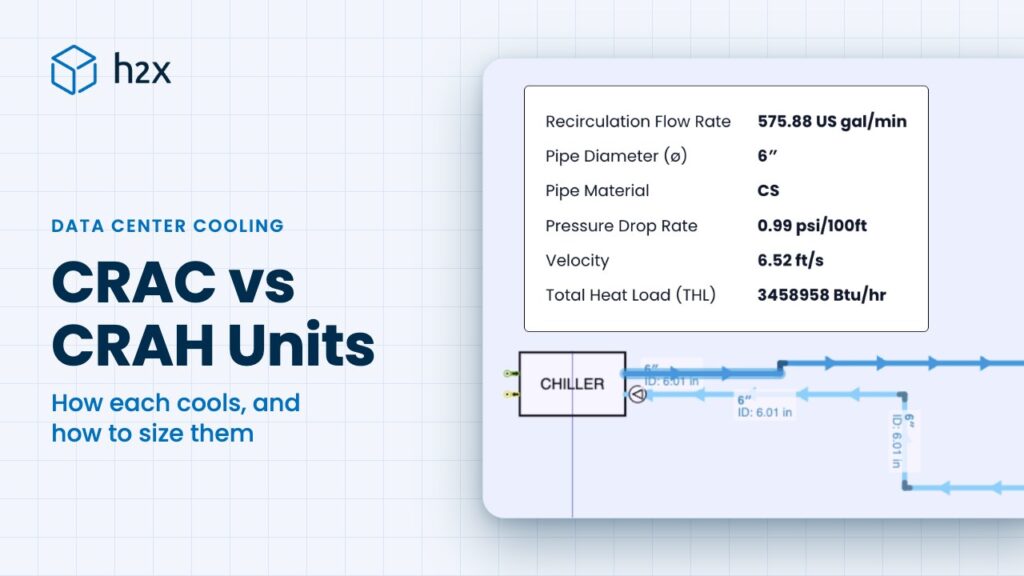
We built this guide’s plant in h2x: six CRAHs at 576,493 Btu/h (169 kW) each, on 54/66 °F (12.2/18.9 °C) chilled water. On the main, h2x gave 575.88 gpm (36.3 L/s) and a total heat load of 3,458,958 Btu/h (1,014 kW). It sized the main at 6 in (150 mm) carbon steel, running at 6.52 ft/s (1.99 m/s). That’s the worked example’s flow to within 0.1%.
Each CRAH was entered at its share of the load with all six running, not its full 60-ton (211 kW) rating. So the model shows normal flows, and the worked example checks the branches separately at the one-out flow of 115.2 gpm (7.27 L/s).
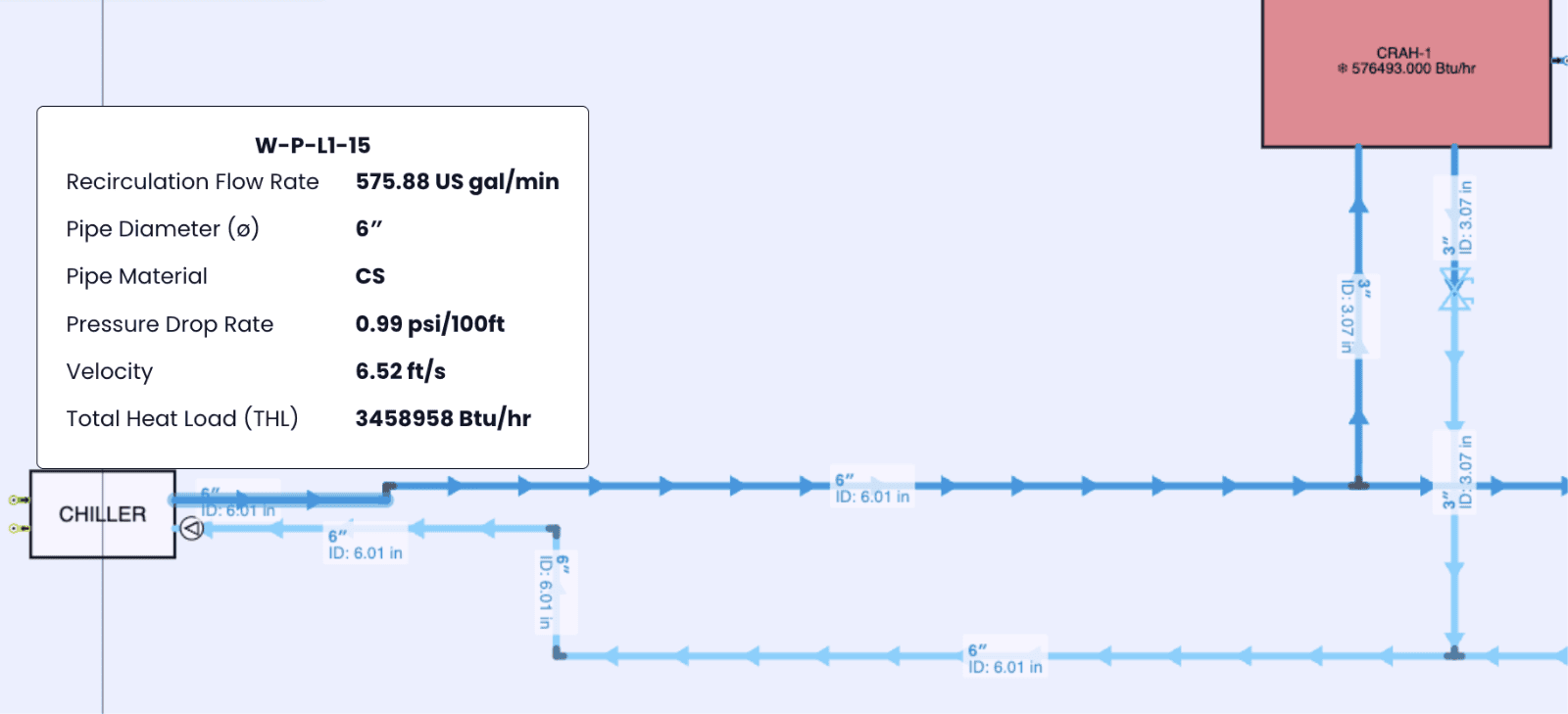
The heat load tool also takes server racks as an internal heat source, so the hall’s load and its CRAH pipework can come from the same model. For more, see h2x’s chilled water design tools and hydronic piping design.
h2x’s heating and cooling water calculations are verified by CIBSE and are aligned with ASHRAE methods.
Key Takeaways
The CRAC vs CRAH difference is where the refrigeration happens. A CRAC carries its own, while a CRAH borrows it from a chiller plant. That one difference decides the plant each needs and the room size it suits.
- CRACs suit small and mid-size rooms: air-cooled from 7 to 200 kW (2 to 57 tons), glycol-cooled from 30 to 1,000 kW (8.5 to 284 tons).
- CRAHs suit halls of 200 kW (57 tons) and up, with more capacity for the footprint and economizer hours from warmer water.
- Size for N+1, and check each unit’s capacity, airflow and branch flow with one unit out.
- Chilled water at 54 to 59 °F (12 to 15 °C) gives more free cooling.
FAQ
What is a CRAC unit?
A CRAC unit is a computer room air conditioner. It cools the room with its own compressor and evaporator coil. Then it rejects the heat to an outdoor condenser, a dry cooler or a cooling tower. CRACs suit smaller rooms without a central chilled water plant.
What is a CRAH unit?
A CRAH unit is a computer room air handler. It blows room air across a chilled water coil and has no compressor of its own. The chilled water comes from a central chiller plant, which makes CRAHs the usual choice for halls of about 200 kW (57 tons) and larger.
Which is more efficient, a CRAC or a CRAH?
In a CRAC vs CRAH comparison for larger data centers, a CRAH system is often more efficient. That’s because a central chiller plant improves with scale and can use economizers for free cooling, though the plant, climate and controls decide it. For small rooms, a CRAC often costs less overall.
Does a CRAH need a chiller?
It needs a chilled water supply, usually from a chiller plant. A CRAH has no compressor, so the water can also come from a district cooling network, or from an economizer when the weather allows. White Paper 59 puts typical chilled water at 46 to 59 °F (8 to 15 °C), with the warmer end giving more free cooling hours.
What is in-row cooling?
In-row cooling places CRAC or CRAH units between the racks in a row, instead of around the edge of the room. The short air path cuts fan energy and suits higher densities. Most in-row units work best with hot aisle or cold aisle containment.
What is the difference between a CRAH and an AHU?
A CRAH is a type of air handling unit (AHU) built for computer rooms. It recirculates room air through a chilled water coil, around the clock. Its load is almost entirely sensible heat, which raises the air’s temperature, with little moisture to remove. A general building AHU often brings in fresh air and handles people and comfort too.
Size the Chilled Water to Every CRAH
h2x adds up each CRAH’s cooling rating and sizes the chilled water mains and branches that serve them. Change a unit’s rating or the water temperatures, and every flow and pipe size follows.
Meet the author

Daniel Mousdell
Daniel Mousdell is the Founding Marketer at h2x, where he creates technical content and resources for HVAC and MEP engineers. Outside of work, he runs LilWayneHQ.
Article published: October 23, 2026
Last updated: October 23, 2026
Technically reviewed by: Conor Jones, Training Manager at h2x