Hot Aisle vs Cold Aisle Containment in Data Centers
Understand hot aisle containment vs cold aisle containment, including how each works, which saves more energy, and how containment changes airflow.
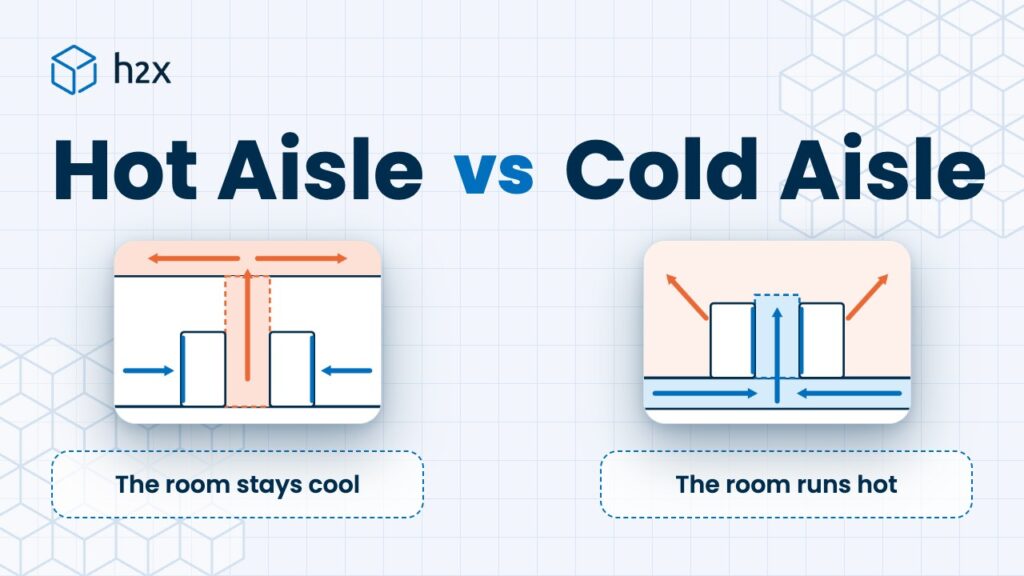
Hot aisle containment encloses the hot exhaust side of a data center’s racks and returns that air straight to the cooling units. Cold aisle containment encloses the cold supply side instead, so the rest of the room runs hot. Both cut the mixing of hot and cold air, but hot aisle containment usually saves more energy.
The difference matters most for the people and equipment outside the enclosure. This guide compares the two and sets out what the energy evidence really shows. Then it works out how much airflow containment saves for a hall of 120 racks.
Quick Answer: Hot aisle containment and cold aisle containment both separate a data center’s cold supply air from its hot exhaust. So the cooling units can supply warmer air and move less of it. Hot aisle containment keeps the room cool and usually allows more economizer hours. Cold aisle containment is easier to retrofit on a raised floor.
What Is Hot Aisle Containment?
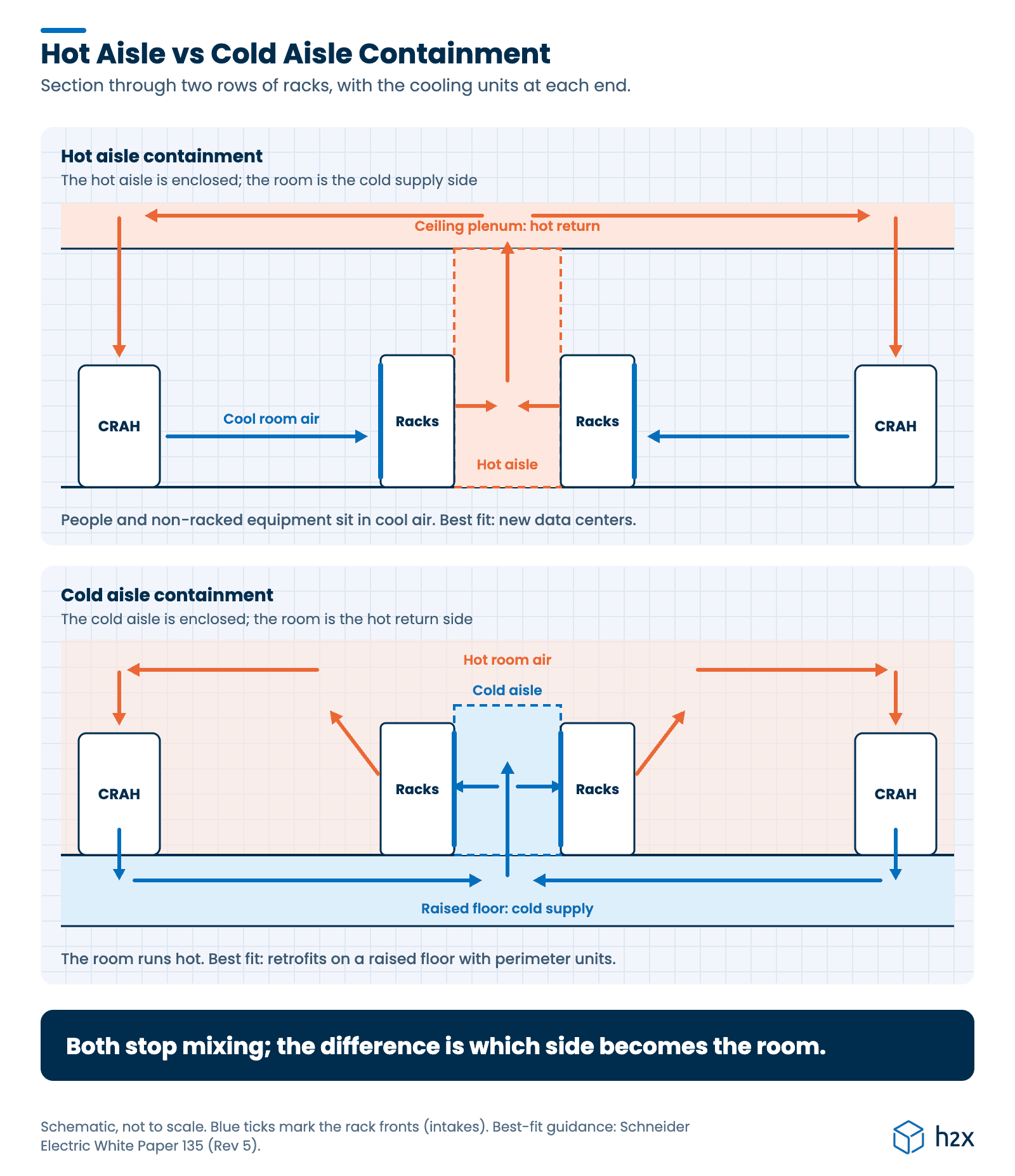
Hot aisle containment (HAC) closes off the aisle behind the racks, where the servers blow out their hot exhaust. Doors close the ends of the aisle. Then a roof or chimney panels carry the hot air up to a ceiling plenum or a return duct, and on to the cooling units.
The rest of the room becomes the cold supply side. So the space where people work, and any equipment outside the racks, sits at the server inlet temperature.
Schneider Electric’s 2017 White Paper 135, “Impact of Hot and Cold Aisle Containment on Data Center Temperature and Efficiency”, describes three ways to do it:
- Row-cooled: in-row cooling units sit inside the contained pod, so each pod runs on its own.
- Ducted to room units: a large duct over the whole hot aisle returns the air to CRAHs or a remote air handler. The paper calls this the preferred design for large purpose-built data centers, because it works with air economizers.
- Ducted racks: a vertical exhaust duct on the back of each rack carries the air to a drop ceiling. It suits scattered high-density racks.
What Is Cold Aisle Containment?
Cold aisle containment (CAC) closes off the aisle in front of the racks instead. Doors and a roof seal the cold aisle, which is usually fed through perforated tiles in a raised floor. The racks then draw only from that sealed supply.
So the rest of the room becomes the hot return. White Paper 135 notes the room can run well above 80 °F (27 °C), and above 100 °F (38 °C) with high-density IT. That’s hard on staff. It’s also hard on equipment outside the racks, such as tape libraries, which then need their own room or ducted cold air.
The upside is retrofit. On a raised floor with perimeter units that draw return air from the room, cold aisle containment only needs aisle doors and roof panels. But a hot aisle system there would need a dropped ceiling or special return ductwork.
Raised floors need depth, too. The US Department of Energy’s data center best practices guide asks for at least 24 in (610 mm) of clear height under one.
Hot Aisle vs Cold Aisle Containment
This table sets the two side by side, with White Paper 135’s findings. Its 43% assumes the room is held at 75 °F (24 °C); without that limit, the two tie.
| Feature | Hot aisle containment | Cold aisle containment |
|---|---|---|
| What’s enclosed | The hot exhaust aisle | The cold supply aisle |
| The rest of the room | Cool, at server inlet temperature | Hot, at exhaust temperature |
| Return path | Ceiling plenum, return duct or in-row units | The open room |
| Supply path | The open room, a raised floor or overhead | Usually a raised floor |
| Usual choice, per White Paper 135 | New data centers | Retrofits on a raised floor |
| Non-racked equipment | Sits in cool room air | May need its own room or ducted cold air |
| Cooling energy in White Paper 135, room at 75 °F (24 °C) | 43% less than cold aisle | The baseline |
| Build cost for a new data center | “Nearly identical” | “Nearly identical” |
Which Containment Saves More Energy?
Both cut air mixing, but neither saves energy automatically. White Paper 135 worked through a 700 kW (199 ton) IT load in Chicago. Its uncontained baseline had a PUE of 1.84, and its CRAH units moved 149% of the IT airflow, because so much cold air leaked past the racks.
Between the two types, the answer depends on how hot you let the room get:
- With no limit on the room temperature, they tie. Both gave 6,218 economizer hours a year and a PUE of 1.65. But with cold aisle containment, the room ran at 106 °F (41 °C).
- With the room held at 75 °F (24 °C) for staff, hot aisle containment wins. It kept 5,319 economizer hours, with a PUE of 1.69. Cold aisle containment lost every economizer hour, and its PUE rose to 1.98. That’s 25% more cooling energy than the open room, against 28% less for hot aisle containment.
That second case is the paper’s headline: hot aisle containment used 43% less cooling energy. The reason is that cold aisle containment can only cool the room by cooling the supply air. So its chilled water had to run as cold as about 36 °F (2.4 °C).
This may also explain why a 2011 Intel and T-Systems lab study was reported as finding no significant difference between the two. White Paper 135 gets the same result when the room temperature isn’t limited.
Keep in mind that the 43% is a calculated result for one climate, not field data. Still, the paper’s conclusion is clear: new data centers should use hot aisle containment, or at least allow for it.
How Does Containment Change the Airflow?
Containment cuts the airflow the cooling units have to move. Without it, some cold air bypasses the racks and some hot exhaust loops back to the server inlets, so the units supply extra air to make up for it. With it, they need only the IT airflow plus a little leakage.
Worked Example
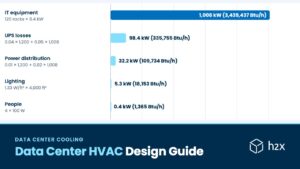
This uses the same hall as our data center HVAC design guide: 120 racks and 3,458,955 Btu/h (1,014 kW) of sensible load. Lighting and people are under 1% of it, so the example treats it all as IT heat. With a 20 °F (11.1 K) rise across the servers, the CFM formula gives the IT airflow:
CFM = 3,458,955 ÷ (1.08 × 20 °F) = 160,137 CFM (75.6 m³/s)
The cases assume the CRAH airflow is the IT airflow plus leakage, at White Paper 135’s typical figures. The fan power follows the fan laws:
| Case | CRAH airflow, share of IT airflow | CRAH airflow | Fan power |
|---|---|---|---|
| No containment (White Paper 135 baseline) | 149% | 238,604 CFM (112.6 m³/s) | 100% |
| Containment, 10% leakage | 110% | 176,150 CFM (83.1 m³/s) | 40% |
| Containment, 3% leakage | 103% | 164,941 CFM (77.8 m³/s) | 33% |
Without containment, the CRAHs supply 78,467 CFM (37.0 m³/s) more than the servers draw. Containment therefore cuts the CRAH airflow by 26 to 31%.
By the fan laws, fan power falls with the cube of airflow, so that could mean 60 to 67% less fan power. Treat it as an upper bound, not a guaranteed saving. It needs fans with variable speed drives, as the DOE guide points out. The system’s resistance, fan efficiency and minimum fan speeds all change the result too. Real designs also vary in leakage, air distribution and pressure balance.
The 20 °F (11.1 K) rise is illustrative. The DOE guide puts the rise across a server at 10 °F (5.6 K) to more than 40 °F (22 K). It depends on the server and its load. White Paper 135, however, assumed 25 °F (13.9 K).
Blanking Panels, Cable Gaps and Bypass Air
Containment only works if the air can’t find a way around it. The DOE guide lists the basics:
- Blank off empty rack slots on the intake side, so exhaust can’t loop back through the gaps.
- Seal cable openings in raised floors and ceilings as tightly as possible.
- Clear the raised floor of cable congestion, and remove abandoned cables.
- Drop the supply straight down. Place overhead diffusers directly in front of the racks, rather than ones that throw air sideways.
White Paper 135 puts raised floor leakage at typically 25 to 50%, against 3 to 10% for a containment system. Also, with hot aisle containment, the hot aisle only leaks through the cable cutouts at each rack. With cold aisle containment, air also leaks through cutouts around the room and under PDUs, so it has about 50% more cold-air leakage.
Containment and Fire Protection
Containment can change how fire detection and suppression work. For example, doors and roof panels can obstruct sprinkler discharge. They can also stop a gaseous agent from reaching the concentration it needs, and they change the airflow that smoke detectors rely on.
So plan fire protection with the containment, not after it. Depending on the design, that may mean detection or suppression inside the enclosed aisle, or changes to the existing system. White Paper 135 notes that both sprinklers and gaseous agents have been installed and approved with containment.
In the US, NFPA 75 covers fire protection for IT equipment rooms, and it deals with containment directly. Its 2020 edition required smoke detection in the exhaust or return air stream where aisles are contained. It also said containment must not obstruct a clean agent’s flow to the IT equipment. Sprinklers must also meet NFPA 13.
Requirements vary with the edition adopted and the location, so agree on the design with a fire protection engineer and the authority having jurisdiction early. Also make sure any plenum, such as a raised floor or dropped ceiling, is rated for air distribution.
Containment in High-Density and Liquid-Cooled Halls
Containment stretches air cooling, but only so far. Vertiv’s practical limit for air cooling is about 20 kW (5.7 tons) per rack, and rear door heat exchangers extend it to 80 kW (23 tons). These are indicative figures, not hard limits. At higher densities, racks usually need liquid cooling, such as direct-to-chip, as we cover in our data center liquid cooling guide.
Even then, containment still matters for the air that’s left. Network racks, storage and the share of each liquid-cooled rack’s heat that stays on air all still need cold supply air without mixing.
Common Containment Mistakes
- Leaving rack gaps open. Missing blanking panels let exhaust loop back to the server inlets.
- Containing without turning the fans down. The airflow saving only reaches the meter if the CRAH fans have variable speed drives.
- Controlling on return temperature. The DOE guide says to control supply air on the IT intake temperatures instead.
- Choosing cold aisle containment for a new build. Holding the room cool for staff then takes away most of its economizer hours.
- Forgetting non-racked equipment. With cold aisle containment, tape libraries and other equipment outside the racks sit in hot air.
- Leaving fire protection until last. Coordinate detection and suppression for the enclosed aisle and the room around it early.
How h2x Helps with Containment Design
In h2x engineering software, server racks go into the heat load as an internal heat source. So the hall’s load and its cooling come from one model.
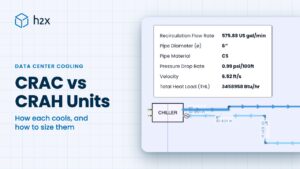
Each CRAH then goes in as h2x’s indoor AHU with a cooling coil, and its cooling rating sets its chilled water flow. From those flows, h2x sizes every pipe, as our CRAC vs CRAH guide shows.
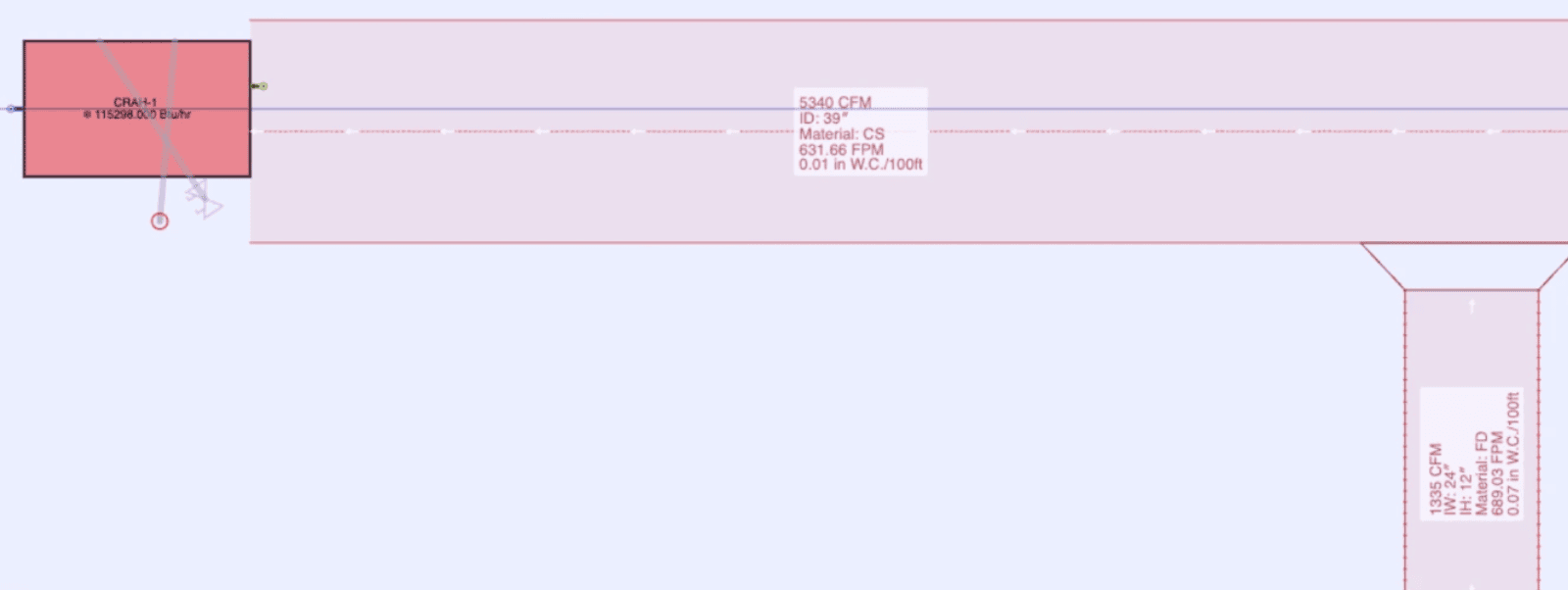
h2x sizes the air side too. For a ducted hot aisle, draw the return main from the aisle back to its CRAH, with a grille for each rack’s exhaust. Then h2x adds up the airflow on each section and sizes it to the system’s maximum velocity and pressure drop.
For this example, we drew a ducted return serving four racks at 1,335 CFM (630 L/s) each, the hall’s airflow shared across its 120 racks. Overall, the main came to 5,340 CFM (2.52 m³/s).
h2x then stepped the duct down from 39 in to 20 in (1,000 to 500 mm) along the run. Those are its metric sizes, shown to the nearest inch. As a result, every section stayed under the system’s maximum velocity of 720 FPM (3.66 m/s). The main ran at 632 FPM (3.21 m/s), and each rack’s drop at 689 FPM (3.50 m/s).
h2x’s heating and cooling water, domestic water and ventilation calculations are verified by CIBSE and are aligned with ASHRAE methods.
Key Takeaways
Hot aisle containment and cold aisle containment both separate hot and cold air. The difference is which side of the racks ends up as the room.
- Hot aisle containment keeps the room cool and, with the room held at 75 °F (24 °C), used 43% less cooling energy in White Paper 135.
- Cold aisle containment is the easier retrofit on a raised floor with perimeter units.
- Containment cuts airflow by about a quarter to a third in the worked example, but the fans need variable speed drives to turn that into a fan energy saving.
- Seal the gaps, and coordinate fire detection and suppression for the enclosure and the room around it early.
FAQ
What is hot aisle containment?
Hot aisle containment encloses the aisle behind the racks, where the servers exhaust their hot air. Doors and a roof or chimneys carry that air to a ceiling plenum, a return duct or in-row coolers. The rest of the room stays at the server inlet temperature, so it’s comfortable for staff.
What is cold aisle containment?
Cold aisle containment encloses the aisle in front of the racks, usually over a raised floor that supplies the cold air. So the racks draw only from that sealed aisle. The rest of the room becomes the hot return, so it can run well above 80 °F (27 °C).
What is the difference between a hot and cold aisle layout and containment?
A hot and cold aisle layout sets the racks in alternating rows, front to front and back to back, so they draw from cold aisles and exhaust into hot aisles. Containment then adds physical barriers, such as end doors, roof panels or strip curtains, so far less air mixes over or around the racks.
Is hot aisle or cold aisle containment better?
For new data centers, hot aisle containment is usually better. In Schneider Electric’s White Paper 135, it used 43% less cooling energy with the room held at 75 °F (24 °C). However, cold aisle containment can be the better choice for a retrofit on a raised floor with perimeter cooling units.
Does cold aisle containment need a raised floor?
Not always, but it usually uses one, with perforated tiles feeding the contained aisle. Overhead supply works too, if the diffusers drop air straight down into the cold aisle. The DOE recommends at least 24 in (610 mm) of clear height under a raised floor.
What are blanking panels in a data center?
Blanking panels fill empty slots in a rack. Without them, hot exhaust air loops back through the gaps to the server inlets. That forces colder supply air, and it undoes much of what containment achieves. Because of this, the DOE guide lists blanking off empty slots as a basic air management step.
Does containment affect fire protection?
Yes. Containment doors and panels can obstruct sprinklers, smoke detection or gaseous suppression, so fire protection may need changes inside and around the enclosed aisle. In the US, check NFPA 75 and NFPA 13. Then agree on the design with the authority having jurisdiction early.
Design the Cooling Around the Containment
h2x takes the hall’s server racks as a heat load, then sizes the pipework for every CRAH in the hall. Change the load or a unit’s rating, and h2x resizes the pipework to match.
Meet the author

Daniel Mousdell
Daniel Mousdell is the Founding Marketer at h2x, where he creates technical content and resources for HVAC and MEP engineers. Outside of work, he runs LilWayneHQ.
Article published: October 27, 2026
Last updated: October 27, 2026