How to Design Hot Water Recirculation Systems in High-Rise Buildings
Learn how to balance hot water recirculation systems, manage static pressure, position PRVs and design pressure zones in high-rise buildings.
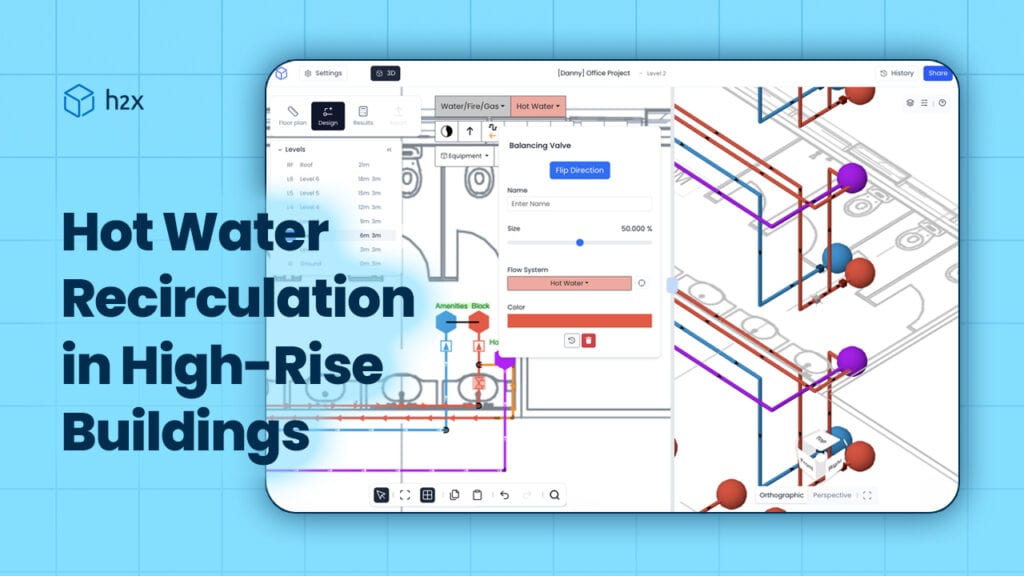
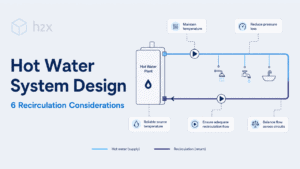
High-rise hot water recirculation systems require careful balancing and pressure control. As building height increases, static pressure varies significantly between lower and upper levels, while multiple circulation circuits can also create uneven flow if the system is not balanced correctly.
Designers therefore need to consider how circulation flow moves through the system, how elevation affects pressure, where to position pressure-reducing valves (PRVs) and whether to divide the building into separate pressure zones.
This guide focuses specifically on those high-rise design challenges. For a broader explanation of system types, controls, energy use and pump sizing, see our complete guide to hot water recirculating pumps.
How High-Rise Hot Water Recirculation Works
In a high-rise building, a hot water recirculation loop can serve multiple risers and branches across a large vertical distance. The design needs to maintain circulation throughout those routes while accounting for differences in hydraulic resistance, heat loss and static pressure between levels.
Short dead leg branches may still remain between the circulating pipework and individual outlets. Designers should consider their length and water volume because both affect how quickly hot water reaches each outlet.
Smaller buildings may use one relatively simple circulation loop. In a high-rise building, however, multiple interconnected circuits may serve different levels and risers.
That creates two important design challenges:
- Circulation flow needs to be distributed correctly between circuits.
- Water pressure needs to remain within the required range throughout the height of the building.
Solving both is essential. A system can have adequate overall circulation but still perform poorly if some circuits receive too little flow, or if pressure becomes too high or too low at particular levels.
How to Balance a Hot Water Recirculation System
Balancing is one of the most important parts of designing a hot water recirculation system with multiple circuits.
Water does not divide itself evenly between different routes. Instead, more flow tends to pass through circuits with lower hydraulic resistance.
For example, one circulation loop may contain shorter pipe lengths or larger pipe diameters than another. That circuit will generally have less resistance, so it can receive more flow than a longer or more restrictive circuit.
Without balancing, this can leave some parts of the system circulating effectively while other circuits receive insufficient flow and experience a larger temperature drop.
Why Balancing Valves Are Used
Balancing valves add controlled resistance to selected circuits, helping distribute the required recirculation flow throughout the system.
The aim is not simply to make every circuit carry the same flow. Each circuit should receive the flow required to offset its heat loss and maintain the intended return-water temperature.
This is particularly important in large buildings where risers and branches can differ significantly in length, pipe size and heat loss.
ASPE guidance on hot water system balancing also explains how lower-resistance circuits can receive disproportionate flow and how balancing valves help regulate circulation between branches and risers.
How Balancing Works Across Multiple Circuits
Consider a system with several circulation loops serving different levels of a building.
If one loop has relatively low resistance, the balancing valve on that circuit can introduce additional resistance. This helps redirect circulation flow towards circuits that would otherwise receive less water.
The required valve setting depends on the hydraulic characteristics and design flow of each circuit. Designers should therefore calculate each setting from the system design rather than apply the same setting to every branch.
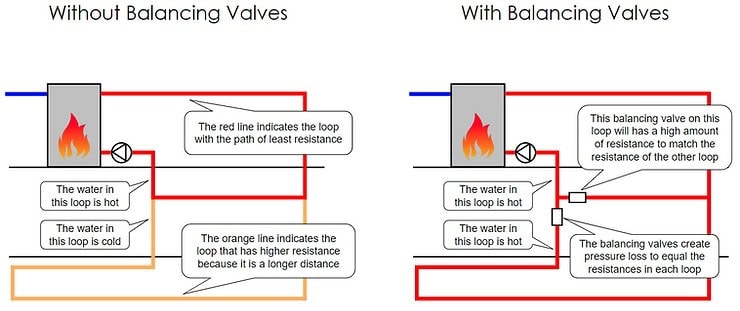
Correct balancing helps each circuit maintain the intended circulation flow while allowing the pump to operate against a predictable system resistance.
How Elevation Affects Water Pressure in High-Rise Buildings
Building height has a major effect on static water pressure.
For water, static pressure changes by approximately 9.81 kPa (0.098 bar) for every 1 m of elevation, or approximately 0.433 psi per ft in US customary units.
As water rises through a building, the available static pressure decreases. Conversely, pressure increases at lower elevations.
This creates a challenge in tall buildings. The system needs enough pressure to serve outlets at higher levels without allowing excessive pressure at lower levels.
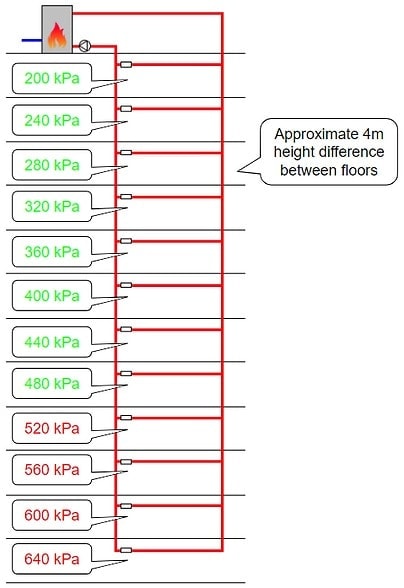
There is no single minimum or maximum pressure that can be applied universally to every high-rise building. The required range depends on the applicable standards, fixture requirements, equipment, system arrangement and project design criteria.
Designers should therefore establish the allowable pressure range for the specific project before sizing pumps or selecting pressure control equipment.
Static Pressure vs System Pressure Loss
Static pressure caused by elevation is different from the pressure loss created by water moving through pipes, fittings and valves.
Both need to be considered in a high-rise design.
Static pressure changes with elevation, while dynamic pressure losses depend on factors such as:
- Flow rate
- Pipe diameter
- Pipe length
- Fittings
- Valves
- Other system components
The available pressure at an outlet therefore depends on the starting pressure, the elevation difference and the pressure losses between the source and the outlet.
For a more detailed look at system pressure calculations, see our guide to residual and static pressure.
Using PRVs in High-Rise Hot Water Systems
Pressure-reducing valves are commonly used where the upstream pressure is higher than the pressure required downstream.
In a high-rise building, they can form an important part of the pressure control strategy. However, their position needs to be considered alongside the circulation system rather than treating the hot water supply and return pipework independently.
PRVs on Individual Branches
One possible approach is to reduce pressure on individual dead leg branches serving outlets or smaller areas of the building.
This can control the downstream pressure without placing the PRV directly within the main circulation path. However, there are practical considerations.
These include:
- Pressure rating: The selected PRV must be suitable for the expected inlet pressure, outlet pressure, water temperature and system conditions.
- Equipment quantity: A large building may require many branch-level valves, increasing equipment and installation requirements.
- Maintenance: Additional valves create more components that may need inspection, servicing or replacement during the life of the building.
Whether branch-level pressure reduction is appropriate therefore depends on the system layout and project requirements.
PRVs Within Recirculation Circuits
Placing a PRV directly within selected circulation circuits requires particular care.
A PRV introduces additional hydraulic resistance. If this resistance is added to some circulation loops but not others, it can change how flow is distributed through the network and affect the system balance.
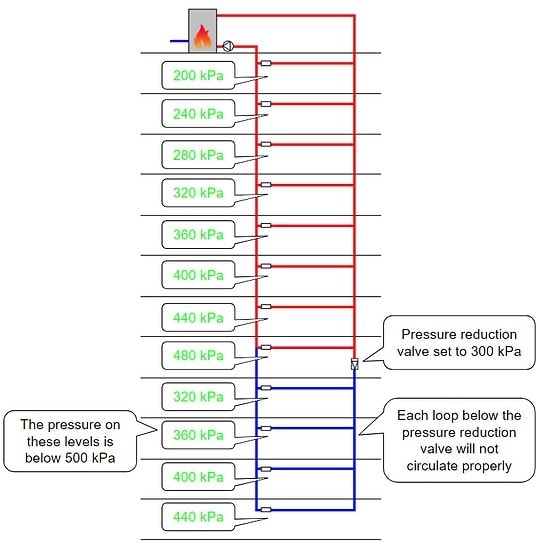
This does not mean that one PRV arrangement is unsuitable in every project. However, PRV positioning needs to form part of the complete hydraulic design, including circulation flow, balancing and pressure zoning.
In taller buildings, dividing the system into separate pressure zones can provide a more manageable approach.
How to Design Hot Water Pressure Zones
A pressure zone is a section of a building designed to operate within a defined pressure range.
Rather than maintaining one pressure regime across the full building height, a high-rise system can be divided into separate zones. Designers can then size and configure each zone around the pressure available at that part of the building.
This makes it easier to prevent excessive pressure at lower levels while maintaining adequate pressure higher in the building.
How Pressure Zoning Works
The exact arrangement varies between projects, but a pressure zone strategy may include:
- Pressure-reducing equipment
- Dedicated distribution pipework
- Circulation pumps
- Heat exchangers or reheating equipment
- Balancing valves
- Temperature and pressure monitoring
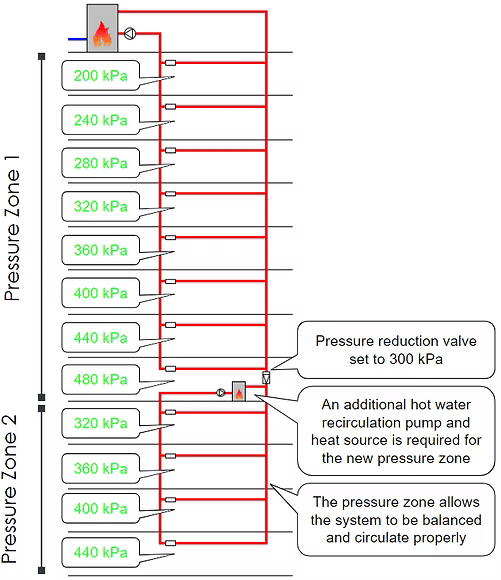
One common high-rise arrangement uses pressure-reducing equipment to supply a lower pressure zone, with dedicated circulation and heat transfer equipment serving that zone.
ASPE provides an example of a zoned high-rise hot water system using a PRV, circulation pump and heat exchanger, while also noting that the exact requirements vary by location and authority having jurisdiction.
Does Each Pressure Zone Need Its Own Recirculation System?
The answer depends on the system architecture.
Where a pressure zone operates as a separate hydraulic circuit, it may require its own circulation pump, heat transfer arrangement and balancing strategy.
Separating the building in this way can make pressure management easier because each zone operates over a smaller vertical range.
However, pressure zoning does not automatically create a balanced system. The circulation circuits within each zone still need to be designed and balanced according to their required flow rates and pressure losses.
High-Rise Hot Water Recirculation Design Checklist
High-rise recirculation design involves more than simply adding a pump and return pipe. Before completing the system design, check the following:
| Design check | What to confirm |
|---|---|
| Circulation layout | Each circuit can receive the required circulation flow |
| Balancing | Lower-resistance circuits do not receive disproportionate flow |
| Pressure range | Project minimum and maximum pressure requirements are met |
| Elevation | Static pressure changes across the building height are included |
| PRVs | Valve locations and pressure ratings suit the system design |
| Pressure zones | Pressure zones maintain manageable pressures across the building height |
| Pump duty | Each circulation system has the required flow and pump head |
| Temperature | Required circulation temperatures can be maintained throughout the system |
| Controls | Operation and monitoring meet the project and water-management requirements |
For more detail on calculating flow, head and pump duty, see our recirculation pump sizing and selection guide.
Designing High-Rise Hot Water Systems in h2x
High-rise hot water design can involve a large number of pipes, circulation circuits, balancing valves and pressure conditions. As the building becomes more complex, coordinating those calculations manually alongside the system layout can become difficult.
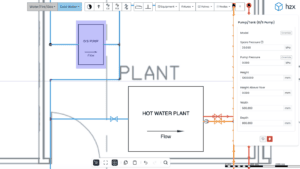
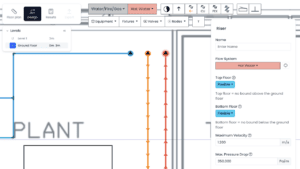
h2x connects the layout and engineering calculations in one workflow.
Designers can sketch the hot water system, define the project parameters and calculate results including:
- Hot water flow rates
- Return-system flow
- Pipe sizes
- Pipe velocity
- System pressure loss
- Recirculation pump duty
- Balancing valve Kv
This makes it easier to review how changes to the system layout affect the hydraulic design without manually updating separate drawings and calculation sheets.
For a step-by-step walkthrough of the underlying design process, see our hot water recirculation system design workflow in h2x.
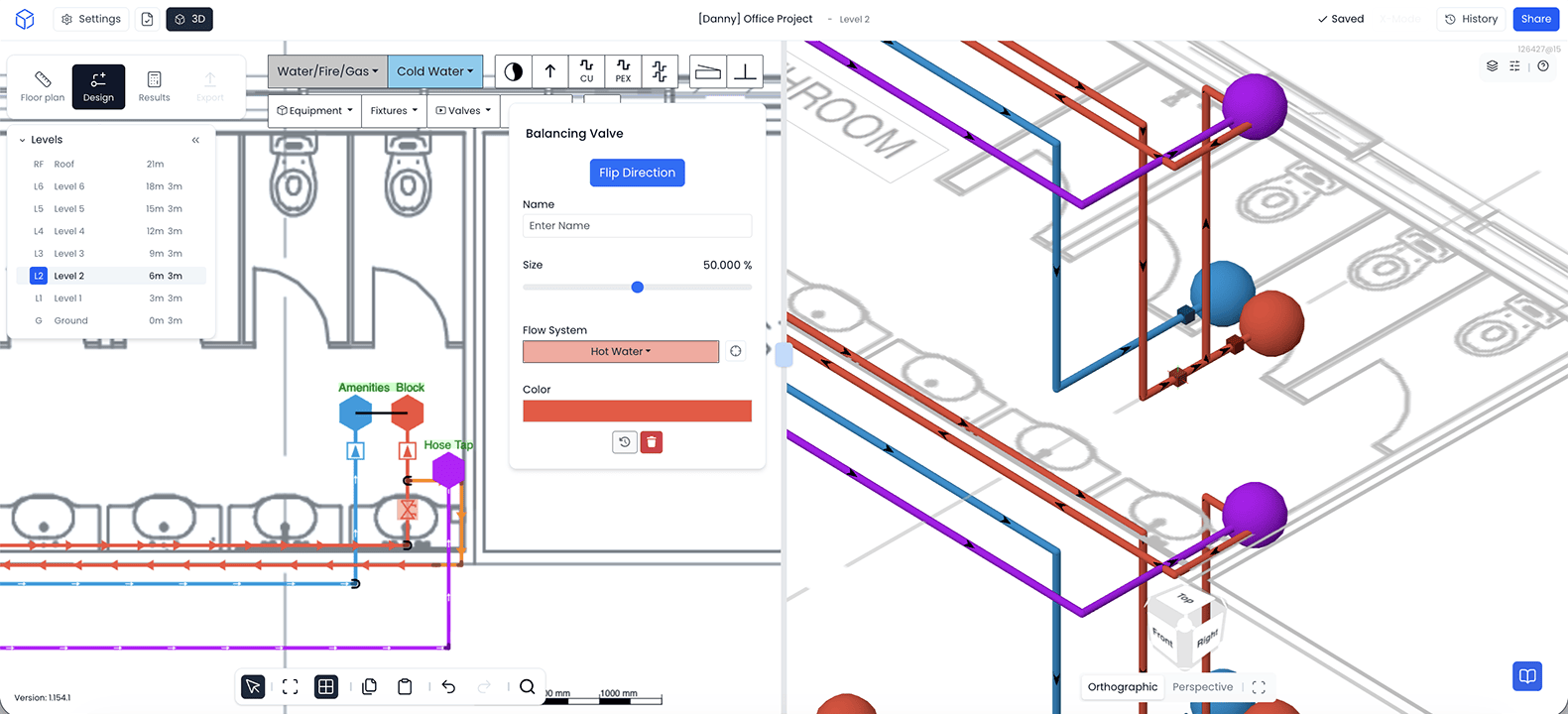
You can then review the calculated results in h2x and use the project outputs as part of the wider design and coordination process.
Design high-rise hot water systems faster in h2x
Calculate pipe sizes, circulation flow, pressure loss and balancing while creating your hot water system layout in one connected workflow.
Frequently Asked Questions
How Does Building Height Affect Hot Water Pressure?
Water pressure changes with elevation. For water, static pressure decreases by approximately 9.81 kPa per m as elevation increases, or approximately 0.433 psi per ft. High-rise systems therefore need a pressure strategy that maintains the required pressure at upper levels without creating excessive pressure lower in the building.
Why Are Balancing Valves Used in Hot Water Recirculation Systems?
Balancing valves add controlled resistance to circulation circuits so the required flow can be distributed throughout the system. Without balancing, lower-resistance circuits can receive disproportionate flow while other parts of the system receive too little circulation.
What Is a Pressure Zone in a High-Rise Building?
A pressure zone is a section of a building designed to operate within a defined pressure range. Dividing a high-rise building into pressure zones can make it easier to maintain suitable pressures across different elevations.
Where Should PRVs Be Installed in a High-Rise Hot Water System?
PRV location depends on the pressure strategy and system layout. Designers need to consider the effect of each valve on downstream pressure and hydraulic resistance, particularly where a PRV interacts with a recirculation circuit.
Can One Hot Water Recirculation Pump Serve an Entire High-Rise Building?
It can in some system arrangements, but this depends on the building height, circulation layout, pressure strategy and required pump duty. Taller buildings may be divided into separate hydraulic or pressure zones, each with its own circulation requirements.
Does Each Pressure Zone Need Its Own Recirculation Pump?
Not necessarily. The required arrangement depends on the pressure zone strategy and overall hot water system design. Where a zone operates as a separate hydraulic circuit, it may require dedicated circulation, heat transfer and balancing equipment.
How Do You Balance Hot Water Recirculation Across Multiple Floors?
First determine the required circulation flow for each circuit. Then calculate the hydraulic resistance and use balancing valves or other suitable balancing methods to regulate flow between the different risers and branches. The objective is to provide each circuit with the flow needed to maintain the required temperature.
Meet the author

Daniel Mousdell
Daniel Mousdell is the Founding Marketer at h2x, where he creates technical content and resources for HVAC and MEP engineers. Outside of work, he runs LilWayneHQ.
Article published: June 14, 2021
Last updated: October 8, 2026
Technically reviewed by: Jonathan Mousdell, Mechanical Engineer and Co-founder at h2x