What Is Water Hammer? Causes, Surge Pressure and How to Stop It
What causes water hammer, how to calculate the surge with the Joukowsky equation, and how to size and place water hammer arrestors, with a worked copper branch example.
Water hammer is the bang in the pipes when a valve shuts fast. In a commercial building, it’s more than noise: the pressure wave reaches the joints, valves, meters and fixtures along the pipework every time that valve closes.
This guide explains what water hammer is and what causes it. It then calculates the surge for a real copper branch and sizes the water hammer arrestors that control it. Figures are imperial first, with metric in brackets.
Quick Answer: Water hammer is a pressure surge in a pipe when moving water stops suddenly, usually at a quick-closing valve. The Joukowsky equation, ΔP = ρ × a × ΔV, puts a fast closure at 442 psi (3,048 kPa) in a nominal 1 in (28.6 mm OD) copper branch at 8 ft/s (2.44 m/s). Lower velocities, slower valves and sized arrestors keep it under control.
What Is Water Hammer?
Water hammer, also called fluid hammer or hydraulic shock, is a pressure wave. When a valve closes, the water right behind it stops first, and that stopped water is squeezed by the water still moving towards it. As a result, the pressure jumps, and the jump travels back up the pipe as a wave at close to the speed of sound in water.
The wave can reflect at changes in the pipe network, such as larger mains, branches or tanks, then travel back towards the valve. It keeps bouncing back and forth until friction uses up its energy. The Copper Tube Handbook from the Copper Development Association describes the result as destructive forces, pounding noises and vibration in the system. In other words, the knocking you hear is that wave hitting the closed valve and the pipe’s bends.
What Causes Water Hammer?
Anything that stops or reverses the flow quickly can cause water hammer. In buildings, the usual sources are:
- Quick-closing valves. Zurn’s arrestor data lists solenoid valves on lavatories, sinks, dishwashers and washing machines, plus drinking fountains and other valves that open and shut often.
- Flush valves. A water closet flush valve that’s out of adjustment can shut faster than it should.
- Pumps. A pump that stops suddenly lets the column of water reverse, so its check valve can slam shut. Similarly, a booster set that refills an empty riser too fast can do the same. That’s why boosted systems need a soft fill, as Flowtech’s water surge guidance for high-rise buildings explains.
- High velocity. The surge rises in direct proportion to the velocity that’s stopped, so an undersized pipe makes every closure worse.
- High static pressure. The surge adds to the pressure already in the pipe, so a pressure reducing valve on a high supply also lowers the peak.
The 2024 International Plumbing Code covers both ends of this in Section 604.9. It says to control the flow velocity to reduce the chance of water hammer, and also to install a water hammer arrestor where quick-closing valves are used.
How to Calculate Water Hammer Pressure
Water hammer pressure depends on three things: how fast the water was moving, how stiff the pipe is, and how quickly the valve closes. Florida International University’s lecture notes set out the method in three steps.
Step 1, Find the Pressure Wave Speed
The wave moves slower in a pipe than in open water, because the pipe wall stretches a little as the pressure passes. For a pipe that’s free to move along its length:
a = √( (K / ρ) / (1 + K × D / (E × e)) )
Here, a is the wave speed, K the water’s bulk modulus and ρ its density. D is the pipe’s inside diameter, e its wall thickness and E the pipe material’s modulus of elasticity. Also use consistent SI units (Pa, kg/m³, m). In other words, a thin wall and a flexible material slow the wave down, and a stiff, thick pipe speeds it up.
Step 2, Check How Fast the Valve Closes
The wave takes 2L/a to travel from the valve to the point of relief and back, where L is the pipe length between them. A valve that closes faster than that counts as a sudden closure, so the full surge reaches it. If it closes more slowly, the reflected wave starts to relieve the pressure before the valve is shut, so the surge is smaller.
Step 3, Calculate the Surge
For a sudden closure, the surge is given by the Joukowsky equation:
ΔP = ρ × a × ΔV
ΔV is the change in velocity, which is the whole flow velocity when the valve shuts fully. For a gradual closure, the FIU notes give ΔP = ρ × L × V / t instead, where t is the closing time. Either way, the pipe sees the static pressure plus the surge.
However, these equations assume a simple, lossless pipe. Long pumped mains and risers with booster sets need more than this. So do systems where the pressure could drop low enough to cause cavitation. So for those, run a transient analysis in dedicated surge analysis software.
Water Hammer Worked Example
Here’s the calculation for one branch. The cold water branch is nominal 1 in (DN 25) Type L copper, with a 1.125 in (28.6 mm) outside diameter. It serves a public washroom 100 ft (30.5 m) from its riser. The static pressure is 70 psi (483 kPa). The water is at 60 °F (15.6 °C), and the branch ends at a quick-closing valve.
Surge in a Copper Branch at 8 ft/s (2.44 m/s)
Pipe and water. First, the handbook gives this tube a 1.025 in (26.0 mm) bore and a 0.050 in (1.27 mm) wall. It also gives copper an E of 17,000,000 psi (117 GPa). NIST lists water at 60 °F (15.6 °C) at 62.37 lb/ft³ (999.0 kg/m³). Its speed of sound is 4,816 ft/s (1,468 m/s). So its bulk modulus is 312,193 psi (2.152 GPa).
Wave speed. With those inputs, the wave travels at 4,105 ft/s (1,251 m/s) in this pipe. That’s about 15% slower than in open water, because the copper wall stretches. It assumes the pipe can move along its length. Still, anchoring it throughout adds only 1% to 2% to the surge. That uses the FIU notes’ factor of 1 − ν², where ν is Poisson’s ratio.
Closing time. Assuming the riser acts as the point of relief, the 100 ft (30.5 m) run back to it gives a 2L/a of 49 ms. Any valve that shuts faster than that gives the full surge. In a real system, though, where the wave reflects depends on the pipework upstream.
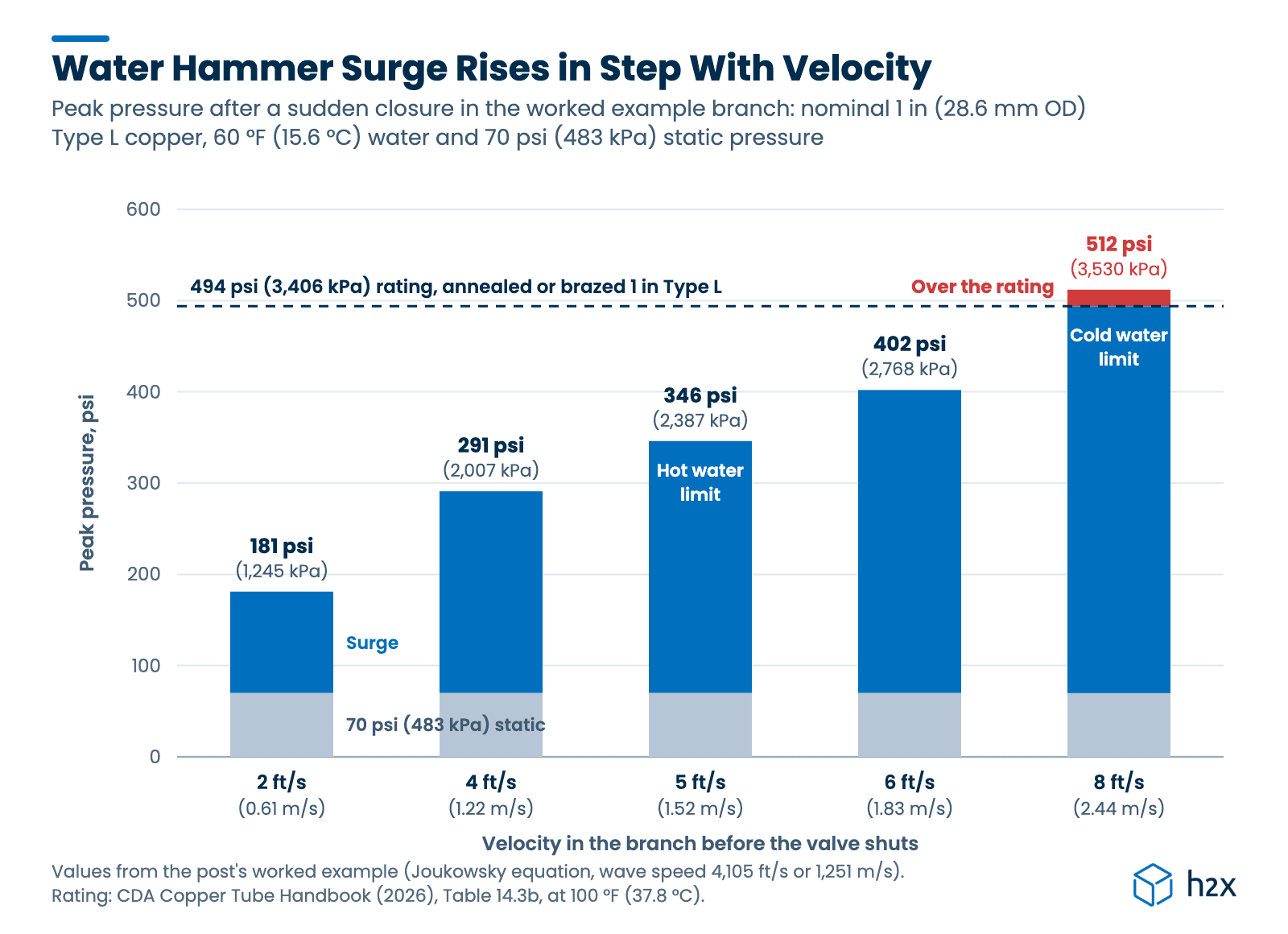
Surge. At the 8 ft/s (2.44 m/s) limit that the handbook and h2x’s US defaults use for cold water, the Joukowsky surge is 442 psi (3,048 kPa). In other words, that’s a head of 1,021 ft (311 m) of water. Added to the 70 psi (483 kPa) static pressure, the branch peaks at 512 psi (3,530 kPa).
How the Peak Compares With the Tube Rating
For comparison, the handbook rates this tube at 494 psi (3,406 kPa) annealed, or brazed, and 850 psi (5,861 kPa) drawn, at 100 °F (37.8 °C). So a single fast closure can push an annealed or brazed branch past its rated working pressure.
But that doesn’t mean the tube bursts. The handbook’s tested burst pressure for annealed tube of this size is 2,650 psi (18,271 kPa), and it calls its calculated ratings conservative. But it also says the lowest of the tube, fitting and joint ratings governs, and the surge repeats with every closure.
The Same Branch at Lower Velocity or Slower Closure
The surge falls in step with velocity. Sized for 5 ft/s (1.52 m/s), the same branch sees 276 psi (1,905 kPa). So with the static pressure, the peak is 346 psi (2,387 kPa). Closing time matters too. Take a valve that closes over 0.5 s, about ten times 2L/a. At 8 ft/s (2.44 m/s), the simple gradual-closure formula gives about 22 psi (148 kPa).
But treat that as an estimate, not a guaranteed peak. The real figure depends on how the flow falls as the valve closes, and other approximations give higher results.
Water Hammer Results
| Result | Value |
|---|---|
| Pipe | 1 in Type L copper, 1.025 in (26.0 mm) bore, 0.050 in (1.27 mm) wall |
| Wave speed | 4,105 ft/s (1,251 m/s) |
| 2L/a for 100 ft (30.5 m) | 49 ms |
| Surge at 8 ft/s (2.44 m/s), sudden closure | 442 psi (3,048 kPa) |
| Peak with 70 psi (483 kPa) static | 512 psi (3,530 kPa) |
| Surge at 5 ft/s (1.52 m/s), sudden closure | 276 psi (1,905 kPa) |
| Surge at 8 ft/s, 0.5 s closure | About 22 psi (148 kPa), simplified estimate |
| Rated working pressure, 1 in Type L at 100 °F (37.8 °C) | 494 psi (3,406 kPa) annealed, 850 psi (5,861 kPa) drawn |
Using FIU’s lower copper modulus, 14,000,000 psi (96.5 GPa), instead changes the surge only slightly. At 8 ft/s (2.44 m/s), it gives 430 psi (2,962 kPa).
Water Hammer Arrestor Sizing
A water hammer arrestor (or arrester) holds a sealed cushion of air that the water can’t reach, as the Copper Tube Handbook describes. When the surge arrives, it compresses the cushion instead of straining the pipe. IPC 604.9 requires arrestors that conform to ASSE 1010 and installation to the manufacturer’s instructions.
How to Size a Water Hammer Arrestor
Most manufacturers size arrestors to the Plumbing and Drainage Institute’s standard PDI-WH 201, which uses fixture units. Zurn’s specification sheet reproduces its tables. First, total the fixture units on each cold and hot water branch. Then pick the size:
| PDI size | Fixture units |
|---|---|
| A | 1 to 11 |
| B | 12 to 32 |
| C | 33 to 60 |
| D | 61 to 113 |
| E | 114 to 154 |
| F | 155 to 330 |
Round half units up, and if the branch’s flow pressure is over 65 psi (448 kPa), go one size larger.
Zurn’s sheet covers flow pressures up to 80 psi (552 kPa), so check the range for the model you specify. Zurn’s current sheet adds that branch flow pressure should ideally stay under 55 psi (379 kPa), with pressure reducing valves where needed.
PDI’s fixture units for public fixtures include 8 cold for a flush valve water closet and 4 for a stall or wall urinal with a flush valve. A lavatory counts 1-1/2 cold and 1-1/2 hot. Our plumbing fixture units guide covers how fixture units work for pipe sizing.
For our washroom branch, the cold side serves three flush valve water closets, two wall urinals with flush valves and three lavatories:
- Cold water branch. 3 × 8 + 2 × 4 + 3 × 1-1/2 = 36-1/2, rounded up to 37, so size C. Taking the 70 psi (483 kPa) as the flow pressure, that steps up to size D.
- Hot water branch. The three lavatories give 4-1/2, rounded up to 5, so size A. At the same pressure, it then becomes size B.
The fixture branch itself is under 20 ft (6.1 m). The 100 ft (30.5 m) in the surge example is the run back to the riser, so each branch gets one arrestor.
Where to Install a Water Hammer Arrestor
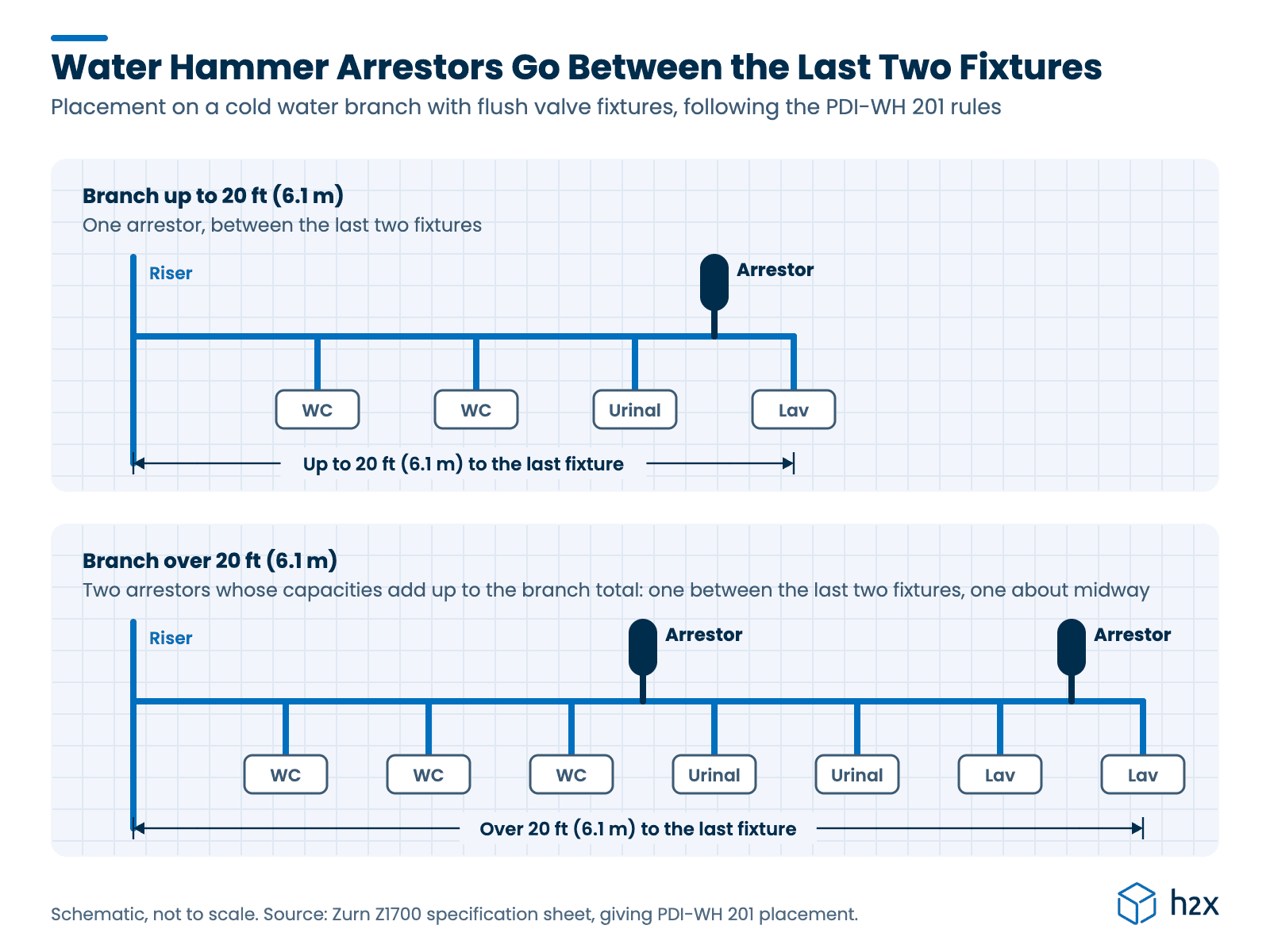
Placement matters as much as size. On a branch up to 20 ft (6.1 m) long, Zurn’s PDI guidance puts one arrestor at the end, between the last two fixtures. The length runs from the start of the horizontal branch to the last fixture. Branches longer than that get two arrestors whose capacities add up to the branch total. One goes between the last two fixtures and the other about halfway along.
For a single fixture, the Copper Tube Handbook puts the arrestor just upstream of the fixture’s valve. For equipment at the end of a long run, Zurn says to place it right next to the valve that closes. Zurn’s Z1700 units, for example, must be installed upright on a horizontal pipe. These are Zurn’s PDI-based rules, and other makers set their own, so follow the instructions for the arrestor you specify.
How to Stop Water Hammer in Existing Systems
If a system already bangs, work through the causes in order:
- Find the valve. Note which fixture or appliance sets it off, and whether it happens when a pump stops.
- Check the pressure. If the static pressure is high, a pressure reducing valve also lowers the peak for every closure.
- Check the velocity. For example, our pipe velocity calculator works out velocity from flow and pipe size. If a branch runs well above 8 ft/s (2.4 m/s) cold or 5 ft/s (1.5 m/s) hot, then it may be undersized.
- Add or replace arrestors. Then fit sized arrestors near the quick-closing valves, using the PDI method above.
- Secure the pipe. The surge also shakes the pipework, so check the supports.
- Check pump controls. For booster sets, check the soft fill and the check valves, and see our booster pump guide.
Water Hammer in UK Systems
In England and Wales, the Water Supply (Water Fittings) Regulations 1999 set the baseline, and Scotland and Northern Ireland have their own versions. Schedule 2, paragraph 3 says every water fitting must be strong enough to resist damage from pressure surges, among other loads.
h2x’s UK template also starts at lower velocities: 4.9 ft/s (1.5 m/s) for cold water and 3.9 ft/s (1.2 m/s) for hot. Its US template starts at 8 ft/s (2.44 m/s) and 5 ft/s (1.52 m/s).
The physics doesn’t change, so the same Joukowsky check applies in metric. Boosted high-rise systems also need the same attention to soft fill as anywhere else.
Preventing Water Hammer in h2x
h2x engineering software helps you control water velocity, one of the main factors in water hammer. Lay out the water system over your floor plan, and h2x sizes each pipe from its flow. So you can see where velocity runs high before anything is built.
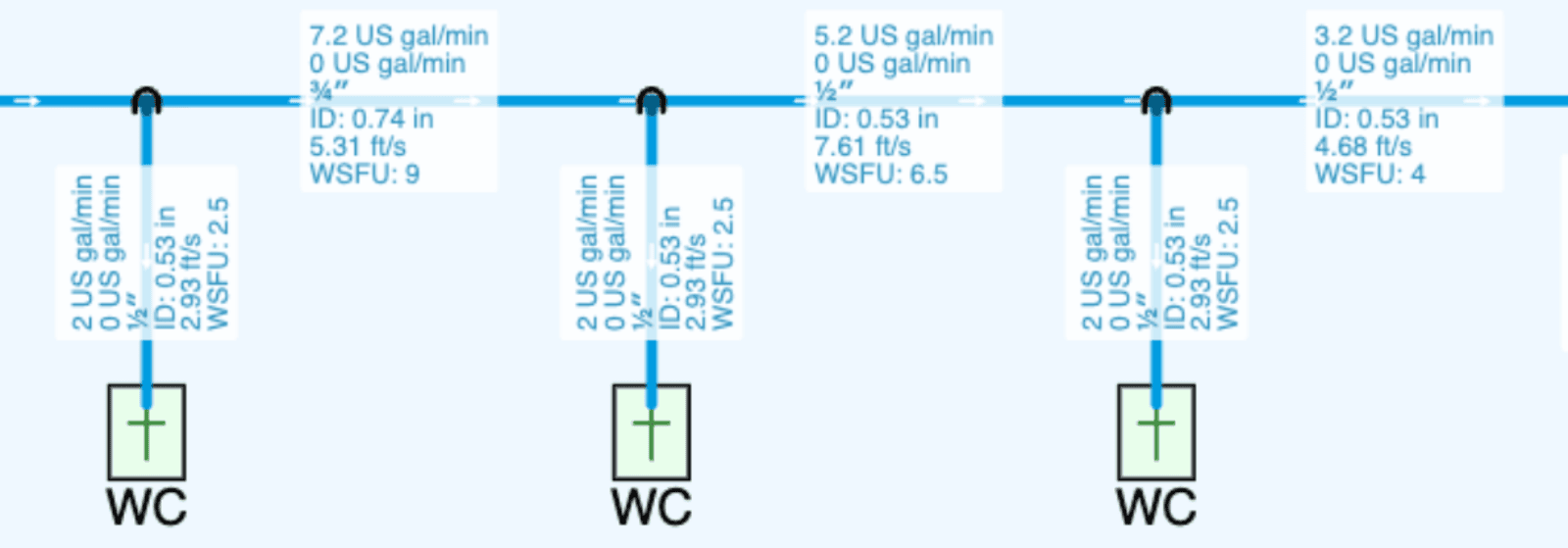
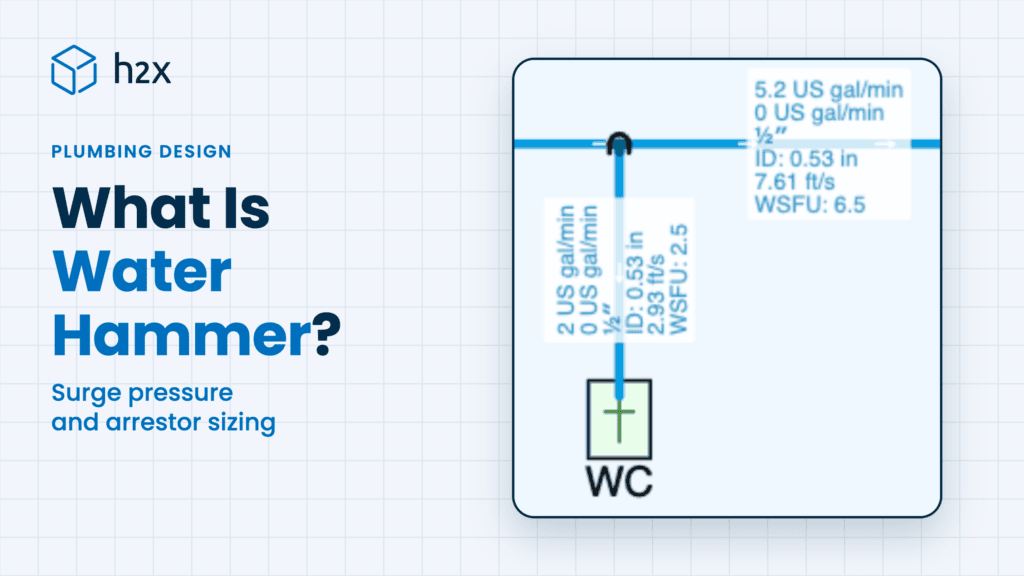
- Velocity limits. h2x sizes every pipe to the maximum velocity you set for each system. A new US project starts at 8 ft/s (2.44 m/s) for cold water and 5 ft/s (1.52 m/s) for hot. You can also lower them for a quieter system. In the branch shown, the 1/2 in (13.5 mm ID) pipe to the last three fixtures runs at 7.61 ft/s (2.32 m/s). That’s just under the limit.
- Fixture unit totals. Switch the Results view to Conduit Sizing, and each pipe label shows the Water Supply Fixture Units (WSFU) it carries, or Loading Units on UK and Australian projects. Use PDI’s own fixture unit values for the arrestor, though, since they can differ from the WSFU used to size pipes.
- Pipe results. Click a pipe in Results to see its velocity, pressure drop and peak flow rate, so the fast branches stand out.
h2x doesn’t place or size water hammer arrestors, so add them to your drawings and size them with the PDI method above. See every tool on h2x’s domestic water design page.
Key Takeaways
Water hammer is a pressure wave, and its size is set by velocity, pipe stiffness and closing speed. So the fixes are a lower velocity, slower valves and correctly sized arrestors in the right place.
- Surge. For a sudden closure, ΔP = ρ × a × ΔV. In a nominal 1 in (28.6 mm OD) copper branch at 8 ft/s (2.44 m/s), that’s 442 psi (3,048 kPa).
- Velocity. Keep cold water at or below 8 ft/s (2.4 m/s) and hot at or below 5 ft/s (1.5 m/s). That’s also the Copper Tube Handbook’s advice.
- Closing time. A valve that closes faster than 2L/a gives the full surge.
- Arrestors. Size them from fixture units with PDI-WH 201, and go up a size above 65 psi (448 kPa) flow pressure.
- Placement. Put one between the last two fixtures on a branch up to 20 ft (6.1 m), and two on longer branches.
FAQ
What causes water hammer?
Water hammer happens when moving water stops suddenly, usually because a quick-closing valve shuts. Solenoid valves on dishwashers, washing machines and sensor faucets are common causes, along with flush valves and pumps whose check valves slam. High velocity and high static pressure make it worse, because the surge grows with velocity and adds to the pressure already in the pipe.
Is water hammer dangerous?
It can be. The pressure wave repeats every time the valve closes. In our worked example, a nominal 1 in (28.6 mm OD) copper branch at 8 ft/s (2.44 m/s) peaks at 512 psi (3,530 kPa). That’s above the 494 psi (3,406 kPa) rating of annealed or brazed tube of that size. Over time, repeated surges can damage joints, valves, meters and fixtures.
How do you stop water hammer?
Lower the velocity, reduce high static pressure with a pressure reducing valve, and fit arrestors near the quick-closing valves. Where you can, use valves that close more slowly. In our example, closing over 0.5 s instead of suddenly cuts the surge from 442 psi (3,048 kPa) to an estimated 22 psi (148 kPa). Also check the pipe supports.
Where should a water hammer arrestor be installed?
Install it close to the valve that causes the surge. On a branch up to 20 ft (6.1 m) long, put it between the last two fixtures. On a longer branch, use two arrestors, one between the last two fixtures and one about halfway along. For a single fixture, fit it just upstream of the fixture’s valve.
What size water hammer arrestor do I need?
Total the PDI fixture units on the branch, then pick the PDI-WH 201 size. That’s A for 1 to 11, B for 12 to 32, C for 33 to 60 and D for 61 to 113. E covers 114 to 154, and F covers 155 to 330. If the flow pressure is over 65 psi (448 kPa), choose the next size up.
Do water hammer arrestors need maintenance?
The Copper Tube Handbook says arrestors that keep the water away from their air cushion need no further maintenance once installed. Sealed designs, such as Zurn’s stainless steel units, avoid losing their air charge through worn seals. Plain capped air chambers are a different case, so check the manufacturer’s instructions for the type you fit.
Size Every Water Pipe to Its Velocity Limit
Draw your water system in h2x and it sizes every pipe to your velocity limits. You can check velocities and fixture units on every pipe, then export a drawing set for site.
Meet the author

Daniel Mousdell
Daniel Mousdell is the Founding Marketer at h2x, where he creates technical content and resources for HVAC and MEP engineers. Outside of work, he runs LilWayneHQ.
Article published: November 18, 2026
Last updated: November 18, 2026