Latent Heat vs. Sensible Heat: What Every Mechanical Engineer Needs to Know
Find out how to differentiate latent heat vs. sensible heat and work them into real projects.
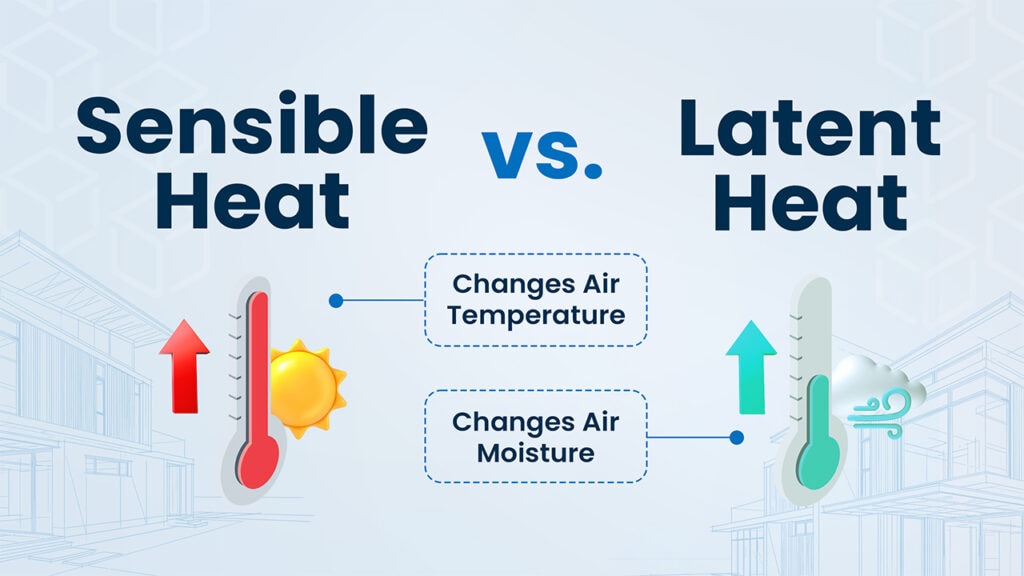
Understanding and calculating heat gains is one of the first hurdles in HVAC design. The distinction between latent heat vs. sensible heat sits in the middle of that challenge — you will encounter both terms in load calculations, equipment schedules, psychrometric charts, and just about every design conversation you’ll have. Get the split wrong and you’ll either under-size your dehumidification or over-cool the space trying to compensate.
Key takeaways:
- Sensible heat raises temperature. Latent heat raises moisture content. A thermometer detects one; a hygrometer detects the other.
- Every cooling load is a combination of both. Lighting, solar, and equipment are sensible-only. People and ventilation contribute both sensible and latent heat.
- The sensible heat ratio (SHR) is the critical number.
SHR = Sensible ÷ Total. Typical offices land between 0.75 and 0.85. Match your equipment’s rated SHR to the actual load split, not just the total. - Getting the split wrong has real consequences. Underestimate latent load and the space feels clammy even when the thermostat reads fine. Overestimate it and you waste energy on unnecessary dehumidification.
- The calculation is straightforward, the skill is in the setup. Capture every source, use published ASHRAE or CIBSE values, and tag each one correctly as sensible, latent, or both. The SHR follows naturally from there.
Quick answer: Sensible heat changes the dry-bulb temperature of air (detectable with a thermometer). Latent heat changes the moisture content of air without changing its temperature (detectable with a hygrometer). Every cooling load is a combination of both, and the sensible heat ratio (SHR) tells you the split: SHR = Sensible Heat Gain ÷ Total Heat Gain.
How To Tell Latent Heat from Sensible Heat
Sensible heat changes the temperature of the air. For example, sunlight warming a room through a window, or a server rack pumping heat into a data hall. In both cases the thermometer goes up, but the moisture in the air stays the same.
Latent heat changes the moisture content of the air, without changing temperature. For example, a room full of people breathing and sweating during a meeting, or steam rising from a kitchen dishwasher — the air feels more humid, but the thermometer barely moves.
If a thermometer can detect it, it’s sensible.
If a hygrometer detects it but the temperature stays the same, it’s latent.
Common Sources of Heat Gain
While latent heat and sensible heat are different, some sources contribute both sensible and latent heat. People are the classic example: they radiate warmth (sensible) and release moisture through breathing and sweat (latent). Ventilation air is another, as it brings in both warmer air (sensible) and more humid air (latent). The table below shows every common source and the type of heat gain it contributes.
| Source | Sensible | Latent | Notes |
|---|---|---|---|
| Solar radiation | Yes | No | Sunlight streaming through windows or absorbed by the building envelope raises temperature only, with no moisture added |
| Conduction through walls, roofs, and floors | Yes | No | Heat is transferred through the building fabric from warmer outdoor air |
| People | Yes | Yes | The human body radiates and convects heat (sensible) while breathing and perspiration releases moisture (latent) |
| Lighting | Yes | No | Virtually all electrical energy consumed by lights ends up as heat in the space |
| Equipment and appliances | Yes | No | Computers, monitors, printers, motors all produce sensible heat, unless the equipment involves water (e.g. a steam humidifier) |
| Ventilation and infiltration | Yes | Yes | Fresh or infiltrating outdoor air contributes a sensible component (temperature difference) and a latent component (moisture difference). This is often one of the largest loads in the building |
| Cooking and food preparation | Yes | Yes | Ovens and hobs add sensible heat; steam from kettles, dishwashers, and open food processes adds latent heat |
| Wet processes | No | Yes | Cleaning, laundry, pools, spas, or any activity involving exposed water are primarily moisture generating |
| Plants and aquariums | No | Yes | Evapotranspiration from indoor vegetation and open water surfaces generates moisture |
Sensible Heat Gain: Key Points
- Sensible heat gain is measured in watts (W) or BTU/h.
- It directly affects the dry-bulb temperature you read on a standard thermometer.
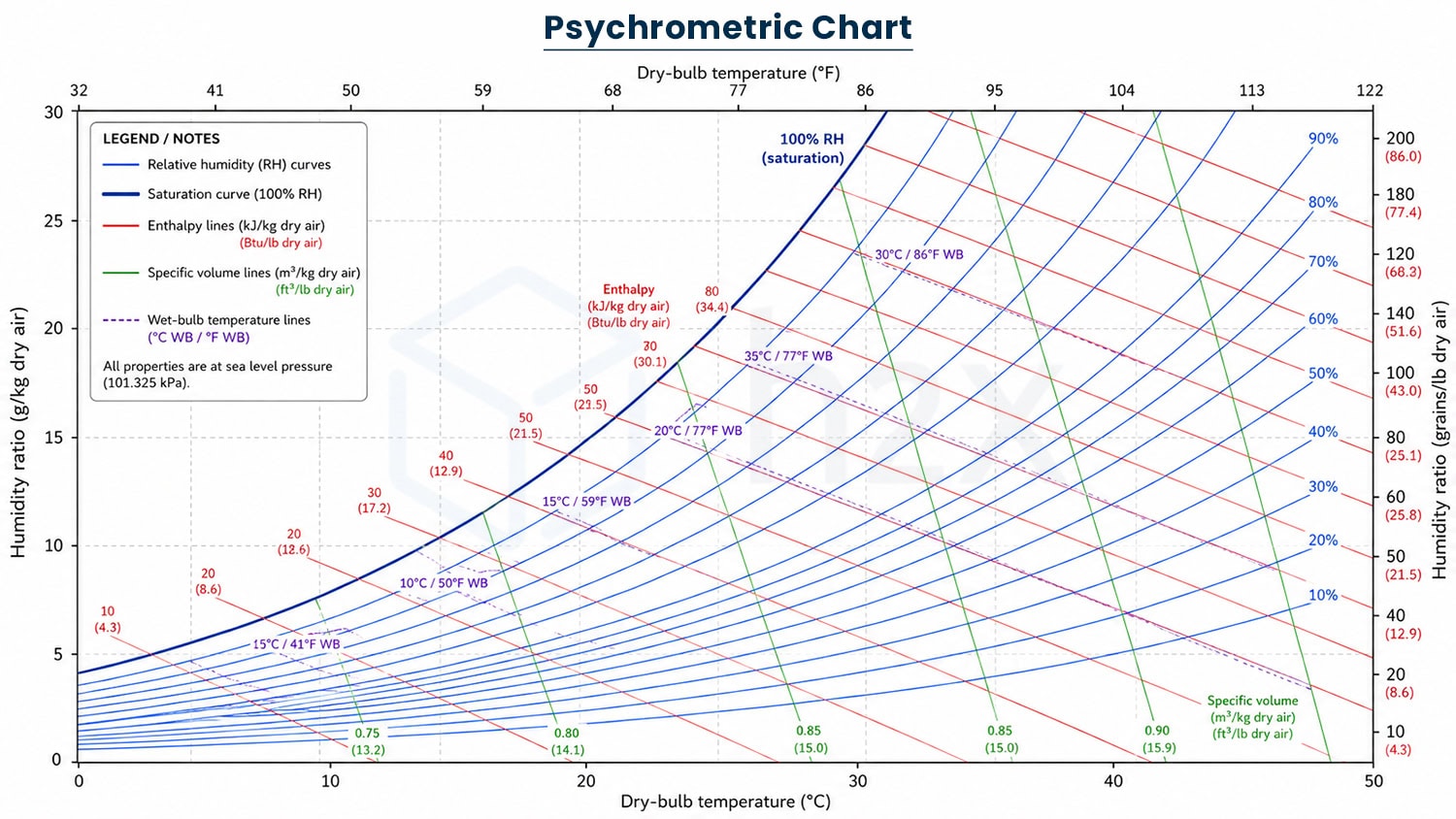
- On a psychrometric chart, pure sensible heat gain moves the condition point horizontally to the right (temperature increases, humidity ratio stays constant).
- Cooling coils offset sensible gain by lowering supply air temperature below the room setpoint.
Quick Example
Imagine a south-facing office with floor-to-ceiling glazing on a sunny afternoon. In this scenario, solar radiation passes through the glass and heats the floor, desks, and walls. Those surfaces then radiate and convect heat into the room air, raising the dry-bulb temperature. That’s textbook sensible heat gain.
Latent Heat Gain: Key Points
- Latent heat gain is also measured in watts (W) or BTU/h, even though it’s about moisture — the unit tracks the energy needed to evaporate or condense that water.
- It affects the humidity ratio (or specific humidity) of the room air, not the dry-bulb temperature.
- On a psychrometric chart, pure latent heat gain moves the condition point vertically upward (the humidity ratio increases while the temperature remains constant).
- Cooling coils offset latent gain by cooling air below its dew point, causing moisture to condense on the coil surface and drain away.
Quick Example
Picture a packed gym class with thirty people exercising, breathing heavily, and sweating. Their exhalations and sweat evaporate into the air, adding moisture without necessarily raising the temperature much on its own. As a result, the room starts to feel humid and sticky. That’s latent heat gain in action.
Latent Heat vs. Sensible Heat: Why the Distinction Matters in Practice
1. Equipment Sizing
When you run a cooling load calculation, the output splits into sensible and latent components. The total cooling load is their sum:
Total Heat Gain = Sensible Heat Gain + Latent Heat Gain
If you only size equipment to handle sensible load, the space might hit the right temperature, but if the latent load is underestimated, you’ll get complaints about stuffiness even though the thermostat reads fine.
2. The Sensible Heat Ratio (SHR)
The Sensible Heat Ratio is a number you’ll encounter constantly:
SHR = Sensible Heat Gain / Total Heat Gain
- An SHR of 1.0 indicates an all-sensible load (no moisture to deal with); think of a server room full of computers and zero occupants.
- An SHR of 0.5 means the load is split evenly between sensible and latent; think of a commercial kitchen or indoor pool facility.
- Typical office spaces land around 0.75 to 0.85.
SHR matters because cooling equipment has its own rated SHR. Because of this, you’ll need to match the equipment’s capability to the actual room conditions. Otherwise, you’ll end up over-cooling the air to wring out enough moisture; wasting energy; or, experiencing humidity control issues.
3. Coil Selection
When selecting a cooling coil for your design, you’re essentially choosing a device that handles both jobs at once:
- Sensible cooling — dropping the air temperature from the mixed-air condition down to the supply-air setpoint.
- Latent cooling (dehumidification) — cooling the air below its dew point so that water condenses out.
If the coil leaving-air temperature is above the dew point, you’ll get sensible cooling but no dehumidification. That’s why, in high-latent-load applications, you sometimes need dedicated dehumidification equipment or a reheat strategy.
4. Psychrometric Chart Confidence
Once you understand sensible and latent as separate vectors, the psychrometric chart stops being intimidating:
- Horizontal line to the right = sensible gain (temperature rises)
- Vertical line upward = latent gain (moisture rises)
- Diagonal line = combined sensible and latent gain (the slope angle depends on SHR)
The coil essentially reverses that diagonal movement on the psychrometric chart: it acts as a diagonal line moving down and to the left, toward the apparatus dew point.
Common Mistakes to Avoid
- Ignoring latent loads in “dry” climates. Even in arid regions, a densely occupied space generates significant latent load from people alone. Don’t zero it out.
- Confusing total heat with sensible heat on equipment data sheets. Always check whether a manufacturer’s rated capacity is total or sensible.
- Forgetting about latent gains from infiltration. Especially in humid climates, uncontrolled air leakage can add substantial moisture to a space.
- Assuming people generate the same heat in every scenario. CIBSE and ASHRAE publish tables for different activity levels. A person sitting at a desk gives off roughly 75 W / 256 BTU/h sensible and 55 W / 188 BTU/h latent, while someone exercising might push 210 W / 717 BTU/h sensible and 315 W / 1,075 BTU/h latent. This is a significant difference.
Quick Reference Table
| Factor | Sensible Heat Gain | Latent Heat Gain |
|---|---|---|
| What changes | Temperature (Dry-bulb) | Humidity ratio (moisture content) |
| Detectable by | Thermometer | Hygrometer |
| Psych chart direction | Horizontal (right) | Vertical (up) |
| Typical sources | Solar, conduction, lights, equipment, people (body heat), ventilation (temperature component) | People (breathing/sweat), cooking, wet processes, ventilation (moisture component) |
| How cooling coils handle it | Lower air temperature | Cool below the dew point to condense moisture |
| Units | W or BTU/h | W or BTU/h |
Practical Tips for Your Load Calcs
- Start by listing every heat source in the space — equipment, people, lights, solar, envelope, ventilation — and tag each one as sensible, latent, or both.
- Use published data. CIBSE Guide A and ASHRAE Fundamentals have well-researched tables for occupant loads, equipment heat gains, and lighting power densities.
- Check the SHR. Once your load calc is done, sanity-check the SHR against what you’d expect for that space type. An office at 0.5 SHR should raise eyebrows. A swimming pool at 0.95 should too.
- Talk to the equipment supplier. When selecting units, share both the sensible and latent loads. A good supplier will make sure the equipment can handle the split, not just the total.
- Think about part-load conditions. Latent loads don’t always track with sensible loads. On a mild, humid day, the sensible load might be low while latent stays high. This is when humidity control gets tricky.
Latent Heat vs. Sensible Heat Worked Example
Let’s walk through a simple calculation for a small office so you can see how sensible and latent loads add up and give you the SHR.
The Space
A 50 m² (540 ft²) open-plan office with 10 people sitting at desks, standard lighting, and mechanical ventilation bringing in fresh outdoor air.
Step 1 — List the Sensible Heat Gains
| Source | Calculation | Sensible Gain |
|---|---|---|
| People (10 seated, office work) | 10 × 75 W / 10 × 256 BTU/h | 750 W / 2,560 BTU/h |
| Lighting (10 W/m² / 3.2 W/ft²) | 50 m² × 10 W/m² | 500 W / 1,706 BTU/h |
| Equipment (10 PCs at 150 W each) | 10 × 150 W | 1,500 W / 5,118 BTU/h |
| Solar through glazing (estimated) | — | 800 W / 2,730 BTU/h |
| Conduction through envelope (estimated) | — | 450 W / 1,535 BTU/h |
| Ventilation — sensible portion (10 L/s per person / 21 CFM per person, ΔT = 10°C / 18°F) | 0.1 m³/s × 1.2 kg/m³ × 1.005 kJ/kg·K × 10 K | 1,200 W / 4,094 BTU/h |
| Total Sensible | 5,200 W / 17,743 BTU/h |
Step 2 — List the Latent Heat Gains
| Source | Calculation | Latent Gain |
|---|---|---|
| People (10 seated, office work) | 10 × 55 W / 10 × 188 BTU/h | 550 W / 1,880 BTU/h |
| Ventilation — latent portion (outdoor humidity ratio 12 g/kg, indoor 8 g/kg / Δw = 0.004 kg/kg) | 0.1 m³/s × 1.2 kg/m³ × 2,450 kJ/kg × 0.004 kg/kg | 1,175 W / 4,010 BTU/h |
| Total Latent | 1,725 W / 5,890 BTU/h |
Note: Lighting, equipment, solar, and conduction are sensible-only sources — they add heat but no moisture. People and ventilation appear in both tables because they contribute both sensible and latent heat.
Step 3 — Calculate the Total Heat Gain
Total = Sensible + Latent
Total = 5,200 W + 1,725 W = 6,925 W (23,633 BTU/h)
The cooling system for this office needs to handle roughly 6.9 kW / 23,600 BTU/h of total cooling load.
Step 4 — Calculate the SHR
SHR = Sensible / Total
SHR = 5,200 / 6,925 = 0.75
What Does This Tell Us?
- 75% of the load is sensible (temperature-driven), and 25% is latent (moisture-driven).
- An SHR of 0.75 is typical for an occupied office — right in the expected 0.75–0.85 range.
- When selecting a cooling unit, you’d look for equipment with a rated SHR close to 0.75 at your design conditions. If the unit’s SHR is too high (say 0.90), it’ll cool the air temperature just fine, but won’t remove enough moisture. The space will then feel clammy. If it’s too low, it’ll over-dehumidify and waste energy.
Frequently Asked Questions
What is sensible heat vs. latent heat?
Sensible heat changes the dry-bulb temperature of air, you can measure it with a thermometer. Latent heat changes the moisture content of air without changing its temperature, you need a hygrometer to detect it. In HVAC design, both must be calculated separately because cooling equipment handles them through different mechanisms.
Why does the latent heat vs. sensible heat split matter for equipment selection?
Cooling equipment has a rated Sensible Heat Ratio (SHR) that describes how much of its total capacity goes toward temperature reduction versus dehumidification. If the equipment’s SHR doesn’t match the room’s actual load split, the space will either feel clammy (too little latent capacity) or be over-dehumidified and waste energy (too much latent capacity).
What is the sensible heat ratio (SHR) and how do I calculate it?
The Sensible Heat Ratio is the proportion of a space’s total heat gain that is sensible. It is calculated as: SHR = Sensible Heat Gain ÷ Total Heat Gain. A value of 1.0 means the load is entirely sensible; 0.5 means it is split equally between sensible and latent. Typical occupied offices fall between 0.75 and 0.85.
What are typical sensible and latent heat outputs for people?
According to ASHRAE Fundamentals and CIBSE Guide A, a person seated at a desk produces approximately 75 W (256 BTU/h) of sensible heat and 55 W (188 BTU/h) of latent heat. Someone exercising produces significantly more, around 210 W (717 BTU/h) sensible and 315 W (1,075 BTU/h) latent. Therefore, always match the activity level to the space type in your load calculation.
Can a space have a high latent load even in a dry climate?
Yes. Even in arid climates, a densely occupied space generates substantial latent load from occupant respiration and perspiration alone. Latent load from people is independent of outdoor humidity. Zeroing out latent gains because the climate is dry is one of the most common — and consequential — errors in cooling load calculations.
What is the difference between sensible cooling and latent cooling on a psychrometric chart?
On a psychrometric chart, sensible heat gain moves the air condition point horizontally to the right, temperature rises, humidity ratio stays constant. Latent heat gain moves it vertically upward, humidity ratio increases, temperature stays constant. Combined gains produce a diagonal movement whose slope angle corresponds directly to the space’s SHR.
Latent Heat vs. Sensible Heat Conclusion
Sensible heat changes temperature. Latent heat changes moisture. Every cooling load is a combination of both, and your job as a mechanical engineer is to understand the split so you can select the right equipment and deliver comfortable, well-controlled spaces.
Mastering this distinction is important because it underpins coil selection, duct sizing, psychrometric analysis, and just about every HVAC design decision you’ll make.
Stop splitting sensible and latent loads by hand.
h2x automatically calculates total, sensible, and latent heat loads for every room and building in your project, so you get the SHR, the cooling load split, and the right equipment size without manual arithmetic.
Meet the author

Jonathan Mousdell
Jonathan Mousdell is a Mechanical Engineer and co-founder of h2x, where he creates technical content and resources for MEP engineers.
Article Last Updated: June 25, 2026