Internal Heat Gain: A Practical Guide for HVAC & Building Services Engineers
Everything you need to know about internal heat gain in your engineering designs — from occupants, lighting, and equipment loads to sensible heat, latent heat, and SHR worked examples.

Internal heat sources are any heat-generating activities or equipment located inside the building envelope. Unlike solar or conductive gains that come from outside, internal heat gain is produced within the conditioned space itself.
The key rule: All energy (measured in BTU/hr or W) consumed inside a building ultimately becomes heat, including a computer running calculations, a person sitting at a desk, a light, or a server processing data.
What Is Internal Heat Gain
Internal heat gain is the heat added to a conditioned space by sources located within the building envelope itself. It includes heat from occupants, artificial lighting, and electrical equipment — all of which convert the energy they consume into heat that the cooling system must remove.
In modern commercial buildings, internal heat gain frequently exceeds solar and fabric gains combined, making it one of the most important factors in the cooling load calculation.
Sensible Heat vs. Latent Heat: A Quick Explainer
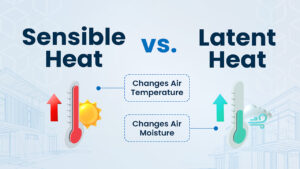
Not all heat affects a building the same way. In fact, internal heat gains are split into two types:
- Sensible heat warms the air — you can measure it with a thermometer. It raises the dry-bulb temperature, and the air is cooled to remove it.
- Latent heat adds moisture to the air — it comes from people breathing and sweating, cooking, and wet processes. It doesn’t raise the temperature but it raises humidity, affecting comfort, mold risk, and equipment performance. Removing it requires dehumidification in addition to cooling.
Understanding this split is critical for selecting the right cooling equipment.
Why Internal Heat Gain Matters in Cooling Load Calculations
| Impact Area | What Can Go Wrong |
|---|---|
| Energy consumption | Internal gains dominate in offices, data centers, kitchens, and labs. Not accounting for it properly leads to incorrect sizing. |
| Cooling load sizing | Underestimate → undersized plant, comfort complaints. Overestimate → oversized plant, poor efficiency, high cost. |
| SHR and coil selection | A high latent load (low sensible heat ratio, or SHR) means a standard cooling coil won’t be enough. Dehumidification capacity must be factored in from the start |
For instance, in many modern office buildings, internal gains could account for 50% of the total cooling load.
Three Main Sources of Internal Heat Gain
Internal heat gains come from three primary sources: occupants, lighting, and equipment. However, each source contributes differently to the total load, in terms of magnitude, predictability, and the split between sensible and latent heat, and each requires a different approach to estimate accurately. Understanding all three is essential before selecting cooling plant or sizing ductwork.
1. Occupants (People)
People generate heat through metabolic processes, and the rate depends on the activity level:
Heat Output per Person by Activity (source: ASHRAE Fundamentals Handbook):
| Activity | Total Heat BTU/hr (W) | Sensible BTU/hr (W) | Latent BTU/hr (W) |
|---|---|---|---|
| Seated, at rest | 392 (115) | 222 (65) | 171 (50) |
| Office work | 478 (140) | 256 (75) | 222 (65) |
| Light bench work | 802 (235) | 290 (85) | 512 (150) |
| Walking (2.2 mph / 3.5 km/h) | 904 (265) | 341 (100) | 563 (165) |
| Heavy work/gym | 1,502–2,388 (440–700) | 580 (170) | 921–1,809 (270–530) |
Key points:
- Latent heat (moisture from breathing and perspiration) becomes critical in dense spaces
- Gyms, auditoriums, and classrooms have high latent loads, which drives dehumidification requirements
- Therefore, always validate occupancy density with the client. For example, a law firm and a call center will have different occupant density and activity, and have different cooling and dehumidification needs.
2. Lighting
All electric lighting releases a portion of its energy as heat. The amount depends on luminaire type and installation method.
| Luminaire Type | Heat to Space | Notes |
|---|---|---|
| Incandescent/halogen | ~100% | Almost entirely heat |
| Fluorescent (T8/T5) | ~85–90% | Some heat to the plenum if recessed |
| LED | ~60–70% | More efficient, but still significant at scale |
Typical installed lighting loads:
| Space Type | BTU/hr·ft² (W/m²) |
|---|---|
| General office | 3.2–4.8 (10–15) |
| Retail | 4.8–7.9 (15–25) |
| Industrial/Warehouse | 1.6–3.2 (5–10) |
| Hospitality | 6.3–12.7 (20–40) |
Key points:
- Recessed fittings discharge some heat to the ceiling void — factor in plenum return air if relevant
- Lighting controls (presence detection, daylight dimming) can significantly reduce the design load
- LED retrofits reduce heat gain as well as energy bills
3. Equipment and Appliances
Often, the most variable and hardest to estimate category. This can include:
- Office: Computers, monitors, printers, photocopiers, AV equipment
- Catering: Ovens, grills, fryers, dishwashers, refrigeration (heat rejection side)
- IT / data: Servers, UPS systems, networking hardware, storage arrays
- Medical / lab: Autoclaves, centrifuges, imaging equipment, incubators
- Industrial: Motors, compressors, process equipment
Typical equipment heat gain benchmarks:
| Space Type | BTU/hr·ft² (W/m²) |
|---|---|
| General office | 4.8–7.9 (15–25) |
| Dense office/Trading floor | 9.5–15.9 (30–50) |
| Laboratory | 31.7–158.5 (100–500) |
| Server room | 158.5–634+ (500–2,000+) |
| Commercial kitchen | 95.1–221.9 (300–700) |
Key points:
- Equipment gains are almost entirely sensible (dry heat)
- Exception: Catering and lab equipment can introduce latent gains via steam and moisture
- Benchmark data from CIBSE or ASHRAE is useful when measured data isn’t available

Sensible Heat vs. Latent Heat — Full Breakdown
| Sensible Heat | Latent Heat | |
|---|---|---|
| What it does | Changes the air temperature | Changes the air moisture content (humidity) |
| How to measure it | Thermometer (dry-bulb temperature) | Hygrometer / psychrometric chart |
| Main sources | Equipment, lighting, and conduction | People, cooking, steam, wet processes |
| How it’s removed | Cool the air | Condense moisture out (dehumidification) |
| Affects | Dry-bulb temperature setpoint | Relative humidity, mold risk, comfort |
Sensible Heat Ratio (SHR)
SHR = Sensible Heat Gain ÷ Total Heat Gain
- SHR of 1.0 = pure sensible load (e.g. server room)
- SHR of 0.8 = typical office
- SHR of 0.5–0.6 = high moisture space (kitchen, gym, pool)
Why SHR matters for design:
- Cooling coils must be selected to match the space SHR
- A coil with the wrong SHR will either over-cool (too cold, under-dehumidified) or leave the space at the right temperature, but damp and muggy
- Direct Expansion (DX) systems are particularly sensitive to SHR mismatch
Internal Heat Gain Examples
Example 1: Open-Plan Office
Space: 2,153 ft² (200 m²) | 30 occupants | LED lighting | Standard equipment
| Source | Calculation | Sensible BTU/hr (W) | Latent BTU/hr (W) |
|---|---|---|---|
| Occupants | 30 × 256 BTU/hr (75 W) sens / 222 BTU/hr (65 W) lat | 7,678 (2,250) | 6,655 (1,950) |
| Lighting | 2,153 ft² × 3.2 BTU/hr·ft² (10 W/m²) × 0.65 fraction | 4,435 (1,300) | 0 |
| Equipment | 2,153 ft² × 6.3 BTU/hr·ft² (20 W/m²) | 13,648 (4,000) | 0 |
| Total | 25,761 (7,550) | 6,655 (1,950) | |
| Grand Total | 32,416 BTU/hr (9,500 W) |
SHR: 0.79
This space has a moderate latent load from occupants. Therefore, the cooling system needs sensible cooling and dehumidification capacity.
Example 2: Commercial Kitchen
Space: 538 ft² (50 m²) | 5 staff | Heavy cooking equipment with hood
| Source | Calculation | Sensible BTU/hr (W) | Latent BTU/hr (W) |
|---|---|---|---|
| Occupants | 5 × 290 BTU/hr (85 W) sens / 512 BTU/hr (150 W) lat | 1,450 (425) | 2,559 (750) |
| Lighting | 538 ft² × 4.8 BTU/hr·ft² (15 W/m²) | 2,559 (750) | 0 |
| Cooking Equipment | 538 ft² × 127 BTU/hr·ft² (400 W/m²) × 0.50 factor | 34,121 (10,000) | 17,060 (5,000) |
| Total | 38,130 (11,175) | 19,619 (5,750) | |
| Grand Total | 57,749 BTU/hr (16,925 W) |
SHR: 0.66
A low SHR indicates dehumidification is critical. Consequently, a standard comfort cooling coil may not cope. Consider a low-SHR coil or dedicated energy-recovery ventilation.
Example 3: Server Room
Space: 20 m² (215 ft²) | No regular occupancy | High-density IT equipment
| Source | Calculation | Sensible BTU/hr (W) | Latent BTU/hr (W) |
|---|---|---|---|
| Occupants | Negligible | 0 | 0 |
| Lighting | 215 ft² × 3.2 BTU/hr·ft² (10 W/m²) | 682 (200) | 0 |
| IT Equipment | 215 ft² × 317 BTU/hr·ft² (1,000 W/m²) | 68,243 (20,000) | 0 |
| Total | 68,925 (20,200) | 0 |
SHR ≈ 1.0
Almost entirely sensible load. Use precision cooling (CRAC/CRAH units) with high SHR performance. Standard comfort coils would be inefficient here.
SHR Comparison Across Space Types
| Space Type | Typical SHR | Dominant Load | Cooling Strategy |
|---|---|---|---|
| Server room | ~1.0 | Sensible (IT equipment) | Precision cooling, CRAC/CRAH |
| General office | 0.80–0.85 | Sensible (equipment + lighting) | Standard comfort cooling |
| Open-plan office | 0.75–0.80 | Sensible + moderate latent | Comfort cooling with dehumidification |
| Gymnasium | 0.55–0.65 | High latent (occupants) | Low-SHR coil, dehumidification focus |
| Commercial kitchen | 0.55–0.70 | Mixed (equipment + steam) | Low-SHR coil, dedicated ventilation |
| Indoor pool | 0.30–0.50 | Latent (evaporation) | Dedicated dehumidification plant |
Key Takeaways
- Every watt (BTU/hr) consumed inside a building becomes heat; there are no exceptions.
- Internal gains often dominate modern commercial buildings at 50% of the total cooling load
- Always validate inputs with the client as occupancy density, equipment schedules, and operating hours vary enormously between building types
- SHR drives coil and plant selection. Get it wrong, and the space will be either too cold, too humid, or both.
- Apply diversity factors to equipment loads — not everything runs at full capacity simultaneously.
- High internal gain spaces may need cooling year-round and this affects zoning, controls, and plant strategy.
- Use dynamic simulation for complex projects. Peak load timing depends on occupancy and equipment schedules, not just peak external conditions.
Internal Heat Gain Frequently Asked Questions
What does Internal Heat Gain mean and what causes it?
Internal Heat Gain is a measurement of all of the heat-generating activities or equipment located inside the building envelope. It is caused by any energy-consuming activity or equipment operating within the building envelope, including occupants, artificial lighting, and electrical equipment.
What is the difference between sensible heat and latent heat?
Sensible heat changes the air temperature, so you can measure it with a thermometer. Latent heat changes the air moisture content, so it affects humidity rather than dry-bulb temperature. In HVAC design, sensible heat usually comes from lighting and equipment, while latent heat often comes from occupants, cooking, steam, and other wet processes.
How does Internal Heat Gain affect building construction and costs?
Internal heat gain can affect energy consumption, cooling load sizing, and cooling coil selection. In many modern office buildings, internal gains could account for 50% of the total cooling load.
How do you control Internal Heat Gain when designing an HVAC system?
Calculating the Sensible Heat Ratio (SHR) will help you determine how to adequately cool the space while keeping energy costs reasonable.
How to reduce Internal Heat Gain
The most effective strategies include switching to LED lighting, specifying energy-efficient equipment, and applying diversity factors to account for equipment not running at the same time. Occupancy-based controls and scheduled shutdowns can also reduce peak internal gains significantly.
Internal Heat Gain Calculations Are Now in h2x

Stop estimating internal heat gains by hand.
h2x automatically accounts for occupant, lighting, and equipment loads in your cooling load calculations, giving you accurate sensible and latent heat splits, SHR, and correctly sized plant without the manual number-crunching.
Meet the author

Jonathan Mousdell
Jonathan Mousdell is a Mechanical Engineer and co-founder of h2x, where he creates technical content and resources for MEP engineers.
Article published: April 1, 2026
Last updated: June 25, 2026