ASHRAE 183: The Industry Standard for HVAC Load Calculations
Learn what ASHRAE Standard 183 requires for HVAC load calculations and what engineering design software needs to produce compliant, audit-ready results.
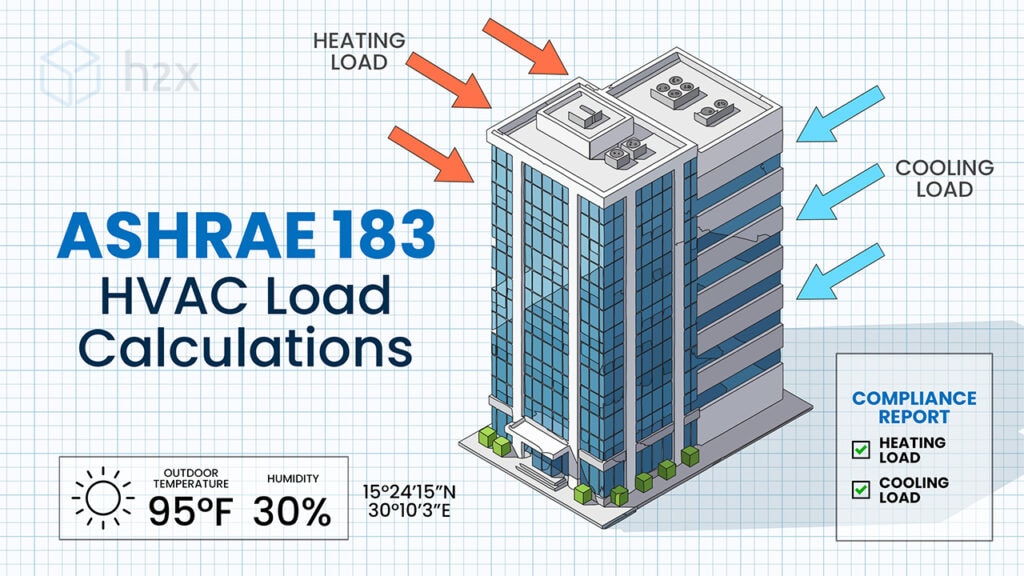
ASHRAE 183 is the ANSI/ASHRAE/ACCA standard for peak cooling and heating load calculations in commercial and industrial buildings. Specifically, it sets standards for input data and calculation methods, and establishes recommended practices for documentation and reporting. ASHRAE 183 compliance is the industry benchmark for judging HVAC design quality.
Key Takeaways:
- ASHRAE 183 sets the minimum requirements for HVAC peak load calculations on non-residential buildings.
- The standard references the Heat Balance load calculation method and the Radiant Time Series method, among others, from the ASHRAE Handbook.
- ASHRAE recommends well-documented inputs, traceable calculations, and clear reporting of results.
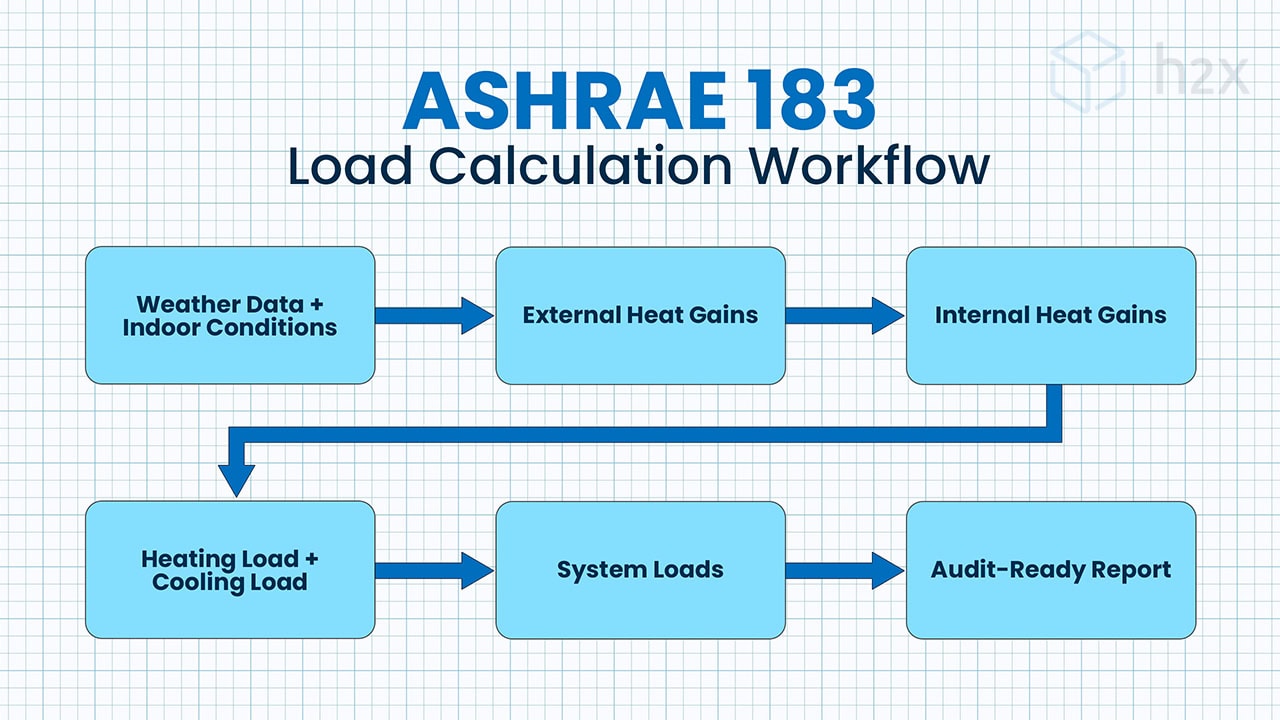
- To achieve ASHRAE 183 compliance, engineering software must support the core calculation requirement sections: 5. Weather Data and Indoor Design Conditions; 6. Cooling Load Methods; 7. External Heat Gains; 8. Internal Heat Gains; 9. Heating Load; and 10. System Cooling and Heating Loads.
- Reviewers, owners, and code officials increasingly expect ASHRAE 183 compliance on every project.
What is ASHRAE 183?
The official title of ASHRAE 183 is “Peak Cooling and Heating Load Calculations in Buildings Except Low-Rise Residential Buildings.” ASHRAE first published Standard 183 in 2007 and most recently updated it in 2024. Importantly, the standard carries ANSI and ACCA accreditation. This means it follows a consensus development process with national standing in the United States.
In scope, the standard covers all buildings except for low-rise residential buildings. This includes commercial offices, schools, hospitals, retail, industrial facilities, and most non-residential occupancies. Low-rise residential work falls under ASHRAE 152 and Manual J procedures.
ASHRAE 183 and CIBSE Software Verification Assessment (SVA)
It’s worth noting that while ASHRAE sets heat load requirements through Standard 183, it does not verify system design. CIBSE, the global body for building services engineering, runs Software Verification Assessment (SVA), which independently tests the physics of system design calculations across a system. Together, ASHRAE and CIBSE form one of the most complete accuracy frameworks currently available for engineering design software.
Currently, no single body certifies both calculation and design methods. For full coverage, h2x is assessed against both ASHRAE and CIBSE standards for mechanical engineering software accuracy:
- ANSI/ASHRAE/ACCA Standard 183-2024 for load calculations
- CIBSE Software Verification Assessment (SVA) for system design
Accurate engineering software must both address the right design requirements and correctly implement and interpret the underlying physics of load calculations.
Why ASHRAE 183 is the industry standard
ASHRAE 183 has become the industry standard because it ties load calculations to rigorous ASHRAE Handbook methods. It also offers reviewers a single reference point when checking submissions across firms and software platforms. Notably, several green building rating systems, energy codes, and procurement specifications now cite ASHRAE 183 directly.
Owners care because compliant calculations help reduce design risk and improve equipment selection. Beyond this, following ASHRAE’s recommendations for transparent documentation also supports other processes, including life-cycle cost analysis, value engineering, and post-occupancy verification.
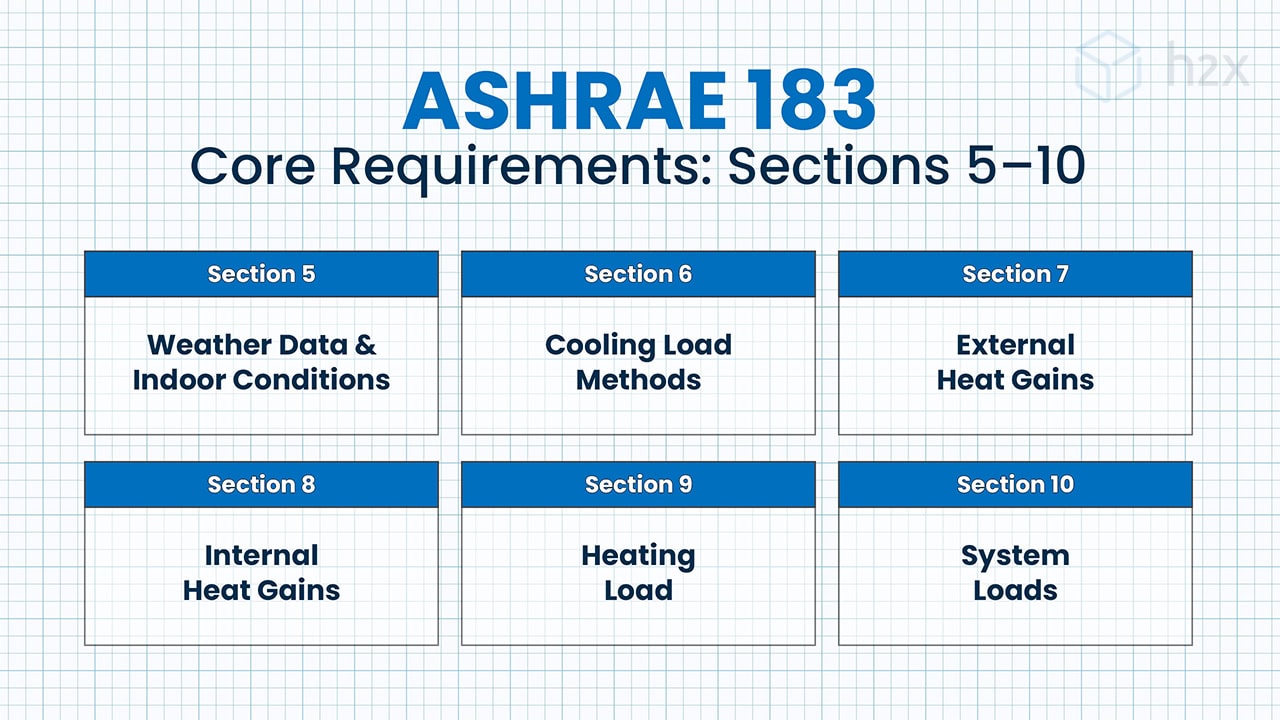
ANSI/ASHRAE/ACCA Standard 183-2024 compliance for load calculations
Sections 5 through 10 of Standard 183 set the requirements for peak cooling and heating load calculation methods. h2x compliance with each clause is detailed below.
5. Weather data and indoor design conditions
| Clause | Requirement | How h2x Complies |
|---|---|---|
| 5.1 | Indoor design conditions shall be established by owner criteria, local codes, or comfort criteria. | h2x lets users set indoor design conditions for each project, including separate summer and winter dry-bulb temperatures and relative humidity. Users can configure these to align with owner criteria, local codes, or comfort standards. |
| 5.2 | Cooling calculations shall use values of outdoor air temperature and humidity for the building use, the building location, time of year, and time of day. | Cooling calculations use ASHRAE weather station data for the project location, including elevation, coordinates, and dry-bulb and wet-bulb temperatures. Two design days per month are evaluated with hour-by-hour profiles to capture time-of-day variation. The user sets building orientation to align loads with the actual site. |
| 5.3 | Solar radiation for cooling calculations shall use solar flux conditions for the building location, time of year, time of day, and orientation of the surface receiving the solar radiation. | h2x calculates solar radiation using hourly solar flux profiles for the project’s latitude and longitude, and the orientation of each surface. The same two design days per month, drawn from ASHRAE weather station data, are used so each surface is evaluated against the correct sun angle for the time of year and time of day. |
| 5.4 | Heating calculations shall use values of outdoor air temperature for the building use and the building location. | Heating calculations use outdoor design temperatures from local weather data. Users can select the 100%, 99.6%, or 99% design value to match project requirements. |
6. Cooling load method
| Clause | Requirement | How h2x Complies |
|---|---|---|
| 6.1 | The calculation method shall account for convective heat gain, radiant heat gain, and the thermal mass effect on cooling load. | h2x runs the EnergyPlus calculation engine, developed by the U.S. Department of Energy, which uses the Heat Balance method. This method accounts for convective heat gain, radiant heat gain, and the thermal mass effect (including thermal lag through construction layers). |
| 6.2 | The cooling load calculation shall address the hours of the day and months of the year necessary to establish the peak cooling load and the hour at which it occurs. The peak load may occur at any of a number of possible hours. | h2x calculates the cooling load for each hour on two design days per month. Results are presented on a room-by-room basis, with the peak load and peak hour clearly displayed for transparency, and then carried through to system sizing. |
7. External heat gains
| Clause | Requirement | How h2x Complies |
|---|---|---|
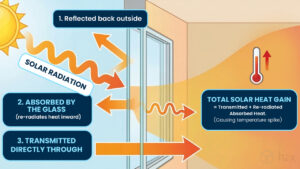
| 7.1.1 | The calculation method shall account for both temperature-driven heat gain and solar heat gain. | Window load calculations include both temperature-driven conduction and solar heat gain through the assembly. Users can see the breakdown between the two to assess each contribution. |
| 7.1.2 | The temperature-driven heat gain shall be calculated using the thermal performance of the entire fenestration assembly. | Users define each fenestration assembly with the relevant technical properties, including the overall U-value of the entire assembly, which h2x uses to calculate temperature-driven heat gain. |
| 7.1.3 | The solar heat gain shall be calculated from incident solar flux and the solar performance of the entire fenestration assembly. | h2x calculates solar heat gain from the hourly solar flux on the assembly together with the user-defined SHGC of the entire fenestration assembly. |
| 7.1.4 | The solar heat gain calculation shall account for interior shading from devices such as blinds, shades, or drapes when such devices are present. | Users can specify interior shading devices, such as blinds, shades, and drapes, for each window. h2x accounts for their effect on solar heat gain when calculating the cooling load. |
| 7.1.5 | The solar heat gain calculation shall account for exterior shading when present. | Users can model exterior shading from nearby buildings, horizontal overhangs, and vertical fins. h2x accounts for these in the solar heat gain calculation when present. |
| 7.2 | Opaque Building Envelope. The heat gain of opaque building envelope components shall account for solar radiation and temperature-driven heat gain, shall consider the thermal performance of materials in the opaque building envelope component, and shall consider the time delay occurring as heat is conducted through the material layers. | Opaque envelope heat gain is calculated using the Heat Balance method, accounting for solar radiation, temperature-driven conduction, and the time delay as heat conducts through the material layers. Users define each assembly’s full thermal properties, including layer density, reflectivity, and absorption coefficient. |
| 7.3 | Infiltration. The calculation method shall account for separate sensible and latent infiltration heat gains when infiltration exists. | Users can set a global infiltration default for the building and override it on a room-by-room basis. h2x calculates separate sensible and latent infiltration heat gains where infiltration is present. |
8. Internal heat gains
| Clause | Requirement | How h2x Complies |
|---|---|---|
| 8.1 | Internal heat gains shall be included in the cooling load. | h2x includes internal heat gains in the cooling load. Users can choose from defaults, create custom definitions, and assign them to room templates or specific rooms, as either absolute units or units per area. |
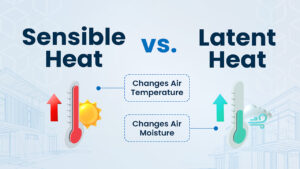
| 8.2 | Sensible and latent heat gain components of all internal gain contributors shall be considered separately. | Sensible and latent components of every internal gain source are defined separately. h2x reports results both combined and as a per-source breakdown. |
| 8.3 | Evaluation of heat gains from the occupants shall take into account the number of occupants, their activity level, and the occupancy schedule. | h2x calculates occupant heat gain from the number of occupants, their activity level (per-person sensible and latent gains), and the occupancy schedule. Users get a range of available preset profiles, with the option to create and assign custom values. |
| 8.4 | Evaluation of heat gains from lighting and internal equipment shall consider their operation schedule and load factor. | Lighting and equipment heat gains use hourly schedules in which users define months, days, and times of operation, with load levels expressed as percentages. h2x applies the schedule and load factor to calculate hour-by-hour heat gain. |
| 8.5 | Evaluation of heat gains from lighting equipment shall account for heat transfer to the ceiling plenum (if applicable). | h2x captures heat transfer, from lighting to the ceiling plenum, through the internal heat source in the room properties, where users can allocate loads to the plenum. These loads are carried through to both the zone and coil loads. |
9. Heating load
| Clause | Requirement | How h2x Complies |
|---|---|---|
| 9.1 | Heating load calculations shall be based on peak temperature-driven heat loss through the building envelope. | Heating load is based on peak temperature-driven heat loss through the building envelope, using the project’s outdoor design temperature and the user-defined envelope U-values. |
| 9.2 | Credit for solar heat gains and for internal heat gains shall not be included as part of the calculation of the peak heating load. | h2x excludes solar heat gain and internal heat gains from the peak heating load calculation. They cannot be credited against heating load, in line with the Standard. |
| 9.3 | Infiltration shall be accounted for when it exists. | Infiltration is accounted for when present. h2x users can set a global building default and override it on a room-by-room basis, including both sensible and latent components. |
| 9.4 | Heating load calculations shall account for cold processes or equipment in the zone that absorbs heat (for example, some refrigerated cases). | Cold processes and heat-absorbing equipment in a zone are currently accounted for through several mechanisms. These include additional spare capacity, thermal bridging allowances, or overriding the calculated load to include the specific value. |
10. System cooling and heating loads
| Clause | Requirement | How h2x Complies |
|---|---|---|
| 10.1 | Cooling and heating system loads shall account for the capacity required to accomplish psychrometric processes. Psychrometric processes include conditioning for reheat, dehumidification, and air mixing. | h2x calculates the sensible and latent loads required for the system’s psychrometric processes. Airflow (CFM) is derived from the sensible load and supply air temperature. Users can view SHR breakdown to verify reheat, dehumidification, and air-mixing capacity. |
| 10.2 | Energy from fans and pumps used in cooling systems shall be accounted for in system cooling loads. | Heat from fans and pumps in cooling systems is currently accounted for by including them in the equipment properties, which h2x carries through the load and coil sizing calculations. |
| 10.3 | Heat transfer through piping and ductwork walls shall be accounted for in determining system loads. | h2x auto-calculates heat transfer through piping based on length, size, and configuration. Ductwork heat gain or loss is currently applied through an input at the equipment properties. |
| 10.4 | Duct leakage shall be considered in determining system load. | Duct leakage is currently incorporated by adding an allowance via the input at the equipment properties, which h2x carries through the load and coil sizing calculations. |
| 10.5 | Outside air cooling and heating loads shall be calculated for the particular system configuration and weather data. | Outside air cooling and heating loads are calculated for each system configuration. h2x supports a range of equipment, including AHUs, FCUs, RTUs, hydronic heating and chilled water systems, and ducted distribution. Users set system temperatures and use ASHRAE design-day weather data with selectable percentile options. |
| 10.6 | Diversity due to variations in actual occupancy, lighting, or equipment use shall be considered in determining system cooling loads. | h2x applies a peak coincidental calculation (diversity) at the system level to account for cross-zone variations in actual occupancy, lighting, and equipment use. This is layered on top of hourly schedules for each load (months, days, hours, and load percentages), so both cross-zone simultaneity and time-of-day variation are captured when sizing the system cooling load. |
| 10.7 | Based on the specific type of system designed, the system cooling and heating loads shall account for inherent system inefficiencies such as damper leakage. | h2x accounts for system inefficiencies, such as damper leakage and coil bypass, by applying inputs to the equipment properties. |
How h2x supports ASHRAE 183 compliance
h2x complies with ASHRAE 183, including hourly load calculations, weather data, and detailed input fields, all inside one workflow. In addition, h2x produces audit-ready reports that capture every assumption and output.
As a result, design teams can submit calculations that meet ASHRAE 183 requirements without juggling separate tools or manual spreadsheets. Visit our heat load calculations feature page to see how engineers handle compliance inside h2x.
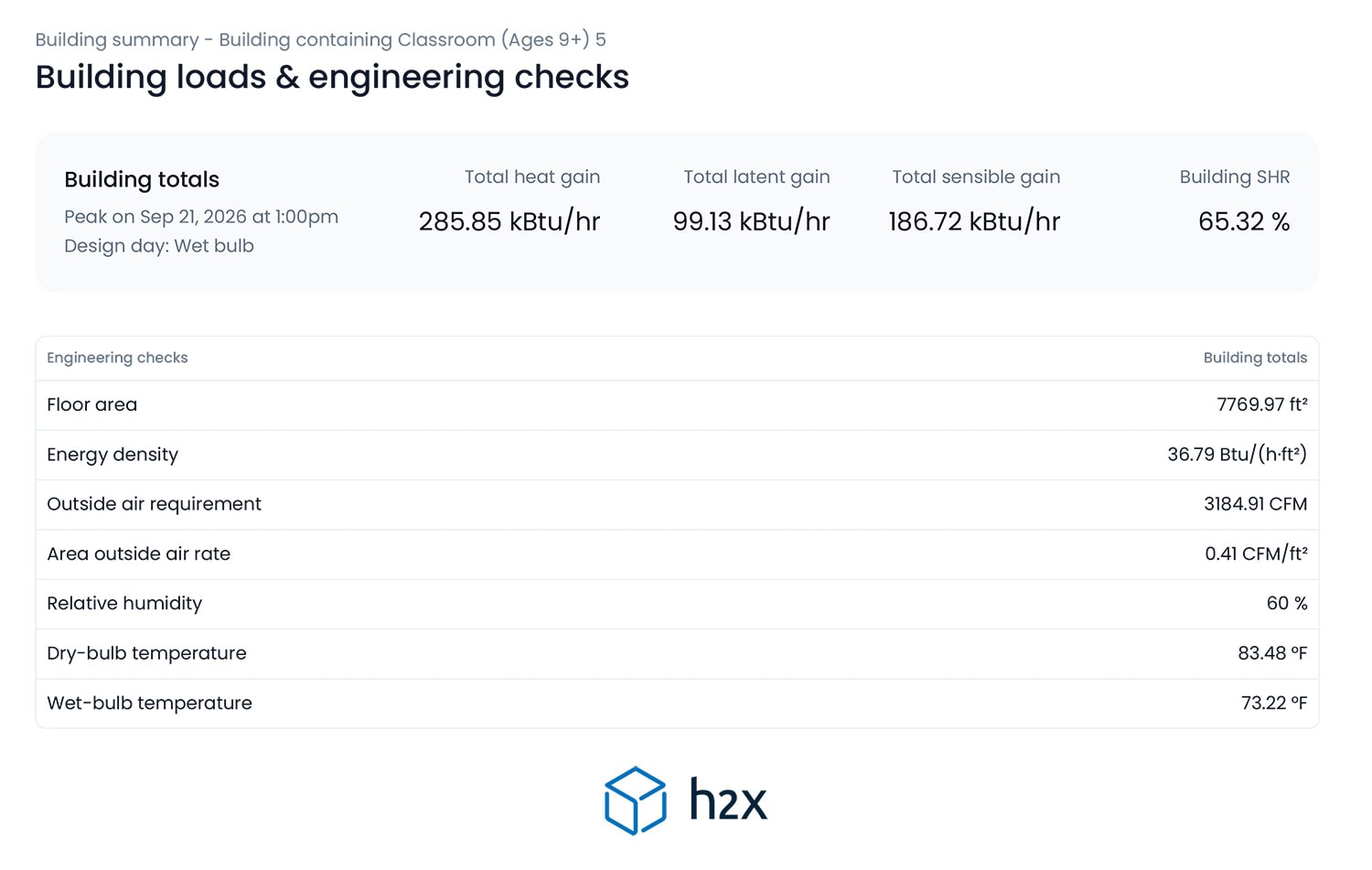
Example h2x heat gain report showing peak load results, sensible and latent gains, outside air requirements, and design conditions for audit-ready HVAC load calculations.
Frequently asked questions
What is ASHRAE standard 183?
ASHRAE 183 is the ANSI/ASHRAE/ACCA standard that defines minimum requirements for HVAC peak load calculations on non-residential buildings. Complying with the standard gives engineers, reviewers, and owners a common benchmark.
Is ASHRAE 183 mandatory?
Adoption depends on jurisdiction and project type. Generally, federal projects, healthcare facilities, and many state energy codes require it directly. Additionally, LEED, NABERS, and similar rating systems increasingly cite the standard in their submission criteria.
Which calculation methods does ASHRAE 183 accept?
The standard names five methods from the ASHRAE Handbook: Heat Balance; Radiant Time Series; Cooling Load Temperature Difference/Cooling Load Factor; Total Equivalent Temperature Difference; and Transfer Function.
How does h2x help with ASHRAE 183 compliance?
h2x is fully compliant with ASHRAE 183. Also, the platform follows ASHRAE recommendations by documenting every input, output, and assumption inside a structured report. Engineers using h2x can be confident that their load calculations follow the best, most current methods.
Conclusion
ASHRAE 183 is the industry standard for HVAC load calculations and raises the floor for defensible HVAC designs. It ties load methods to rigorous documentation and current ASHRAE data. To comply, engineering design software must support hourly methods, current weather files, and more, as outlined by the standard.
Ready to meet ASHRAE 183 requirements with confidence?
See compliant HVAC load calculations in action. h2x covers every clause from weather data to system loads, with audit-ready reports built in.
Meet the author

Jonathan Mousdell
Jonathan Mousdell is a Mechanical Engineer and co-founder of h2x, where he creates technical content and resources for MEP engineers.
Article published: July 13, 2026
Last updated: July 13, 2026