AS/NZS 3500 Plumbing and Drainage Standards Explained
AS 3500 explained for hydraulic designers: what each part covers, what changed in 2025, when each state adopts it and how it sizes pipes.
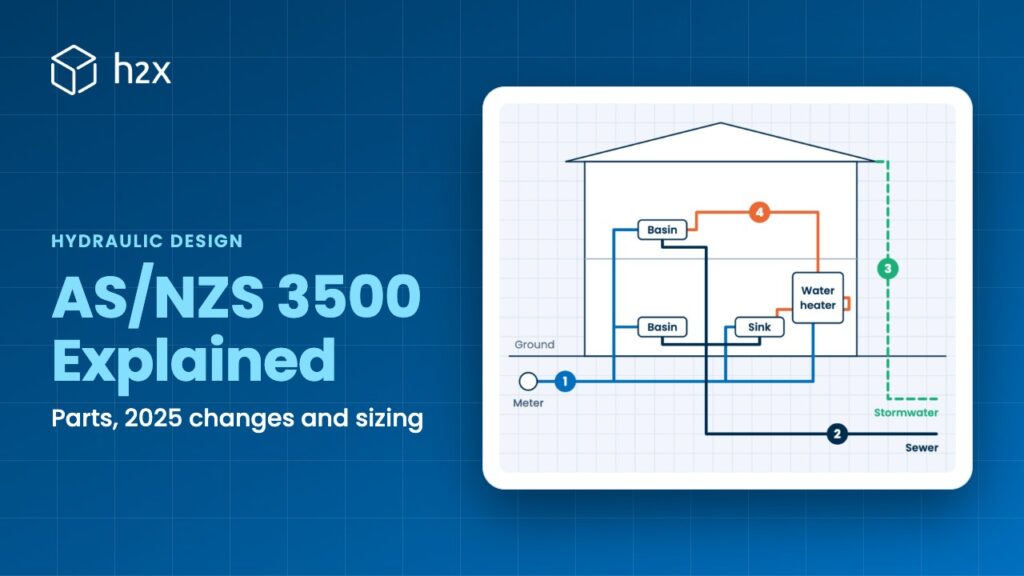
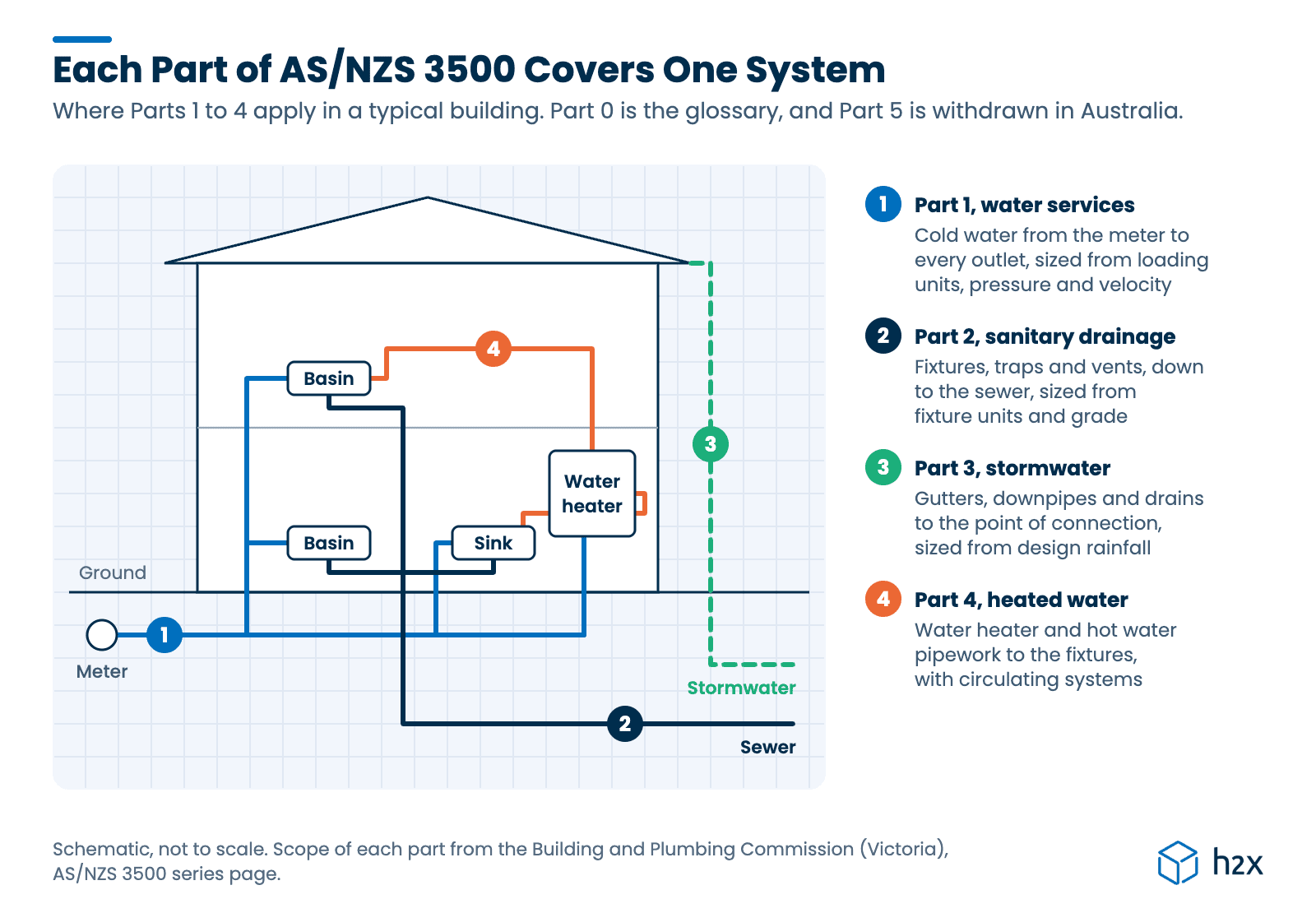
AS/NZS 3500, often shortened to AS 3500, is the plumbing and drainage standard for Australia and New Zealand. Its four main parts set the rules for water services, sanitary drainage, stormwater and heated water, including how to size each one.
So if you design hydraulic services, AS 3500 is what your pipe sizes, grades and gutters get checked against. The 2025 editions replaced 2021, but not everywhere on the same date. So this guide covers each part, what changed, which edition applies where and how the sizing methods work.
Quick Answer: AS/NZS 3500 is the plumbing and drainage standard for Australia and New Zealand: Part 1 water services, Part 2 sanitary drainage, Part 3 stormwater and Part 4 heated water. In Australia, the National Construction Code calls it up as the deemed-to-satisfy solution. The 2025 editions replace 2021 on dates that vary by state.
What Is AS 3500?
AS/NZS 3500 is a joint Standards Australia and Standards New Zealand series for plumbing and drainage design, installation and testing. You’ll also see it written as AS3500, but it’s the same series.
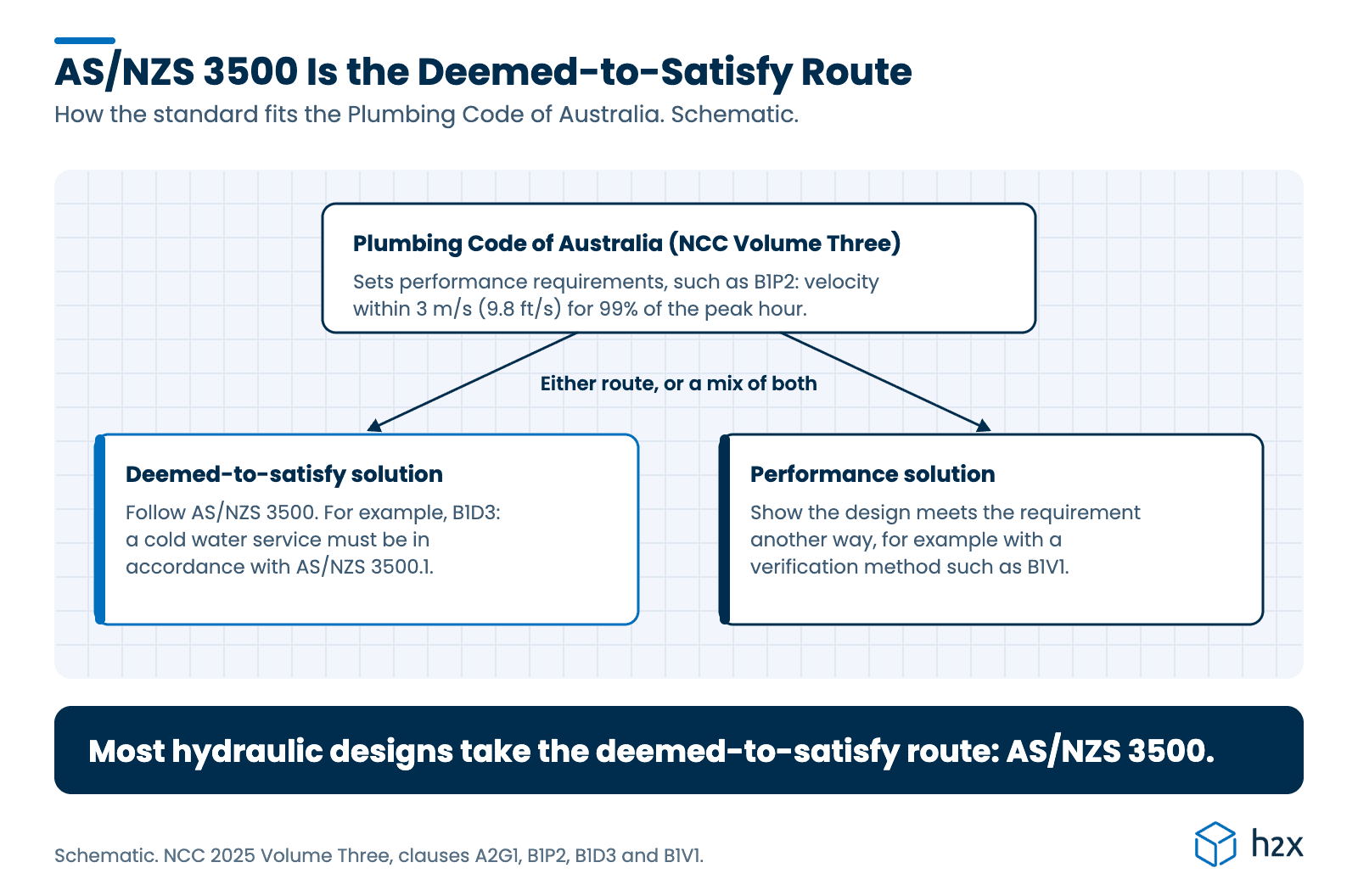
In Australia, AS 3500 gets its legal force through the Plumbing Code of Australia (PCA). The PCA, in turn, is Volume Three of Australia’s National Construction Code, or NCC. Stormwater (Part 3) is also called up in the NCC’s building volumes, such as the Housing Provisions for gutters. It sets performance requirements, and a design meets them in one of two ways, or a mix of both:
- Deemed-to-satisfy. Follow AS/NZS 3500. For example, PCA 2025 clause B1D3 says a cold water service “must be in accordance with AS/NZS 3500.1”.
- Performance solution. Show the design meets the performance requirements another way. One way to prove it is a verification method the PCA sets out, such as B1V1 for cold water velocity.
Most hydraulic designs follow the deemed-to-satisfy route, so in practice AS 3500 is the rulebook.
The Parts of AS/NZS 3500
The series has a glossary, four technical parts and one withdrawn part. Victoria’s Building and Plumbing Commission (BPC) sets out the scope of each 2025 part on its AS/NZS 3500 series page.
| Part | Current edition | What it covers | What it sizes |
|---|---|---|---|
| 0, Glossary of terms | AS/NZS 3500.0:2021 | Definitions used across the series | Nothing, since it only defines terms |
| 1, Water services | AS/NZS 3500.1:2025 | Cold water, such as drinking water, fire services, rainwater, tanks and backflow prevention | Water pipes, from demand, pressure and velocity |
| 2, Sanitary plumbing and drainage | AS/NZS 3500.2:2025 | Fixtures to a sewer or on-site system, as well as traps and venting | Discharge pipes, stacks and drains, by fixture units |
| 3, Stormwater drainage | AS/NZS 3500.3:2025 Amd 1:2026 | Roof, surface and subsoil drainage, up to the connection | Gutters, downpipes and stormwater drains, by design rainfall |
| 4, Heated water services | AS/NZS 3500.4:2025 | Water heaters, heated water pipework and circulating systems, as well as temperature control | Heated water pipes and circulating systems |
| 5, Housing installations | AS/NZS 3500.5:2012, withdrawn in Australia | A combined version for houses | House water and drainage, now replaced in Australia |
Standards New Zealand notes that Part 5 remains current in New Zealand even though Standards Australia withdrew it.
What Changed in the AS 3500 2025 Editions
Standards Australia published the 2025 editions of Parts 1 to 4 on 17 April 2025. But most of the changes are about products and installation details, not design methods. BPC’s change summaries list no changes to Part 1’s sizing section or Part 2’s fixture unit method.
Water Services (Part 1)
- Flexible hoses now come in four classes, each with a maximum pressure and length (clause 2.3.2.2). New markings show hoses rated to 70 °C (158 °F) or 90 °C (194 °F).
- Atmospheric vacuum breakers are now registered testable backflow devices (Table 4.4.1), so they need commissioning and testing.
- Isolating valves are now required immediately before each flexible hose to a mixer, tap outlet or cistern (clause 5.4.2).
- Miscellaneous devices and appliances get their own clause (5.20), so they no longer need a performance solution.
Sanitary Plumbing and Drainage (Part 2)
- Waterless urinals connect straight to a stack or drain, through a DN 65 or larger pipe graded at 5% or more (clause 13.24). That limits struvite blockages.
- Multi-unit developments of three or more residential buildings get revised drainage rules (Section 14), so each unit now needs its own overflow relief gully or reflux valve.
- Polypropylene pipe is now allowed for vacuum drainage too (clause 16.2).
- Grades are now written as ratios, such as 1:100 instead of “1 in 100”.
Stormwater Drainage (Part 3)
- Eaves gutter overflow is now designed for a 1% annual exceedance probability (AEP), with every downpipe assumed blocked. Appendix F, for roofs up to 400 m² (4,300 ft²), became mandatory, with exceptions for some wide eaves and verandas.
- Valley gutters can now serve up to 40 m² (430 ft²) of roof, up from 20 m² (215 ft²). Amendment 1, published on 13 March 2026, then revised the new valley gutter chart, Figure 3.6.2.
- Discharges from devices and appliances reach stormwater through a tundish or pit (clause 5.3.8), and the system is sized for the maximum discharge.
Heated Water Services (Part 4)
- Flexible hoses also follow the same classes and markings as Part 1.
- Circulating systems need an isolating valve before each flexible hose connected to a mixer valve or tap outlet (clause 10.10.2).
When the 2025 Editions of AS 3500 Apply
Each state and territory decides when to adopt a new PCA. The PCA then decides which AS 3500 edition counts as deemed-to-satisfy, so the result is a patchwork. This is the position on 26 October 2026, from each regulator:
| Jurisdiction | When the 2025 editions apply | Source |
|---|---|---|
| Victoria | Work started from 20 October 2025, then PCA 2025 from 1 May 2026 | BPC |
| New South Wales | Not until 1 May 2027 (NCC 2025) | NSW Government |
| Queensland | Not until 1 May 2027 (NCC 2025) | Business Queensland |
| Western Australia | From 1 May 2026 (PCA 2025), but only Parts 1, 2 and 4 | Industry Bulletin 173 |
| South Australia | From 1 May 2026, when PCA 2025 started | PlanSA |
| Tasmania | Not until 1 May 2027, since NCC 2022 was reinstated on 5 June 2026 | Building Standards Tasmania |
| ACT | From 1 May 2026, though PCA 2022 is allowed until 30 April 2027 | ACT DI2026-55 |
| Northern Territory | No date set, so NCC 2022 continues | NT Government |
| New Zealand | Not cited yet, so the 2021 editions apply | Standards New Zealand |
Two dates are worth watching. First, Victoria required the 2025 standards six months before the code that calls them up. And Tasmania adopted NCC 2025 on 1 May 2026, then reverted to NCC 2022 on 5 June. Check the regulator’s page for your project’s start date before you lock in an edition.
PCA 2025 brings more than the new standards, too. In Victoria, copper alloy products touching drinking water must carry the Lead Free WaterMark for work started from 1 May 2026.
AS/NZS 3500 in New Zealand
New Zealand uses AS/NZS 3500 through acceptable solutions to its Building Code. Each one modifies the standard:
- G12/AS3 (Water Supplies) cites AS/NZS 3500.1:2021 and AS/NZS 3500.4:2021.
- G13/AS3 (Foul Water) cites AS/NZS 3500.2:2021, but without its Section 14 multi-unit provisions.
- E1/AS2 (Surface Water) cites AS/NZS 3500.3:2021 too.
The 2025 editions aren’t cited yet. Standards New Zealand says the government will consult on them in a future Building Code update. Until then, a 2025 edition is an alternative solution you’d propose to the building consent authority.
How AS 3500 Sizes Water, Drainage and Stormwater
Each part has its own sizing logic. The methods below are summaries, so you’ll still need the standard’s tables.
Cold and Heated Water
AS/NZS 3500.1 sizes water pipes by loading units, a rating for each fixture based on Hunter’s probability method. WA’s pipe sizing technical note sets out the steps for the 2021 edition:
- Draw the installation, label each pipe section and set up a sizing table.
- Assign each fixture its loading units, then add them up for every section.
- Convert each section’s loading units to a probable simultaneous flow rate (L/s). But a section serving one outlet takes that outlet’s flow.
- Find the pressure available at the meter and the minimum needed at the worst outlet: 50 kPa (7 psi).
- Then work out the allowable pressure drop and the index length to the furthest outlet.
- Finally, size each section from the standard’s pipe sizing tables, keeping velocity at or below 3 m/s (9.8 ft/s).
Heated water pipes are sized in a similar way, with Part 4 covering what’s specific to heated water, such as water heaters, circulating systems and dead legs. For more on turning loading units into flow, read how to calculate water demand.
Sanitary Drainage
AS/NZS 3500.2 gives each fixture a fixture unit rating and adds them up for each section. Its tables then give the fixture units each pipe size can carry at a given grade, and the design still has to meet the standard’s venting and installation rules. For comparison, our fixture unit charts by code compare AS/NZS 3500 ratings with the UPC and EN 12056.
The Australian Building Codes Board (ABCB) has pointed out the method’s main limit, though. It gives each fixture the same rating in every building type, whatever its real usage. PCA 2025 includes improved verification methods for sizing sanitary systems as an alternative.
Stormwater
AS/NZS 3500.3 sizes roof and surface drainage from a design rainfall intensity at a set AEP. The NCC’s Housing Provisions, Part 7.4 also show the basics for houses. Eaves gutters take 5% AEP and overflows 1% AEP, using 5-minute rainfall intensities from Bureau of Meteorology data. Box gutters go to AS/NZS 3500.3.
AS 3500 Worked Example for a Commercial Building
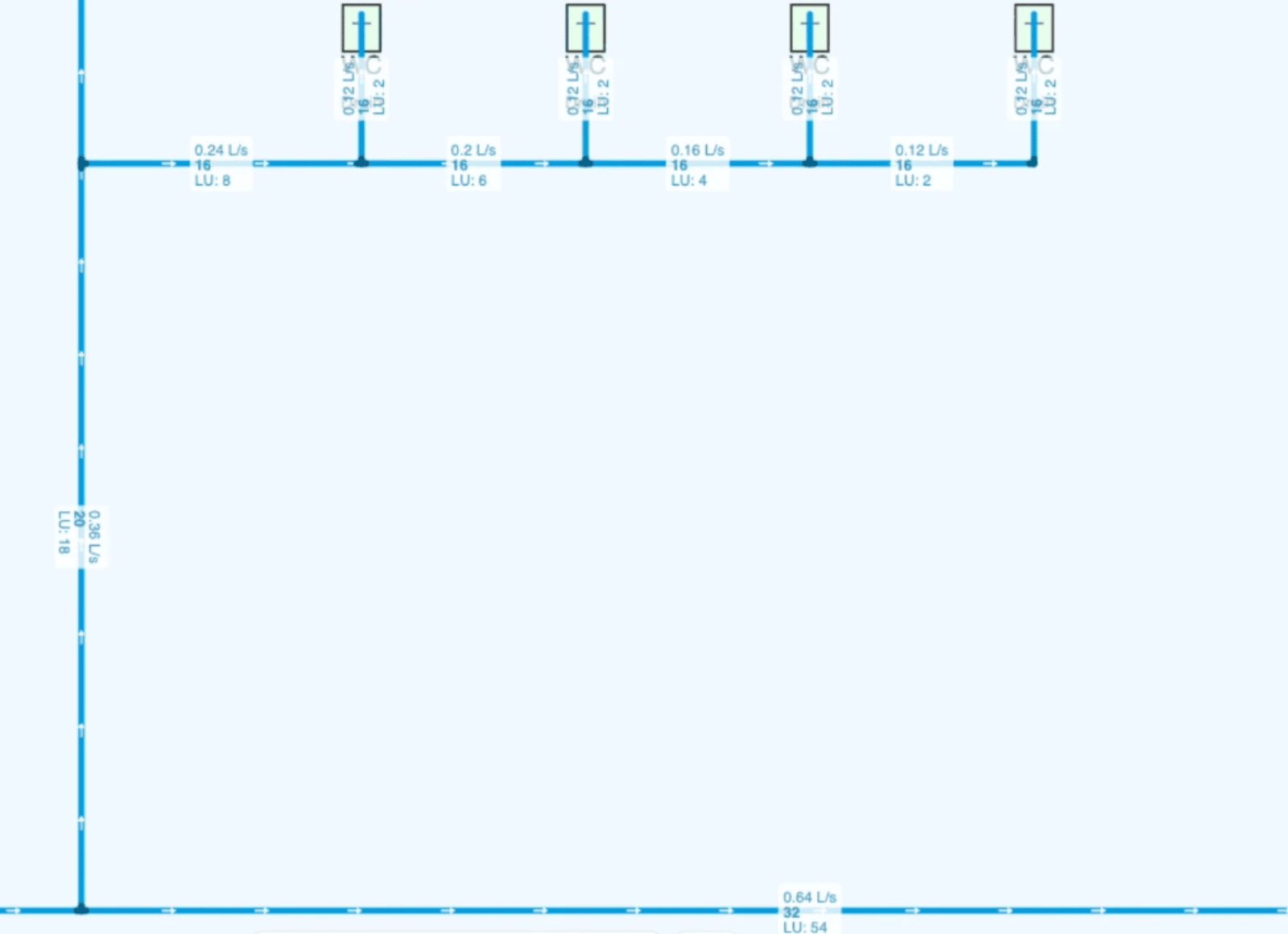
Take an illustrative small office with three identical washroom zones off one cold water main. Each zone has 4 WCs, 4 basins, 2 urinals and a kitchenette sink, so we sized it in h2x engineering software with AS/NZS 3500.1 loading units. For velocity, we kept h2x’s defaults: 3 m/s (9.8 ft/s) on branches and 1.5 m/s (4.9 ft/s) on mains.
- Assign loading units. For cold water, h2x gives each cistern WC, flushing urinal and kitchen sink 2 loading units and each basin 1, so one zone comes to 18.
- Add them up along each pipe. The WC branch carries 4 loading units past two WCs and 8 past all four. Then the main carries 18 for each zone it serves, up to 54.
- Convert each total to a peak flow. Two WCs need 0.16 L/s (2.5 gpm), but four need only 0.24 L/s (3.8 gpm). A pipe to a single fixture takes that fixture’s own flow rate instead.
- Size each pipe so it carries its peak flow within the velocity limit.
- Finally, check the pressure at the worst outlet. After losses through the pipes, fittings and meter, it needs at least 50 kPa (7 psi), or more if a fixture’s maker asks for it.
| Pipe serves | Loading units | Peak flow, L/s (gpm) | Peak flow per loading unit (L/s) | Pipe size (velocity only) |
|---|---|---|---|---|
| 2 WCs | 4 | 0.16 (2.5 gpm) | 0.040 | 16 mm PEX |
| 4 WCs | 8 | 0.24 (3.8 gpm) | 0.030 | 16 mm PEX |
| 4 basins | 4 | 0.16 (2.5 gpm) | 0.040 | 16 mm PEX |
| 1 zone (11 fixtures) | 18 | 0.36 (5.7 gpm) | 0.020 | 20 mm PEX |
| 2 zones (22 fixtures) | 36 | 0.52 (8.2 gpm) | 0.014 | 25 mm copper |
| 3 zones (33 fixtures) | 54 | 0.64 (10.1 gpm) | 0.012 | 32 mm copper |
What the Results Show
The falling flow per loading unit is diversity at work. Doubling the WCs from two to four adds half as much flow again, not twice as much. And three zones need 1.8 times the flow of one, because the more fixtures a pipe serves, the less likely they all run at once. WA’s technical note also gives the same 0.52 L/s (8.2 gpm) for 36 loading units.
The whole building stays within the 60 loading units that AS/NZS 3500.1’s flow table covers. But bigger buildings go past it, and h2x then extends the curve and flags the result as extrapolated. At that point the figure is only an estimate, so h2x’s engineers recommend switching to Barrie’s Book, whose loading unit allowances run higher.
The Plumbing Code’s Alternative for Apartments
But loading units have a known weakness in apartments. The Hydraulic Consultants Association of Australasia (HCAA) helped monitor four Australian residential buildings. Even so, their measured peak flows were only 24 to 35% of the AS/NZS 3500.1 design values. So the PCA now offers a second route: Verification Method B1V1, for cold water in Class 2 and Class 3 buildings.
B1V1 checks Performance Requirement B1P2. Velocity can’t exceed 3 m/s (9.8 ft/s) for at least 99% of the time water is needed in the peak hour. Instead of loading units, B1V1 uses each fixture’s flow rate and the probability that it’s running at peak, based on the number of apartments and occupants. Each pipe’s design flow is that 99th percentile flow, or the largest single fixture downstream if that’s greater. Then the bore must keep it within 3 m/s (9.8 ft/s).
B1V1 only verifies velocity. Pressure and the PCA’s other requirements still apply, so document the calculation and agree it with the plumbing regulator or certifier on your project.
Common Mistakes
- Designing to the wrong edition. NSW and Queensland stay on the 2021 editions until 1 May 2027, but Victoria has required 2025 since 20 October 2025. Check your project’s start date against the table.
- Assuming New Zealand follows Australia. New Zealand’s acceptable solutions still cite the 2021 editions, with their own modifications.
- Mixing codes. AS/NZS 3500 loading units only work with AS/NZS 3500’s flow tables. Push them through another code’s demand curve and the result looks plausible but isn’t compliant.
- Sizing by velocity alone. A pipe can stay under 3 m/s (9.8 ft/s) and still lose too much pressure. Check that the worst outlet keeps at least 50 kPa (7 psi).
- Using B1V1 without documenting it. Agree it with the plumbing regulator or certifier before you rely on smaller pipes, and still check pressure.
- Forgetting Part 3’s new overflow rules. Eaves gutter overflow is now a mandatory design with all downpipes assumed blocked.
Sizing to AS/NZS 3500 in h2x
h2x design software sizes water and drainage pipes on your drawings as you lay them out. In Settings > Methods, you choose the Peak Flow Rate Calculation Method: AS/NZS 3500.1 loading units, the dwellings method, Barrie’s Book loading units or HCAA. HCAA is a 99th percentile method for apartments, built on the HCAA’s water demand research. Wastewater design uses AS/NZS 3500.2 fixture units.
As you add fixtures, h2x adds up the units on every section and sizes each pipe to your limits, and the sizes update when the layout changes.
Key Takeaways
AS/NZS 3500 is the deemed-to-satisfy rulebook for plumbing and drainage in Australia, and an acceptable solution in New Zealand. Which edition applies depends on where and when the job starts. The 2025 changes are mostly product and installation rules, not sizing methods.
- Victoria required the 2025 editions from 20 October 2025, and WA, SA and the ACT adopted PCA 2025 on 1 May 2026.
- NSW, Queensland and Tasmania stay on NCC 2022 until 1 May 2027, and the Northern Territory hasn’t set a date.
- New Zealand still cites the 2021 editions through G12/AS3, G13/AS3 and E1/AS2.
- Loading units build in diversity: in our office example, three washroom zones needed 1.8 times the peak flow of one.
- PCA Verification Method B1V1 gives apartments a probability-based alternative to loading units, but it needs documenting.
- h2x sizes water and drainage as you draw, with AS/NZS 3500 loading units and fixture units or the 99th percentile HCAA method.
FAQ
Is AS 3500 the same as AS/NZS 3500?
Yes. AS/NZS 3500 is the full name of the joint Australian and New Zealand series, and engineers often shorten it to AS 3500 or AS3500. Meanwhile, the old Australian-only AS 3500 parts from the 1990s are withdrawn. So a current reference to AS 3500 means the AS/NZS series.
Is AS/NZS 3500 mandatory?
It’s the deemed-to-satisfy solution in the Plumbing Code of Australia, which state and territory laws adopt. You can meet the code another way, through a performance solution, which a verification method can help prove. But most hydraulic designs follow AS/NZS 3500 because it’s the accepted route.
Can I get AS/NZS 3500 for free?
Not in full, because the standard is sold by Standards Australia and Standards New Zealand. Still, Standards Australia’s reader room offers limited free access for non-commercial use. The Plumbing Code of Australia itself, including its verification methods, is free to read on the ABCB’s NCC website.
What is AS/NZS 3500.3 used for?
AS/NZS 3500.3 covers stormwater: roof drainage, surface drainage and subsoil drainage to a point of connection. So it sizes gutters, downpipes and drains from design rainfall at a set probability. The 2025 edition made eaves gutter overflow design mandatory and raised the valley gutter catchment limit to 40 m² (430 ft²).
Which edition of AS/NZS 3500 applies in my state?
It depends on when your state adopts the 2025 Plumbing Code. For example, Victoria required the 2025 editions from 20 October 2025. WA, SA and the ACT adopted PCA 2025 on 1 May 2026, and NSW, Queensland and Tasmania follow on 1 May 2027. So check your regulator for your project’s start date.
Does h2x use AS/NZS 3500?
Yes. h2x sizes water services with the AS/NZS 3500.1 loading unit or dwellings method, or with Barrie’s Book loading units from Barrie Smith’s copper tube sizing guide. For apartments, it also offers HCAA, a 99th percentile method. Drainage uses AS/NZS 3500.2 fixture units, and sizes update as the layout changes.
Size Water Services to AS/NZS 3500 as You Draw
h2x adds up loading units on every section and sizes each pipe to your velocity limit. Change the layout and the sizes update, ready for pressure checks and design review.
Meet the author

Daniel Mousdell
Daniel Mousdell is the Founding Marketer at h2x, where he creates technical content and resources for HVAC and MEP engineers. Outside of work, he runs LilWayneHQ.
Article published: October 29, 2026
Last updated: October 30, 2026
Technically reviewed by: Michael Ainscough, Technical Engineer at h2x