Darcy-Weisbach Equation vs Hazen-Williams for Pipe Friction Loss
Compare the Darcy-Weisbach equation and Hazen-Williams formula, when to use each and how they calculate pipe friction loss, with a worked example in ft and m.
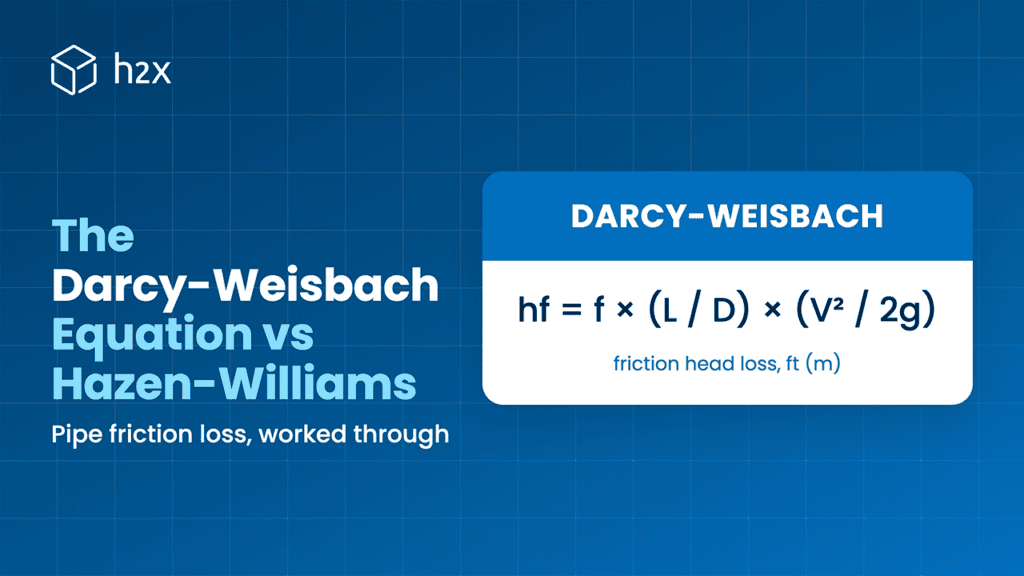
The Darcy-Weisbach equation calculates pipe friction head loss for any fluid from a friction factor, while the Hazen-Williams formula is a simpler empirical fit for water only. Both feed the same design decisions: pipe size, pump head and whether the index run still delivers enough pressure.
But the choice matters most when the fluid isn’t cold water. Hazen-Williams has no term for temperature or viscosity. On a heating hot water loop, it can overstate friction by a quarter or more. And that error carries straight into the pump selection.
This guide gives both formulas in US and metric units and compares them. Then it works one pipe through both at two water temperatures. The discipline is plumbing and HVAC in the US. It’s public health engineering (PHE) and mechanical in the UK, and hydraulic engineering in Australia and New Zealand (ANZ). Still, the equations are the same everywhere.
Quick Answer: The Darcy-Weisbach equation, hf = f (L/D)(V²/2g), gives friction head loss for any fluid and temperature, using a friction factor from the Colebrook equation or the Moody chart. The Hazen-Williams formula is a simpler empirical fit for water near 60 °F (15.6 °C) at ordinary velocities. Use Darcy-Weisbach for hot water, glycol or high velocities.
What Is the Darcy-Weisbach Equation?
In the Darcy-Weisbach equation, friction head loss rises with pipe length, the square of velocity and a dimensionless friction factor. It falls as the diameter grows. It works for any Newtonian fluid, because fluid properties enter through the friction factor.
hf = f × (L / D) × (V² / 2g)
Δp = f × (L / D) × (ρV² / 2)| Symbol | Meaning | US unit | Metric (SI) unit |
|---|---|---|---|
| hf | Friction head loss | ft | m |
| Δp | Friction pressure loss | lb/ft² (divide by 144 for psi) | Pa |
| f | Darcy friction factor | dimensionless | dimensionless |
| L | Pipe length | ft | m |
| D | Internal diameter | ft | m |
| V | Mean velocity | ft/s | m/s |
| g | Gravitational acceleration | 32.174 ft/s² | 9.80665 m/s² |
| ρ | Fluid density | lb/ft³ | kg/m³ |
The friction factor depends on the Reynolds number, Re = ρVD / μ, and on the pipe’s relative roughness, ε/D. In laminar flow it’s simply f = 64 / Re. Almost every building water system runs in turbulent flow. There, you solve the Colebrook equation by iteration or read f off a Moody chart:
1 / √f = −2 log₁₀( ε / (3.7D) + 2.51 / (Re √f) )
Here μ is dynamic viscosity and ε is the pipe’s absolute roughness. Our friction factor guide covers the Colebrook, Swamee-Jain and Moody methods in detail.
What Is the Hazen-Williams Formula?
The Hazen-Williams formula is an empirical equation for water flowing in full pipes. It swaps the friction factor for a single roughness coefficient, C. So you can solve it in one step, with no Reynolds number and no iteration.
In the US, the usual form is the one NFPA 13 (2025 edition) uses for sprinkler calculations. It gives pressure loss per foot of pipe:
p = 4.52 × Q^1.85 / (C^1.85 × d^4.87)
Here p is the friction loss in psi per ft, and Q is the flow in gpm. C is the Hazen-Williams coefficient, and d is the internal diameter in inches.
The SI form gives head loss over the whole pipe, so convert L/s to m³/s first:
hf = 10.67 × L × Q^1.852 / (C^1.852 × D^4.87)
In this form hf is in m, L in m, Q in m³/s and D in m. The two forms round their exponents differently, but for the same pipe they agree within about 1%.
A higher C means a smoother pipe and so less friction. These are the values NFPA 13 sets for sprinkler pipe:
| Pipe | Hazen-Williams C |
|---|---|
| Copper tube, stainless steel, CPVC | 150 |
| Black steel, wet systems | 120 |
| Black steel, dry systems | 100 |
How Do the Two Equations Compare?
The Darcy-Weisbach equation is the more general method, but Hazen-Williams is the quicker one. The ASPE comparison of the two sets out where each one holds, and this table follows it.
| Factor | Darcy-Weisbach | Hazen-Williams |
|---|---|---|
| Fluids | Any Newtonian fluid, including glycol mixes | Water only |
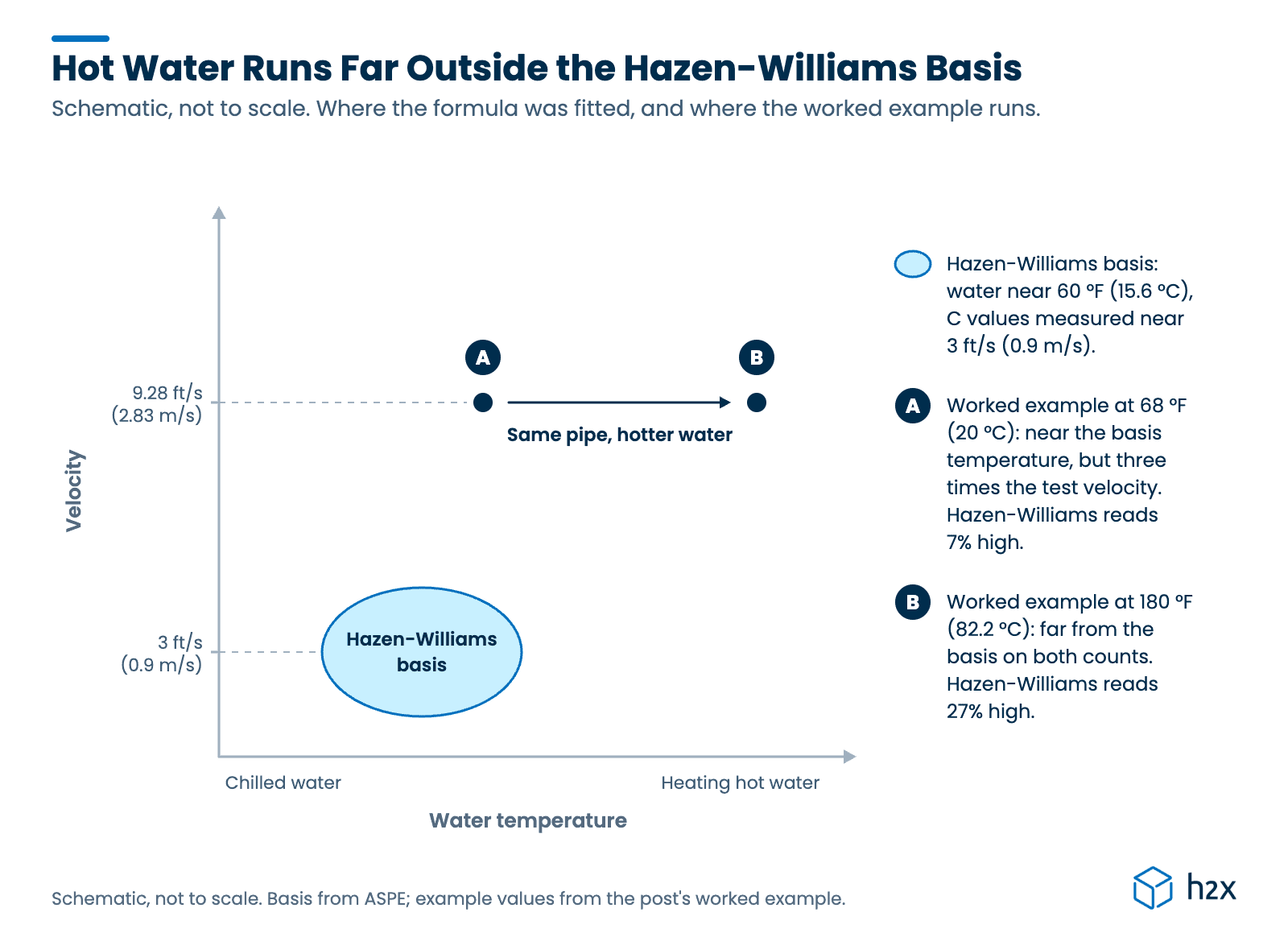
| Temperature | Enters through density and viscosity | No term; assumes water near 60 °F (15.6 °C) |
| Velocity | Valid across the turbulent range | C values hold near the velocity they were measured at, about 3 ft/s (0.9 m/s) |
| Pipe size | Valid for all sizes | Less accurate in large pipes |
| Inputs | Roughness, density, viscosity, velocity | C value, flow, diameter |
| Effort | Iterative friction factor | One step |
| Where codes call for it | NFPA 750 (2027 edition) water mist above 25 ft/s (7.6 m/s) | NFPA 13 sprinkler calculations |
So the real question isn’t which equation is better. It’s whether your fluid and operating point sit inside the narrow range Hazen-Williams was fitted to.
Which Equation Should You Use for HVAC and Plumbing Systems?
Use Darcy-Weisbach by default, and keep Hazen-Williams for cold water and for fire systems where the code calls for it. Here’s how that plays out by system.
| System | Typical fluid | Recommended method | Why |
|---|---|---|---|
| Domestic cold water | Water near mains temperature | Either | Close to the Hazen-Williams basis of about 60 °F (15.6 °C) |
| Domestic hot water | Hot water | Darcy-Weisbach | Viscosity falls as water heats, and Hazen-Williams can’t follow it |
| Heating hot water | Water up to 180 °F (82.2 °C) | Darcy-Weisbach | The worked example below shows a 27% gap at 180 °F (82.2 °C) |
| Chilled water | Water below 60 °F (15.6 °C) | Darcy-Weisbach | Colder than the Hazen-Williams basis, so viscosity is higher |
| Glycol loops | Water and glycol mix | Darcy-Weisbach | Hazen-Williams doesn’t apply to fluids other than water |
| Fire sprinklers | Water | Hazen-Williams | NFPA 13 uses it for hydraulic calculations |
| Water mist | Water | Darcy-Weisbach above 25 ft/s (7.6 m/s) | NFPA 750, as set out by ASPE |
For fire sprinklers, though, the simplicity is worth the trade. ASPE’s author puts Hazen-Williams within about 10% of Darcy-Weisbach for fire protection piping, which is acceptable at sprinkler design margins.
In the UK, CIBSE Guide C (2007 edition) Chapter 4 gives the reference data for pressure drop in pipework. In Australia and New Zealand, AS/NZS 3500.1:2025 sets the design requirements for cold water services. Check which friction method your authority accepts before you submit.
Hazen-Williams vs Darcy-Weisbach Worked Example
This illustrative example runs one straight copper pipe through both equations, first with cold water and then with heating hot water. Water properties come from the NIST Chemistry WebBook, and fittings are left out so the two methods compare like for like.
| Input | US | Metric |
|---|---|---|
| Flow, Q | 793 gpm | 50 L/s (0.05 m³/s) |
| Length, L | 1,640 ft | 500 m |
| Internal diameter, D | 5.91 in | 150 mm |
| Pipe | Copper, C = 150 | Copper, C = 150 |
| Absolute roughness, ε | 0.000005 ft | 0.0015 mm |
Step 1. Velocity
First, the cross-sectional area is 0.1902 ft² (0.01767 m²). Dividing the flow by that area gives a velocity of 9.28 ft/s (2.83 m/s). That’s three times the velocity Hazen-Williams C values were measured at, so expect the two methods to drift apart.
Step 2. Hazen-Williams
With the NFPA 13 form, the loss is 0.0173 psi per ft (0.391 kPa/m), so 28.3 psi (195 kPa) over 1,640 ft (500 m). As head, that’s 65.5 ft (19.95 m). Temperature doesn’t appear anywhere, so the answer is the same for cold and hot water.
Step 3. Darcy-Weisbach with Water at 68 °F (20 °C)
At 68 °F (20 °C), NIST gives a density of 62.32 lb/ft³ (998.2 kg/m³). The dynamic viscosity is 6.73 × 10⁻⁴ lb/(ft·s) (1.0016 mPa·s), so the Reynolds number is about 423,000, well into turbulent flow.
Solving Colebrook with ε/D = 0.00001 gives f = 0.0137. A perfectly smooth pipe gives 0.0136, so roughness barely matters in drawn copper. The head loss is then:
hf = 0.0137 × (1,640 / 0.4921) × (9.28² / (2 × 32.174)) = 61.1 ft (18.63 m)
Step 4. Darcy-Weisbach with Water at 180 °F (82.2 °C)
At 180 °F (82.2 °C), NIST gives 60.58 lb/ft³ (970.4 kg/m³) and 2.32 × 10⁻⁴ lb/(ft·s) (0.3445 mPa·s). Viscosity has dropped to about a third. So the Reynolds number rises to about 1.2 million, and the friction factor falls to 0.01155.
hf = 0.01155 × (1,640 / 0.4921) × (9.28² / (2 × 32.174)) = 51.5 ft (15.71 m)
Results
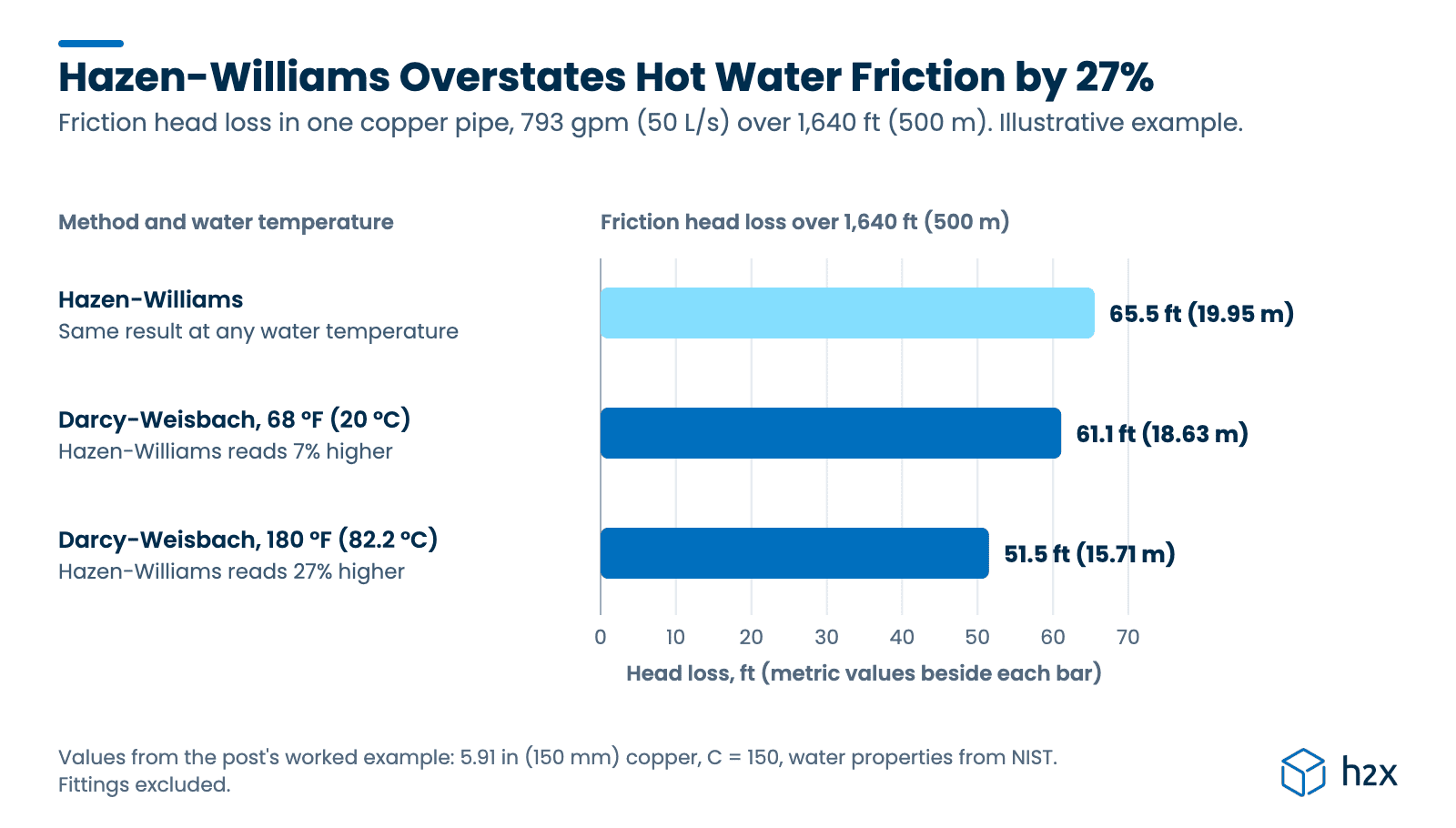
With cold water, then, the two methods sit within 7%, which is close enough for most cold water sizing. With 180 °F (82.2 °C) heating water, Hazen-Williams overstates the loss by 27%. If you carry that into a pump selection, the pump runs well past its design point once the system is up to temperature.
Common Mistakes
- Mixing up Darcy and Fanning friction factors. The Darcy factor is four times the Fanning factor. Check which one a chart or spreadsheet gives before you use it.
- Using Hazen-Williams for glycol. It only applies to water, so use Darcy-Weisbach with the mixture’s own density and viscosity.
- Applying a C value far from its test velocity. C values come from tests near 3 ft/s (0.9 m/s). Bentley’s analysis shows the error grows as you move away from that point.
- Mixing unit forms. The 4.52 constant takes gpm and inches and gives psi per ft. The 10.67 constant takes m³/s and m, so pick one form and keep to it.
- Using cold water properties for hot water. Look up density and viscosity at the design temperature, or try our pressure drop calculator. The effect of water temperature on friction loss is bigger than most designers expect.
- Forgetting fittings and valves. Both equations give straight-pipe friction only. Add fittings by equivalent length, and size valves from their flow coefficient.
How h2x Helps with Pipe Friction Loss
h2x engineering software calculates pipe friction with the Darcy-Weisbach equation, at the fluid temperature you set. So a heating loop and a chilled water loop each get friction losses at their own design temperature, not at 60 °F (15.6 °C).
It sizes pipes as you draw them, by maximum velocity, maximum pressure drop or both, using the Pipe Sizing Method setting. It adds the pressure loss of each pipe and component along the run, and the index path updates when the layout changes.
h2x has been used to size thousands of pipes and ducts across the world. A senior engineer can open the project and see every pipe size, flow rate and pressure drop in one place. You still set the limits and the design margin, but the arithmetic is no longer where errors creep in.
Key Takeaways
Darcy-Weisbach works for any fluid at any temperature, and Hazen-Williams is a one-step shortcut that holds for cold water at ordinary velocities. Use the shortcut where it fits and the code asks for it, and use Darcy-Weisbach everywhere else.
- Darcy-Weisbach:
hf = f (L/D)(V²/2g), with f from the Colebrook equation or a Moody chart. - Hazen-Williams:
p = 4.52 Q^1.85 / (C^1.85 d^4.87)in psi per ft, with C = 150 for copper under NFPA 13. - Temperature: Hazen-Williams assumes water near 60 °F (15.6 °C) and has no viscosity term.
- Worked example: for one copper pipe, Hazen-Williams read 7% high at 68 °F (20 °C) and 27% high at 180 °F (82.2 °C).
- Codes: NFPA 13 uses Hazen-Williams for sprinklers, while NFPA 750 calls for Darcy-Weisbach above 25 ft/s (7.6 m/s).
- h2x: h2x calculates friction with Darcy-Weisbach at the fluid temperature you set, and sizes each pipe by velocity, pressure drop or both.
FAQ
Is Darcy-Weisbach more accurate than Hazen-Williams?
Yes, across most conditions. The Darcy-Weisbach equation accounts for the fluid’s density and viscosity through the friction factor, so it stays valid for hot water, chilled water and glycol. Hazen-Williams is an empirical fit for water near 60 °F (15.6 °C). ASPE puts the two within about 10% for fire protection piping, and this guide’s example found 7% with cold water.
Can you use Hazen-Williams for hot water?
You can, but it will overstate friction loss, because hot water is less viscous than the water the formula was fitted to. In this guide’s worked example, Hazen-Williams read 27% higher than Darcy-Weisbach with 180 °F (82.2 °C) water. For heating hot water and domestic hot water, use Darcy-Weisbach with properties at the design temperature.
What is the Hazen-Williams C value for copper?
NFPA 13 sets C = 150 for copper tube, the same as stainless steel and CPVC. Black steel is 120 in wet sprinkler systems and 100 in dry ones. Outside fire protection, check the value your design guide or authority uses. Remember too that C values were measured near 3 ft/s (0.9 m/s).
Why is the Darcy friction factor four times the Fanning factor?
They’re defined differently. The Fanning factor relates wall shear stress to the flow’s dynamic pressure. The Darcy factor relates head loss over a length of pipe to velocity head and diameter. So the Darcy value is exactly four times the Fanning value, and mixing them up gives a fourfold error.
Does h2x use Darcy-Weisbach or Hazen-Williams?
h2x uses the Darcy-Weisbach equation for pipe friction, and you set the fluid temperature, so losses follow the water’s real density and viscosity. It sizes each pipe as you draw, by maximum velocity, maximum pressure drop or both, and adds component losses along the run. Every pipe’s flow rate and pressure drop stays visible for review.
See Pipe Sizing Done as You Draw
h2x sizes every pipe with Darcy-Weisbach at your design temperature, as you lay it out. Every pipe size, flow rate and pressure drop stays in one place for review.
Meet the author

Jonathan Mousdell
Jonathan Mousdell is a Mechanical Engineer and co-founder of h2x, where he creates technical content and resources for MEP engineers.
Article published: April 26, 2023
Last updated: October 13, 2026