Why Is Residual Water Pressure Important in Plumbing Systems?
Residual water pressure is the pressure available while water is flowing. Learn what affects it, why low pressure matters and how to improve it.
Residual water pressure is the pressure available at a point in a water system while water is flowing. It shows whether enough pressure remains to serve an outlet or component after accounting for pressure losses through pipes, valves, fittings, equipment and changes in elevation.
This makes residual pressure an important part of plumbing system design. A system can have plenty of pressure when no water is being used but still struggle to provide the required pressure when demand increases.
This guide explains what residual water pressure is, why it matters, what causes it to fall and what designers can do when the available pressure is too low. For the complete calculation method and worked example, see our guide on how to calculate residual and static water pressure.
Quick Answer: Residual water pressure is the pressure available while water is flowing under a specified operating condition. As water moves through a system, pressure is lost through pipes, valves, fittings and other components, while elevation can increase or decrease the pressure available. Designers check residual pressure to make sure outlets and equipment still receive their required inlet pressure when the system is operating.
Key Takeaways
- Residual pressure is the pressure available at a point while water is flowing.
- Designers should consider residual pressure together with the flow rate and location at which it applies.
- Pressure losses through pipes, valves, fittings and equipment reduce the pressure available downstream.
- Elevation also affects residual pressure, with higher outlets generally having less pressure available from the same supply.
- Higher flow rates generally increase flow-dependent pressure losses.
- Low residual pressure can prevent outlets and components from receiving their required inlet pressure.
- Possible solutions include reducing system losses, changing component selections or providing additional pressure with a booster pump.
- Any pressure-boosting solution should also be checked under static conditions to make sure maximum pressure limits are not exceeded.
What Is Residual Water Pressure?
Residual water pressure is the pressure remaining at a particular point in a water system while water is flowing.
The flow condition matters. A residual pressure value only becomes meaningful when you consider the flow rate and location at which it applies. Pressure available under a low-flow condition may be very different from the pressure available when several outlets are operating at the same time.
For design purposes, designers commonly check residual pressure at the required or peak design flow condition. Under that condition, it can represent the lowest operating pressure that the designer needs to assess, but residual pressure should not simply be defined as the lowest possible pressure in every situation.
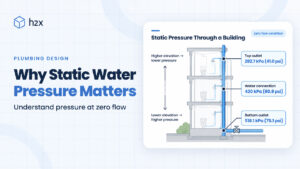
This is different from static pressure, which applies when there is no flow. With no water moving, flow-dependent pressure losses disappear, so a system can experience low residual pressure during periods of demand while also experiencing excessive static pressure when demand falls to zero.
For a side-by-side comparison of the two conditions, see our guide on how to calculate residual and static water pressure. For more on the zero-flow condition, see why static water pressure is important in plumbing systems.
What Does Residual Pressure Mean in a Hydrant Flow Test?
The term is also used in fire-water testing. The principle is similar: residual pressure describes pressure at a specified point while water is flowing. In a hydrant flow test, however, engineers use pressure and flow measurements to assess the available water supply for fire protection.
The US Fire Administration’s guide to water supply system evaluation provides examples of static and residual pressure measurements during hydrant flow testing. This article focuses on residual pressure within building water distribution systems.
Why Is Residual Water Pressure Important?
Outlets, valves, appliances and other components may require a minimum inlet pressure to operate as intended.
It is therefore not enough to know that the building has adequate pressure when little or no water is being used. The design also needs to demonstrate that sufficient pressure remains when water is flowing through the system.
If the available residual pressure falls below the requirement of the outlet or component, the result may include:
- reduced flow or poor outlet performance;
- equipment operating outside its specified inlet pressure range;
- difficulty serving outlets at higher elevations or at the end of high-loss flow paths; and
- failure to meet applicable manufacturer, project or regulatory requirements.
There is no single minimum residual pressure that applies to every outlet or water system. Designers should use the pressure requirements of the actual outlets and components, together with the standards and project requirements that apply.
What Causes Residual Pressure to Drop?
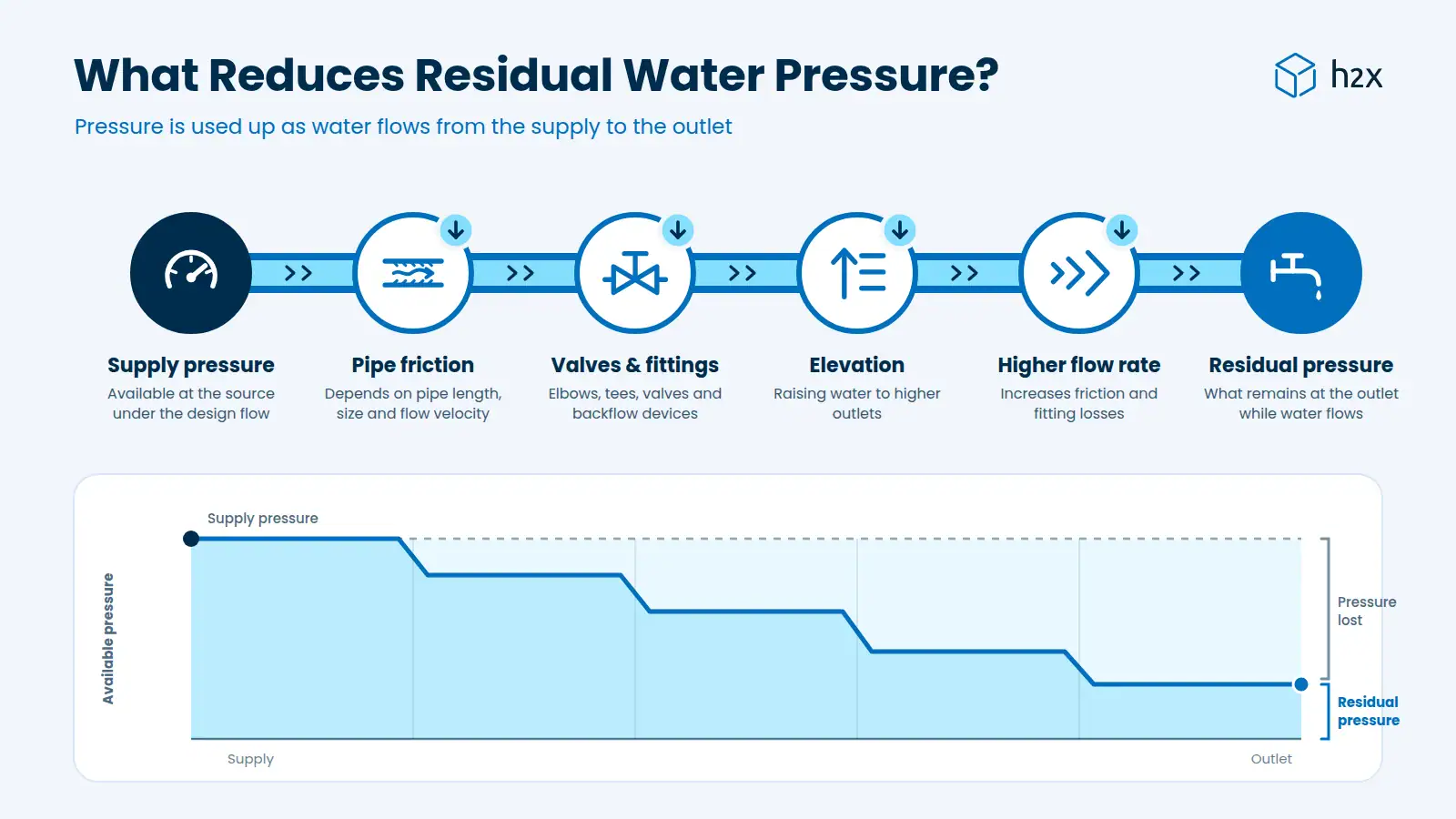
Residual pressure depends on both the pressure available from the supply and the pressure consumed as water travels to the outlet.
Supply Pressure
The calculation starts with the pressure available from the water supply under the relevant flow condition. Using the static supply pressure for a residual-pressure check can overstate how much pressure will actually be available while the system is operating.
Pipe Friction
Water loses pressure as it flows through pipes. The amount of friction loss depends on factors including the flow rate, pipe size, pipe length and internal characteristics of the pipe.
Increasing pipe size can reduce velocity and friction loss, which may leave more residual pressure available downstream.
Valves, Fittings and Equipment
Elbows, tees, valves, backflow devices and other components add resistance to the flow path. Individually some losses may be small, but together they can consume a significant part of the available pressure.
Elevation
Elevation changes pressure regardless of pipe friction. An outlet above the supply connection generally has less pressure available because raising water through the building consumes some of the available pressure.
For water, the pressure change caused by elevation is approximately 9.81 kPa per m (0.433 psi per ft).
Flow Rate
As flow increases, flow-dependent pressure losses generally increase. Designers should therefore assess residual pressure at a realistic design flow condition rather than assume that a low-demand pressure reading will remain available during peak use.
Where Should Residual Pressure Be Checked?
Designers should check residual pressure at the outlets and components that are most difficult to serve under the design flow condition.
The critical location is not necessarily the outlet that is physically furthest from the supply. It may instead be the point with the greatest combination of:
- elevation increase;
- pipe friction;
- valve and fitting losses;
- equipment pressure losses; and
- required inlet pressure.
Critical outlets with specific minimum pressure requirements should also be checked individually.
The Residual Pressure Balance
Residual pressure is the supply pressure under the design flow condition, minus the losses along the flow path, adjusted for elevation:
Residual pressure at outlet = Supply residual pressure − Flow-dependent pressure losses ± Elevation pressure change
Flow-dependent losses can include pressure lost through pipes, valves, fittings and other equipment.
You can use our Pressure Drop Calculator to calculate pressure loss through a pipe.
For the complete calculation process, formulas and worked example, read how to calculate residual and static water pressure.
What Happens If Residual Pressure Is Too Low?
If the calculated pressure at an outlet is below its required minimum inlet pressure, review the flow path and available pressure supply.
The correct solution depends on what is consuming the available pressure. Simply adding a booster pump should not be the automatic first response.
Potential options include:
| Possible Cause | Effect on Residual Pressure | Possible Design Response |
|---|---|---|
| High pipe friction | Consumes more of the available pressure along the flow path | Review pipe sizes, lengths and flow velocities |
| High-loss valves or equipment | Creates additional pressure loss while water is flowing | Review component selections and manufacturer pressure-loss data |
| Large elevation increase | Reduces the pressure available at higher outlets | Review pressure zoning or provide additional pressure where required |
| Low supply pressure under flow | Leaves less pressure available before system losses are applied | Verify the available supply pressure and consider boosting where necessary |
| High design flow rate | Increases flow-dependent pressure losses through the system | Review the design flow assumptions and system sizing |
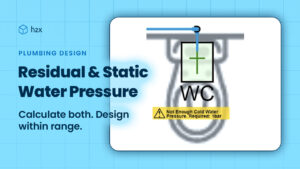
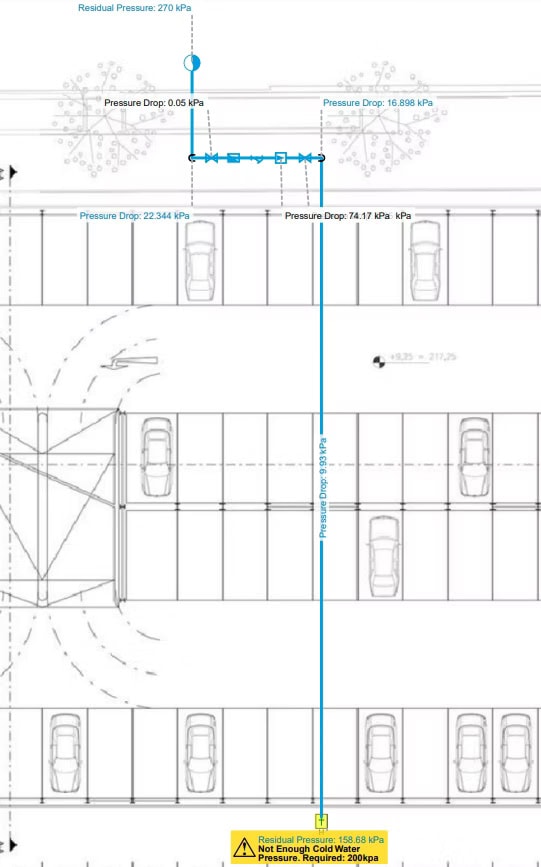
In the h2x example below, pressure losses through the system leave the outlet with approximately 158.7 kPa (23.0 psi) of residual pressure, below its required minimum of 200 kPa (29.0 psi).
Can a Booster Pump Improve Residual Pressure?
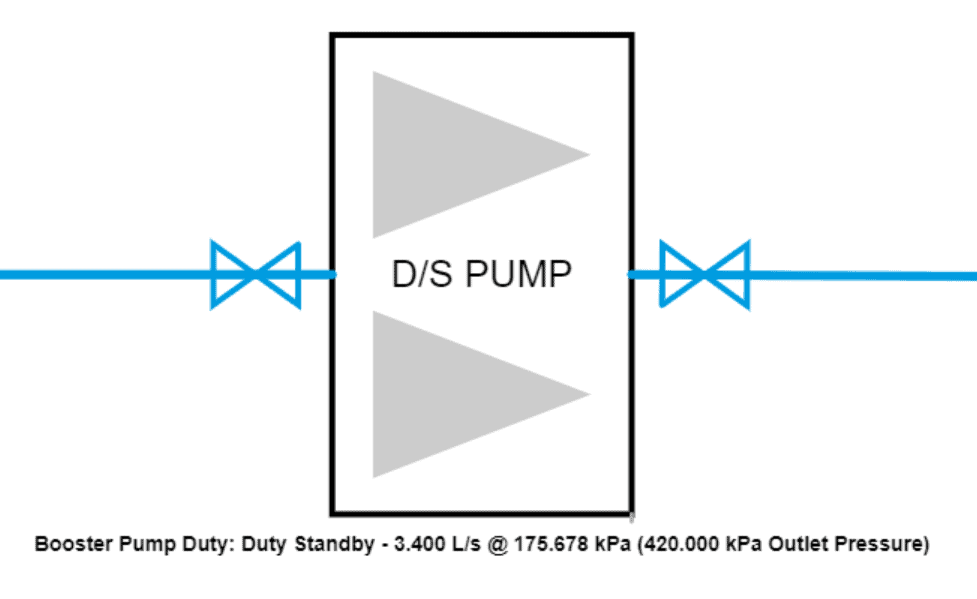
Yes. A booster pump can increase the pressure available downstream and may be required where the existing supply cannot provide sufficient pressure at the design flow condition.
However, adding a pump changes the system pressure conditions. After adding a booster pump, check the design again under both flowing and zero-flow conditions. Depending on the pump, controls and system arrangement, increasing residual pressure can also affect the pressure experienced when demand is low or zero.
Which Fixes for Low Residual Pressure Affect Static Pressure?
Residual pressure answers one question: is enough pressure available while the system is operating? Static pressure answers another: does the pressure stay below allowable limits when there is no flow?
Fixes that reduce flow-dependent losses, such as larger pipes or lower-loss valves and fittings, increase residual pressure without changing static pressure. Those losses only occur while water is flowing, so removing them has no effect at zero flow.
Fixes that add pressure, such as a booster pump, can increase both, depending on the pump and its controls. Where static pressure is already close to the maximum allowed by downstream components, reducing losses may solve a low residual-pressure problem without creating a high static-pressure problem.
How h2x Helps Check Residual Pressure
Manually recalculating pressure every time a pipe size, valve, fitting or system layout changes can become time-consuming.
h2x calculates pressure through the water system as part of the design workflow, taking account of the pressure available from the source and losses through the system. This makes it easier to identify outlets where the available pressure falls outside the requirements assigned to the design.
See how pressure calculations work as part of the h2x water design workflow:
As the layout changes, designers can review the pressure calculations alongside pipe sizes, flow rates and other system results.
Conclusion
Residual water pressure shows how much pressure remains at an outlet or component while the system is operating.
It is affected by the pressure available from the supply, the flow rate, friction through pipes, losses through valves and fittings, equipment and changes in elevation.
Designers should check residual pressure at the relevant operating condition and compare the result with the minimum inlet pressure required by the component being served. Where the pressure is too low, identify the cause of the loss before deciding whether the system needs larger pipes, lower-loss components, a different arrangement or additional pressure from a booster pump.
Frequently Asked Questions
Does increasing pipe size improve residual pressure?
It can. Increasing pipe size generally reduces water velocity and friction loss at the same flow rate, which can leave more pressure available downstream. The effect depends on the complete flow path and system conditions.
Is the furthest outlet always the one with the lowest residual pressure?
No. The critical outlet depends on the combined pressure losses and elevation along its flow path together with its required inlet pressure. A closer outlet at a higher elevation or behind high-loss components can sometimes be more difficult to serve.
Can residual pressure change during the day?
Yes. The pressure available from the water supply and the demand within the building can both change over time. Designers should therefore assess residual pressure using supply and flow conditions that are appropriate for the design.
Can a pressure reducing valve affect residual pressure?
Yes. A pressure reducing valve controls downstream pressure and also creates a pressure change while water is flowing. Designers should account for the valve’s operating characteristics and pressure loss when checking the residual pressure available downstream.
Check Water Pressure as You Design
h2x calculates pressure throughout your water system as the design changes, helping you identify outlets that may not have enough pressure under operating conditions.
Meet the author

Daniel Mousdell
Daniel Mousdell is the Founding Marketer at h2x, where he creates technical content and resources for HVAC and MEP engineers. Outside of work, he runs LilWayneHQ.
Article published: November 17, 2022
Last updated: October 8, 2026
Technically reviewed by: Jonathan Mousdell, Mechanical Engineer and Co-founder at h2x