Do Heat Pumps Work in Cold Weather? How They Extract Heat From Air Below 0°F
Yes, heat pumps can work below 0°F (-18°C). Here's how cold-climate systems extract heat, maintain capacity, and handle defrost cycles.
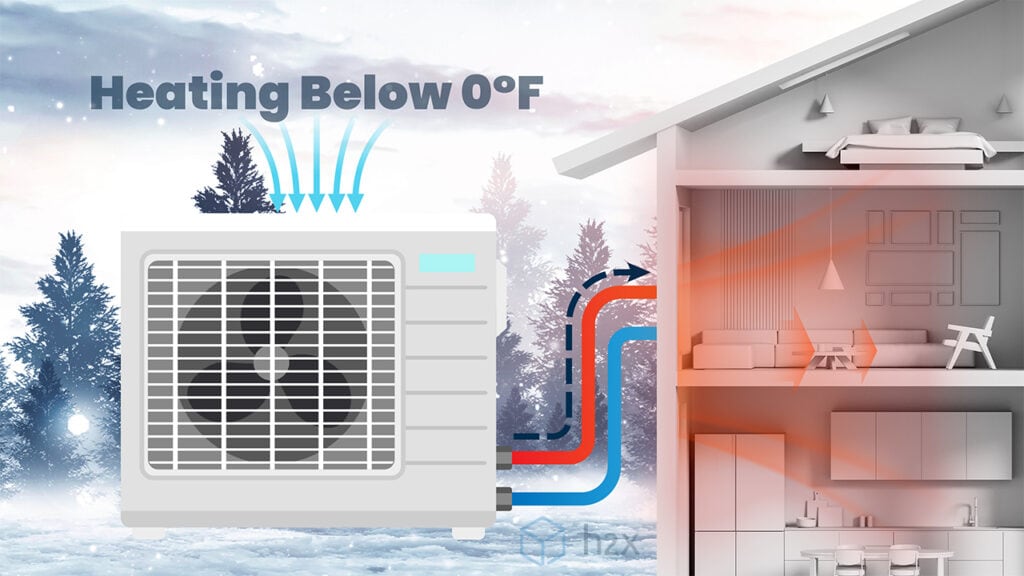
Do heat pumps work in cold weather? Yes, heat pumps work in cold weather, including temperatures below 0°F (-18°C). The bigger question for many building owners and engineers is how a heat pump can extract heat from air that feels bitterly cold. Reason might lead one to believe that no meaningful amount of heat could be extracted from cold air. However, the actual answer is more complicated, and requires understanding what “cold” means thermodynamically.
For engineers, the answer to do heat pumps work in cold weather depends less on whether heat exists in the air, and more on refrigerant actions, compressor design, defrost control, and system sizing.
Why cold air still contains extractable heat
Temperature is a measure of molecular kinetic energy. Absolute zero — -459.67°F (0 K) — is the only temperature at which a substance contains zero thermal energy. Outdoor air at -10°F (-23°C) is still about 450°F above absolute zero, or roughly 250 K. As such, it contains substantial thermal energy.
While energy is present and available for extraction, considerable engineering challenges remain. Extraction requires a working fluid that can evaporate at a temperature below the ambient air temperature.
How the vapor compression cycle extracts heat in cold weather
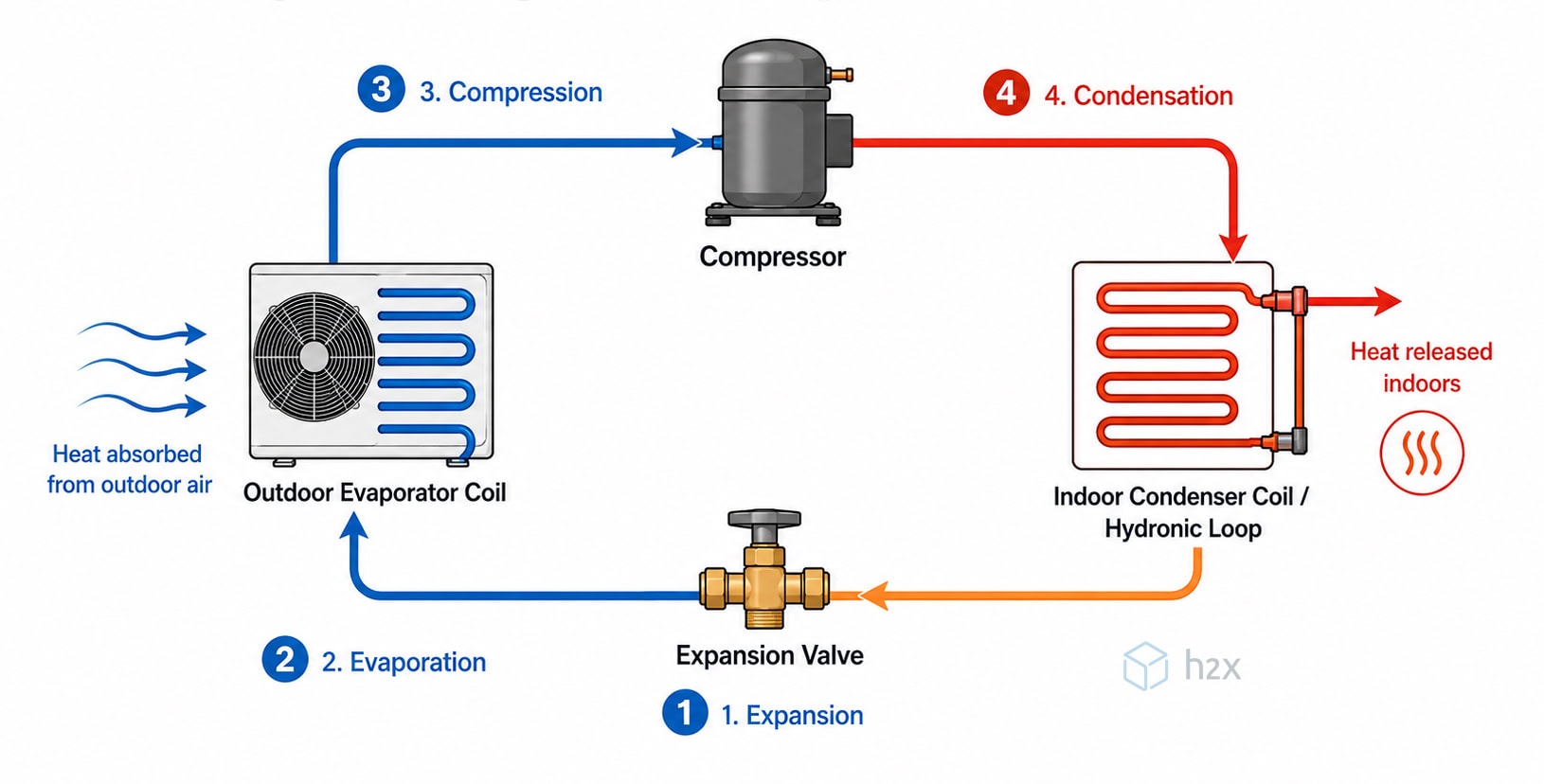
Heat pumps operate on the vapor compression refrigeration cycle, which has four distinct stages:
1. Expansion
High-pressure liquid refrigerant passes through an expansion valve. Pressure drops rapidly, causing the refrigerant temperature to fall well below the ambient outdoor air temperature. In cold-climate operation, the refrigerant may be at -20 to -30°F (-29 to -34°C) when leaving the expansion valve.
2. Evaporation
Next, the cold, low-pressure refrigerant enters the outdoor heat exchanger (the evaporator coil). Because the refrigerant is colder than the outdoor air — even when that air is at 0°F or below — heat flows from the air into the refrigerant. This is explained by the second law of thermodynamics, where heat always flows from higher temperatures to lower temperatures. In this scenario, refrigerant provides the lower temperature sink. The refrigerant absorbs this heat as latent heat of evaporation, changing from liquid to vapor without a significant rise in temperature.
3. Compression
The low-pressure refrigerant vapor then enters the compressor. There, its pressure and temperature increase dramatically through compression. After compression, the refrigerant may be at 140–180°F (60–82°C) or higher. Along with the heat pulled from outside, the electrical energy used by the compressor is also added to the heat transfer.
4. Condensation
Finally, the hot, high-pressure vapor enters the indoor heat exchanger (the condenser). Once there, it releases its latent heat of condensation into the hydronic loop, warming the water distribution system. The refrigerant condenses back to liquid, and the cycle repeats.
Maintaining a positive temperature differential
We can observe the second law of thermodynamics most clearly in step 2. The heat pump system does not need the outdoor air to be “warm” in terms of warmth that we can physically sense. Rather, it only needs the outdoor air to be warmer than the refrigerant in the evaporator.
By selecting refrigerants with appropriate pressure-temperature relationships and engineering the expansion stage to produce sufficiently cold refrigerant, manufacturers can maintain a positive temperature differential at the evaporator. This enables continuous heat extraction at outdoor temperatures well below 0°F.
Enhanced vapor injection: how cold-climate heat pumps maintain output
Standard single-stage vapor compression cycles lose efficiency rapidly as outdoor temperatures drop. This is because the pressure ratio between the evaporator and condenser increases, demanding more compressor work per unit of heat moved. Modern cold-climate heat pumps compensate for this through Enhanced Vapor Injection (EVI), also called vapor injection or economized compression.
In an EVI system, a secondary expansion valve and heat exchanger are added to the refrigerant circuit. A portion of the liquid refrigerant is flash-evaporated in this intermediate stage, cooling the remaining refrigerant before it enters the main evaporator. The flash vapor — now at an intermediate pressure — is injected directly into the compressor at mid-stroke through a dedicated port.
The effects of EVI are significant:
- Higher discharge temperature: The injected vapor raises the refrigerant temperature at the compressor discharge, when it is at its hottest. This enables the system to maintain adequate condensing temperature at high external heat demands even in very cold conditions.
- Increased mass flow through the condenser: More refrigerant mass participates in heat rejection, increasing heating capacity without increasing compressor displacement.
- Improved COP at low ambient temperatures: The intermediate injection reduces the effective pressure ratio the compressor must work against, improving the thermodynamic efficiency of the compression process.
Many cold-climate systems can maintain useful heating output at outdoor temperatures around -13 to -22°F (-25 to -30°C), although COP and capacity vary by manufacturer, model, and design condition. This level of performance with an EVI system was simply not achievable with the single-stage designs that earned air-source heat pumps their reputation for cold weather unreliability in the 1980s and 1990s.
How inverter-driven compressors help heat pumps work in cold weather
The second major technological development enabling cold-climate heat pump performance is the variable-speed inverter-driven compressor.
As the name suggests, fixed-speed compressors operate at full capacity or not at all. In fact, partial load conditions represent the majority of annual operating hours in most climates, rather than peak load conditions. Under these partial load conditions, a fixed-speed compressor is mechanically forced to cycle. It loses efficiency at each start and stop, creating the temperature instability described in the context of thermal mass.
An inverter-driven compressor modulates its speed continuously to match the real-time heating load. In mild conditions, it runs slowly and at a very high COP. Then, as the load increases with falling outdoor temperature, it ramps up. The system operates across a continuous capacity range, most often 10–120% of rated capacity, matching output to demand without cycling. This part-load efficiency is where inverter systems deliver their greatest advantage. It is the reason seasonal performance metrics (like HSPF2 or seasonal COP) are more promising than rated-condition snapshots suggest.
How defrost cycles affect heat pumps in cold weather
One operational reality of heat pumps that often surprises building owners in cold climates is the defrost cycle. When the outdoor heat exchanger extracts heat from cold air that is humid, the moisture in that air freezes onto the evaporator coil. This can act as an insulating layer. Left unchecked, frost buildup reduces heat transfer and eventually blocks airflow entirely, causing the system to stop working. ASHRAE notes that defrost cycles are necessary to clear frost from outdoor coils, but excessive defrosting can reduce heat pump efficiency.
Reverse-cycle defrosting
Modern cold-climate heat pumps manage this potential hazard automatically through reverse-cycle defrosting. The system briefly switches to cooling mode, redirecting hot refrigerant through the outdoor coil to melt accumulated frost, then returns to heating operation. A full defrost cycle typically takes about 10 minutes and occurs as needed based on coil temperature sensors and time-based controls. During defrost, some units supplement heating output with electric resistance elements to prevent a noticeable drop in supply temperature. This is an important consideration when sizing backup heat capacity for the building.
The frequency and duration of defrost cycles depend on outdoor temperature and relative humidity. At temperatures around 28–35°F (-2 to 2°C) with high humidity, frost accumulates rapidly and defrost events are more frequent. At very low temperatures (e.g. below 15°F (-9°C)) the air holds less moisture, so frosting is actually less aggressive, despite the colder conditions. Understanding this curve helps engineers accurately predict seasonal performance rather than relying on rated-condition efficiency figures alone.
Backup heat and system sizing in cold climates
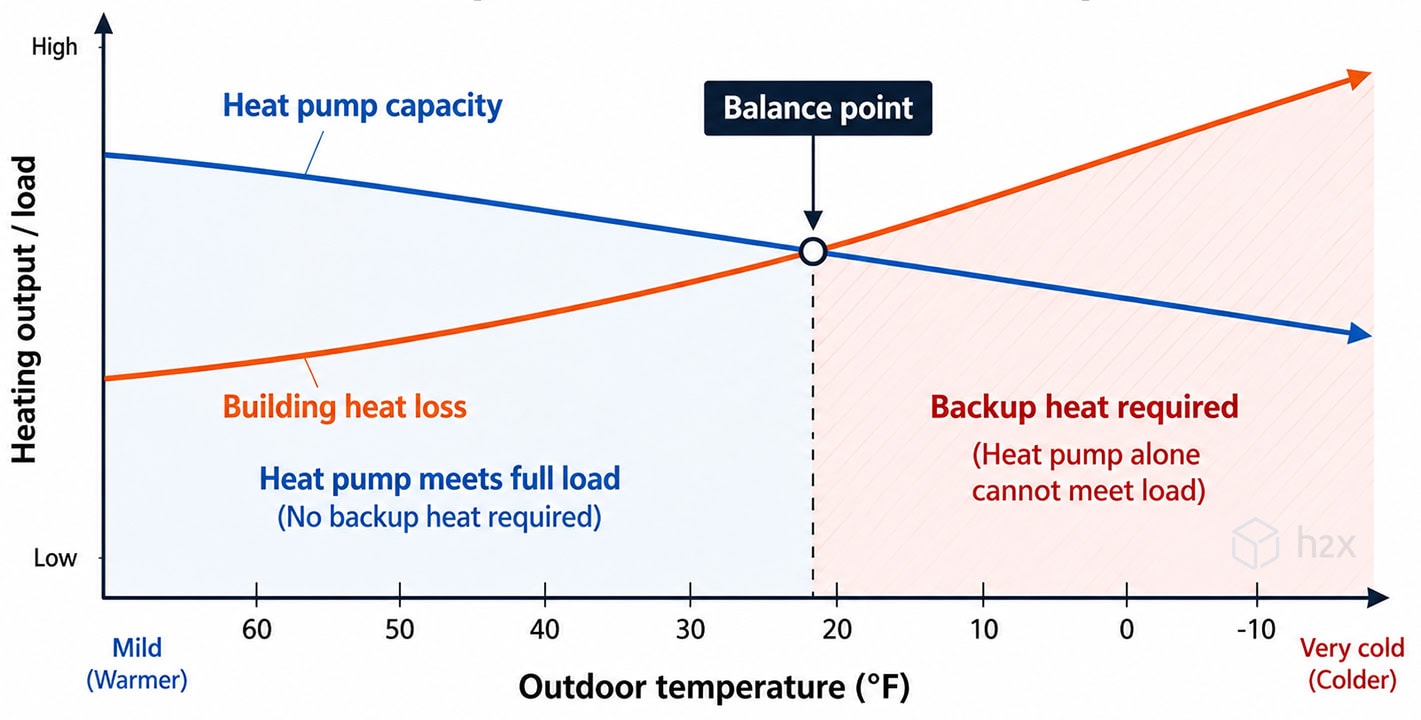
Every cold-climate heat pump installation has a balance point: the outdoor temperature at which the heat pump’s output exactly matches the building’s heat loss. Above that temperature, the heat pump handles the full load. Below it, the system either falls short or relies on supplemental heat to make up the difference. Identifying this balance point accurately is one of the most important steps in cold-climate heat pump system design. Erring in either direction would have significant consequences.
Supplemental heat most commonly takes the form of electric resistance elements integrated into the air handler or hydronic buffer tank. These are simple, inexpensive, and responsive, but they operate at a COP of 1.0. That means every unit of electrical input delivers exactly one unit of heat, without the multiplication effect the heat pump provides. Over a heating season, heavy reliance on resistance backup can erode the efficiency gains that initially justified the heat pump investment. The goal in system sizing is to push the balance point as low as practically possible, reducing the time that resistance heat is active.
Dual-fuel configurations
The alternative to resistance backup is a dual-fuel configuration, which would involve pairing the heat pump with a gas or propane furnace. In climates where natural gas is available and electricity prices are high, dual-fuel systems can offer the best seasonal economics. In this scenario, the heat pump handles the majority of hours at high efficiency. The furnace takes over only during the coldest periods, when it can do so more cheaply than resistance heat.
Engineers specifying dual-fuel systems need to carefully model local utility rates and typical weather data to determine the optimal switchover temperature, which varies significantly by location.
Full-load sizing
One sizing decision that often generates debate is whether to size the heat pump to meet the full design load or to accept a balance point above the design temperature and rely on backup for the coldest days.
Full-load sizing maxes out heat pump hours and keeps backup use to a minimum, but comes with higher equipment costs and the risk of oversizing in mild conditions. In these conditions, an oversized inverter-driven unit will still modulate down, but may operate less efficiently than a well-matched smaller unit. For most climates, though, sizing the heat pump to cover 80–90% of the design load and accepting backup heat for the remaining hours is a practical approach.
How to read cold-climate heat pump performance ratings
Heat pump efficiency ratings are one of the more misunderstood areas of HVAC specification. The confusion is understandable: manufacturers use multiple metrics, test conditions vary, and headline figures are almost always measured at conditions more promising than those a cold climate would regularly deliver. Understanding what the numbers represent, as well as their limitations, is essential for making accurate equipment comparisons and setting realistic expectations with building owners.
The table below shows how cold weather heat pump performance typically changes as outdoor temperatures fall.
| Outdoor temperature | Typical performance impact | Design consideration |
|---|---|---|
| 47°F (8°C) | High COP and strong heating capacity | Useful rating point, but not enough for cold-climate selection |
| 17°F (-8°C) | Capacity and COP begin to drop | Check manufacturer performance tables |
| 5°F (-15°C) | Cold-climate performance becomes easier to compare | Review COP, capacity retention, and backup heat needs |
| Below 0°F (-18°C) | Useful output is still possible with cold-climate models | Balance point, defrost, and supplemental heat become critical |
Coefficient of performance (COP)
COP, or coefficient of performance, is the most straightforward metric. COP refers to the heating output in watts divided by electrical input in watts under a specific set of conditions. A COP of 3.0 means the system delivers three units of heat for every one unit of electricity consumed. The problem is that COP is only a snapshot. It tells you about performance at one outdoor temperature and one load condition, but not across a season. A unit rated at COP 3.5 at 47°F (8°C) may deliver COP 1.8 at 5°F (-15°C). The figure that dominates your energy bills depends entirely on your climate.
Heating Seasonal Performance Factor 2 (HSPF2)
HSPF2, or Heating Seasonal Performance Factor 2, attempts to address this by aggregating performance across a full heating season. A standard climate bin calculation method weights efficiency at different outdoor temperatures by the hours per year those temperatures occur.
This makes HSPF2 more useful than rated COP for comparing equipment. However, it is typically calculated using a reference climate that may not reflect your project location. For example, a system with an excellent HSPF2 in a mild Pacific Northwest climate may perform very differently in Minnesota or Alberta.
The most reliable approach for cold-climate specification is to request full performance data tables from manufacturers. This includes COP and capacity at a range of outdoor temperatures from 47°F (8°C) down to -13°F (-25°C) or lower. Plotting these curves against your local climate bin data gives a far more accurate picture of expected seasonal performance. It also reveals where different products diverge. Two units with similar HSPF2 ratings can have meaningfully different capacity retention at -4°F (-20°C). This determines whether your building stays warm on the coldest nights of the year.
For US projects, engineers should also review current ENERGY STAR heat pump efficiency criteria, including HSPF2 and low-temperature performance requirements.
Key Takeaways: Do Heat Pumps Work in Cold Weather?
- Heat pumps can work in cold weather, including outdoor temperatures below 0°F (-18°C).
- They extract heat because cold air still contains thermal energy above absolute zero.
- Cold-climate models use inverter compressors, enhanced vapor injection, and improved controls to maintain output.
- Efficiency decreases as outdoor temperature falls, so sizing and backup heat strategy matter.
- Engineers should compare manufacturer COP and capacity tables against local weather data before selecting equipment.
Frequently asked questions: heat pumps in cold weather
Do heat pumps work in cold weather below 0°F?
Yes. Modern cold-climate heat pumps are rated to operate at outdoor temperatures as low as -13°F (-25°C) and maintain a heating COP of 1.8–2.5 at those conditions. This is made possible by enhanced vapor injection (EVI) compressor technology, which maintains a positive temperature differential between the refrigerant and the outdoor air even at extreme temperatures.
At what temperature do heat pumps stop working?
Standard heat pumps usually lose capacity and efficiency as outdoor temperatures fall below freezing. Older or single-stage systems may struggle to meet the full building load around 25–30°F (-4 to -1°C), depending on the building and equipment. Cold-climate models maintain useful output much lower, often below 0°F (-18°C).
What is a heat pump balance point?
The balance point is the outdoor temperature at which the heat pump’s heating output exactly matches the building’s heat loss. Above that temperature, the heat pump meets the full load. Below it, supplemental heat — typically electric resistance elements or a dual-fuel gas furnace — makes up the shortfall. Accurately identifying the balance point requires full peak heat load calculations.
Do heat pumps ice up in cold weather?
Yes, frost accumulation on the outdoor evaporator coil is normal when operating in cold, humid conditions. Modern units manage this automatically through reverse-cycle defrost, which briefly redirects hot refrigerant through the outdoor coil to clear accumulated frost. A full defrost cycle takes approximately 10 minutes and is triggered by coil temperature sensors. Frosting is most aggressive at temperatures between 28–35°F (-2 to 2°C) with high humidity, and is actually less severe at very low temperatures because cold air holds less moisture.
Is a cold-climate heat pump more efficient than a gas furnace in winter?
At moderate winter temperatures, yes, significantly so. A cold-climate heat pump delivering a COP of 2.0 at 5°F (-15°C) moves twice as much heat per unit of electricity as a resistance heater and outperforms a gas furnace on a delivered-energy basis in many climates. The crossover point depends on local electricity and gas prices, the building’s design load profile, and how often outdoor temperatures fall below the system’s balance point. Dual-fuel configurations are often the optimal economic solution where gas infrastructure is available.
Conclusion
Cold-climate heat pump technology has advanced significantly from the unreliable, efficiency-starved systems of earlier decades. Enhanced vapor injection, inverter-driven compressors, and improved refrigerant formulations have collectively made air-source heat pumps a credible primary heating solution in some of the coldest regions worldwide.
That said, the technology only delivers on its promise when it is correctly specified. Understanding the vapor compression cycle and its limits, accounting for defrost actions in seasonal performance predictions, sizing backup heat thoughtfully around the balance point, and reading manufacturer performance data at the right temperatures make for a successful cold-climate installation.
Heat pumps are not a universal answer to every heating challenge. However, in the right application, and with the right specification, they represent one of the most efficient ways to move heat into a building regardless of what the thermometer says outside.
The harder the climate, the more your selection decisions depend on accurate building-side calculations. h2x gives you peak loads, low-temperature radiator and underfloor sizing, and live updates across the design, so you can spend your time on equipment selection rather than spreadsheet takeoffs.
Size cold-climate heat pumps accurately from your first calculation
Accurate cold-climate heat pump selection starts with a reliable peak load. h2x calculates building heat loss, low-temperature emitter sizing, and system capacity in one connected model, helping you identify balance points and backup heat requirements earlier.
Meet the author

Andrew Spencer
Andrew Spencer is a Mechanical Engineer at h2x.
Article published: July 1, 2026
Last updated: July 9, 2026