CFM Calculation Formula: 4 Ways to Calculate Required Airflow
Four CFM calculation formulas for ventilation, cooling load, and duct sizing, with a fully worked example.
CFM (cubic feet per minute) measures the volume of air moving through a space or duct each minute.
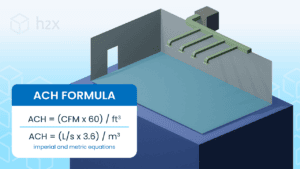
The most common CFM calculation formula is CFM = (room volume x required air changes per hour) / 60. Depending on the exact system you are sizing, CFM can also be calculated from cooling load, heat gain, or duct velocity.
Below, the four methods cover the situations HVAC designers encounter most often, with a fully worked example.
Key Takeaways:
- CFM calculation formula from air changes per hour (ACH):
CFM = (room volume in ft³ x ACH) / 60. - From cooling capacity: roughly 400 CFM per ton as a starting point (the range is from 350-450 depending on climate and coil).
- From sensible heat:
CFM = sensible BTU/h / (1.08 x temperature difference in °F). - From duct velocity:
CFM = duct area in ft² x velocity in ft/min. - Metric:
1 CFM = 0.472 L/s = 1.70 m³/h; metric formulas are provided below. - h2x calculates required airflow and sizes the ductwork automatically from the same model.
What is CFM in HVAC?
CFM stands for cubic feet per minute – the volume of air a fan, duct or diffuser moves every minute. It is the standard airflow unit in the United States. Metric projects use litres per second (L/s) or cubic metres per hour (m³/h); 1 CFM equals about 0.47 L/s or 1.7 m³/h.
Almost every ventilation and air conditioning decision comes back to CFM: how much air a room needs, how big the ducts must be to carry the required volume, and what the fan or air handler has to deliver.
Why Does Calculating CFM Correctly Matter?
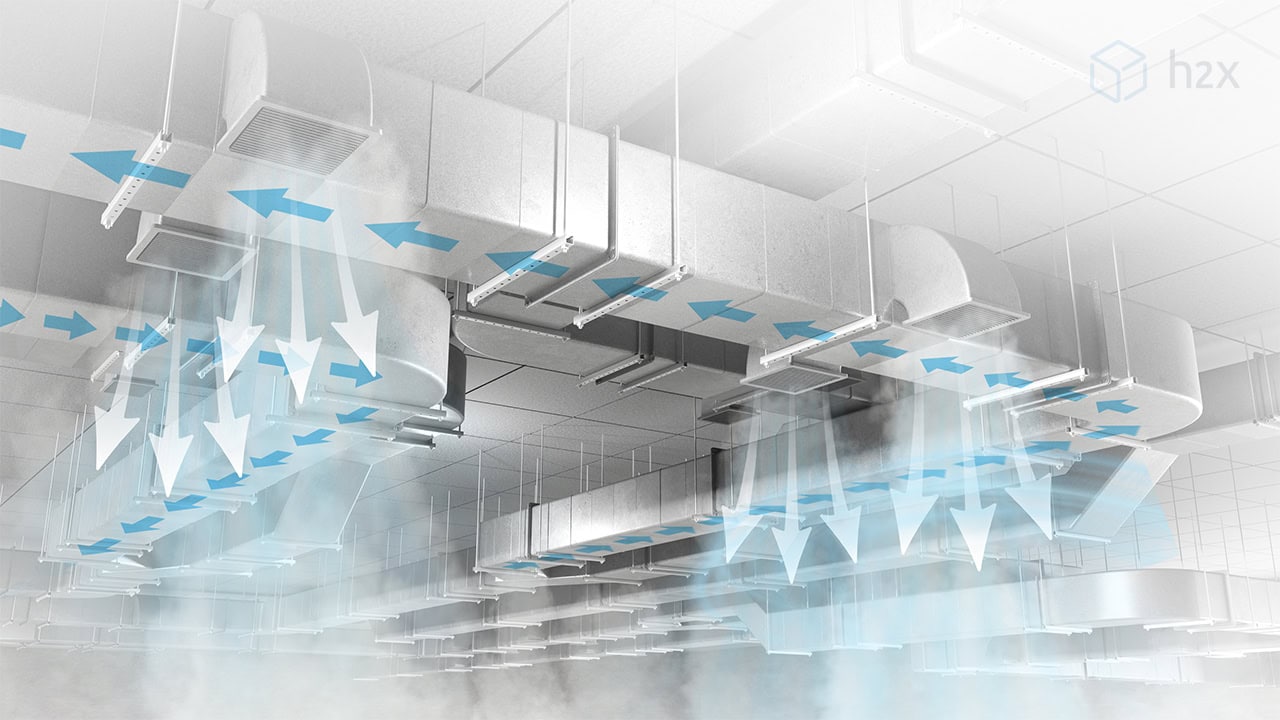
Undersize the airflow and rooms never reach setpoint, ventilation falls below code minimums, and coils can freeze from low airflow. Oversize it, and ducts get expensive, fans waste energy, and occupants complain about noise.
Airflow errors are also expensive to fix later. For example, a duct riser sized 20% too small would require a rebuild, not just an adjustment.
The Four CFM Calculation Formulas
How CFM is calculated depends on what you are sizing. So, which CFM calculation formula do you need?
If a code or guideline gives you an air change rate, use method one. If you are sizing airflow for comfort cooling, use method three. Method two is typically only used as a quick sense check. If you are working with the ducts themselves, use method four.
1. CFM calculation formula from air changes per hour (ventilation)
CFM = (room volume in ft³ x ACH) / 60
Use this when a code or guideline specifies an air change rate.
Metric: airflow in L/s = (room volume in m³ x ACH) / 3.6
2. CFM calculation formula from cooling capacity (rule of thumb)
Airflow is roughly 400 CFM per ton of cooling as a starting point, with real systems typically running 350-450 CFM/ton depending on climate, humidity and coil selection. Use this formula for quick checks only, and never for final design.
Metric: roughly 54 L/s per kW of cooling (400 CFM/ton converted)
3. CFM calculation formula from sensible heat load
CFM = sensible heat gain in BTU/h / (1.08 x ΔT), where ΔT is the difference between room and supply air temperature in °F. This is the calculation method behind proper load-based design. The 1.08 factor combines air density and specific heat at standard conditions.
Metric: airflow in L/s = sensible load in W / (1.21 x ΔT in °C)
4. CFM calculation formula from duct size and velocity
CFM = duct cross-sectional area in ft² x air velocity in ft/min. Use this to check what an existing duct can deliver, or invert it to size a duct for a known airflow.
Metric: airflow in L/s = duct area in m² x velocity in m/s x 1,000
Which CFM Formula Should You Use?
| Situation | Formula to use |
|---|---|
| Ventilation / air changes | CFM from ACH |
| Cooling airflow | CFM from sensible heat |
| Quick cooling estimate | 400 CFM per ton |
| Existing duct check | CFM from duct area and velocity |
Worked Example: How to Calculate CFM for a Room
Now, let’s size the airflow for a 12-person conference room, using the CFM calculation formulas above in the order an HVAC designer would.
The room: 25 ft long x 18 ft wide x 9 ft high.
Floor area = 25 x 18 = 450 ft²Room volume = 450 x 9 = 4,050 ft³- Occupancy = 12 people
Step 1: Minimum outdoor air for ventilation (ASHRAE 62.1).
Conference rooms require 5 CFM per person plus 0.06 CFM per square foot:
- People component:
12 x 5 = 60 CFM - Area component:
450 x 0.06 = 27 CFM - Minimum outdoor air =
60 + 27 = 87 CFM
Step 2: Supply airflow for cooling (sensible heat formula).
The cooling load calculation indicates 9,720 BTU/h of sensible gain:
- roughly 2,940 BTU/h from the 12 occupants (about 245 each),
- 3,000 BTU/h from lighting and equipment, and
- 3,780 BTU/h of solar gain through the glazed wall.
With 55°F supply air into a 75°F room, ΔT = 20°F:
CFM = 9,720 / (1.08 x 20)CFM = 9,720 / 21.6 = 450 CFM
Step 3: Pick the governing requirement.
The room needs 450 CFM of supply air to handle the cooling load, of which at least 87 CFM must be outdoor air. Cooling governs the duct and diffuser sizing, while ventilation sets the outdoor air fraction (about 19%).
Step 4: Double-check the air change rate.
ACH = (450 x 60) / 4,050 = 6.7 air changes per hour
Between 6 and 8 ACH is a sensible result for a densely occupied meeting room – if this came out at 2 or at 20, it would be a sign that something upstream is wrong.
Step 5: Size the duct (formula 4 in reverse).
Targeting 600 ft/min so the duct stays quiet next to the meeting space:
Required area = 450 / 600 = 0.75 ft²- A
12 in x 9 inrectangular duct (0.75 ft²) or a12 inround duct (0.79 ft²) both work
Same example in metric: the room is 7.6 m x 5.5 m x 2.7 m = 113 m³. The cooling load is 2,850 W sensible with an 11°C supply differential: L/s = 2,850 / (1.21 x 11) = 214 L/s (which is 450 CFM x 0.472 – the same answer). ACH = (214 x 3.6) / 113 = 6.8, matching the imperial check.
CFM in Metric Units: L/s and m³/h
US projects specify airflow in CFM; UK, European and Australian projects use litres per second (L/s) or cubic metres per hour (m³/h). The quantities are identical; only the units change.
1 CFM = 0.472 L/s— multiply CFM by 0.472 to get L/s1 CFM = 1.70 m³/h— multiply CFM by 1.7 to get m³/h1 L/s = 2.12 CFM— multiply L/s by 2.12 to get CFM1 m³/h = 0.589 CFM— multiply m³/h by 0.589 to get CFM
| From | To | Multiply by |
|---|---|---|
| CFM | L/s | 0.472 |
| CFM | m³/h | 1.70 |
| L/s | CFM | 2.12 |
| m³/h | CFM | 0.589 |
Quick reference: 100 CFM is about 47 L/s or 170 m³/h. A typical residential bathroom extract of 50 CFM is roughly 24 L/s – the figure UK designers will know from Approved Document F.
Working in metric? Use these versions of the four formulas:
ventilation airflow L/s = (volume m³ x ACH) / 3.6cooling airflow L/s = sensible watts / (1.21 x ΔT °C)duct airflow L/s = area m² x velocity m/s x 1,000- roughly
54 L/s per kWof cooling as the metric rule of thumb
In h2x design software, you set imperial or metric units once per project and every calculation and report follows automatically.
Common Mistakes in CFM Calculations
- Using
400 CFM/tonas final design. This value is a screening number; humid climates often need350 CFM/tonfor proper dehumidification. - Ignoring the sensible/total heat split. The 1.08 formula uses sensible load only; using total load oversizes airflow.
- Forgetting duct losses. The fan must deliver the room total plus leakage; sealed and tested ductwork keeps the two close.
- Mixing units. Combining metric volumes with
CFM, orft/minwithm/s, is the fastest way to a wrong answer. Convert everything to one system before you start. - Sizing to the room and forgetting the system. Every branch CFM must add up through the riser to the air handler; balancing fails when they do not.
Best Practices for Airflow Calculations
- Start from the governing requirement. Ventilation code, cooling load, or process need: the largest wins.
- Use load-based CFM for final design. Rules of thumb are for feasibility only.
- Apply velocity limits by space type. Keep duct velocities lower near quiet spaces to control noise.
- Double check with ACH. Convert your answer to air changes per hour and check whether it is plausible for the room type.
- Document the basis of each room’s airflow. Reviewers and commissioning teams will ask for evidence of how the airflow matches the outside air requirements from the Standard (ASHRAE or CIBSE).
- Keep airflow and duct sizing connected. Software like h2x recalculates both together when the design changes.
How h2x automates CFM Calculation and Duct Sizing
Every CFM number in a project depends on other numbers. These include loads, air change targets, duct sizes, and fan selections. Spreadsheets hold those pieces separately, but h2x duct design software keeps them connected.
Enter the room data once and h2x calculates required airflow, sizes the ducts, checks velocity and pressure drop, and produces submission-ready reports.
Watch the video below to see duct sizing in a live project, or book a 1:1 call to see how to do CFM calculations for duct layout on your own designs.
Final Thoughts on CFM Calculation
There is no single CFM calculation formula. Instead, there is an appropriate formula for each situation: air changes for ventilation, sensible heat for cooling airflow, and area times velocity for ducts.
Pick the governing requirement, calculate properly rather than by rule of thumb, check the result as an air change rate, and keep airflow and duct sizing connected. This way, any changes do not break the design.
Frequently Asked Questions: CFM Calculation
What is the formula for CFM?
The most common CFM calculation formula is CFM = (room volume in cubic feet x air changes per hour) / 60. Airflow can also be calculated from sensible heat load (CFM = BTU/h / (1.08 x ΔT)) or from duct area times velocity.
How many CFM do I need per square foot?
A common screening figure for cooling in commercial projects is about 1 CFM per square foot, but it varies widely with ceiling height, glazing, climate and occupancy. Therefore, use this figure for first checks only and calculate from the actual load for design.
How many CFM per ton of cooling?
Nominal airflow is 400 CFM per ton. Dry climates may run 450 CFM/ton, while humid climates often design at 350 CFM/ton to improve moisture removal. Also, this is roughly 54 L/s per kW in metric units.
How do I convert CFM to L/s or m³/h?
Multiply CFM by 0.472 to get litres per second, or by 1.7 to get cubic metres per hour. And if you’re going the other way, multiply L/s by 2.12 to get CFM.
How does h2x calculate CFM?
h2x software determines each room’s required airflow from the governing input – air change rate, heat load, or fixture requirement – then sizes the connected ductwork with velocity and pressure drop checks, and updates everything automatically when the layout changes. In fact, h2x works in imperial or metric units, as designated by the designer.
Want airflow calculations that update themselves?
h2x calculates required CFM from your load inputs, sizes the ductwork, and recalculates automatically when the design changes. So there are no disconnected spreadsheets and no manual cross-checks.
Meet the author

Jonathan Mousdell
Jonathan Mousdell is a Mechanical Engineer and co-founder of h2x, where he creates technical content and resources for MEP engineers.
Article Last Updated: July 9, 2026