
Case Study from: Woodhouse & Sturnham
Learn how Woodhouse & Sturnham designed a large underfloor heating system with h2x, staying within pipe limits and adapting to client changes.
Name: Luke Woodhouse
Company: Woodhouse & Sturnham
Location: East Midlands, United Kingdom

The Background
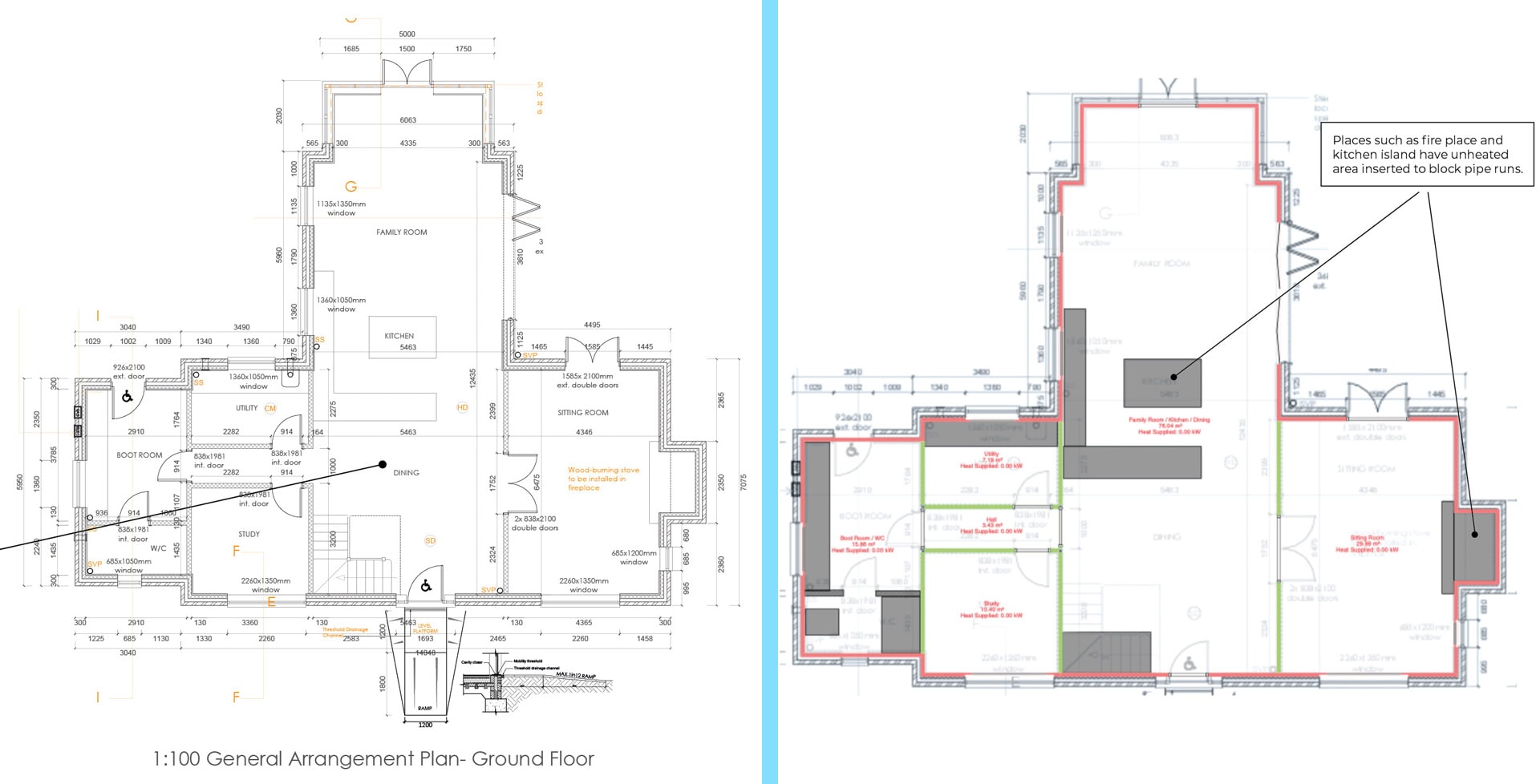
Woodhouse & Sturnham were appointed to design the underfloor heating (UFH) for a new-build home with a large footprint. The client supplied architectural plans, which the team first validated by cross-checking scale and dimensions in h2x to ensure digital measurements aligned with the drawings.
At the outset, manifold and heat source locations were not fixed. The team progressed with a flexible scheme, zoning and routing UFH in a way that could absorb later decisions from the client without restarting the design from scratch.
The Challenge
Two constraints shaped the approach. First, the UFH network needed to respect a maximum circuit length of 120 m to avoid temperature drop and ensure even heat delivery. Second, the layout was evolving: the client's revisions affected door positions, kitchen cabinetry, island size, and unheated areas, each of which changes feasible pipe routes and circuit lengths.
The initial calculations revealed that some large rooms pushed projected circuit lengths far beyond the design threshold (e.g., 477 m for the central zone). The team also had to maintain clear passage through doorways (virtual gateways in h2x) and define unheated areas under fixed furniture and units so pipework was not wasted where heat would be ineffective.

The Solution
Using h2x, the team iterated quickly: rooms were zoned, doorways defined, and unheated areas marked precisely from the architectural set. Smaller rooms (e.g., the boot room and W/C) were combined into one zone to improve 11-port manifold capacity, reserving ports for larger spaces.
Where projected runs exceeded limits, Woodhouse & Sturnham introduced heated area partitions to split rooms into multiple circuits, each returning directly to the manifold and staying below 120 m. When the client requested longer runs, the team explained the performance trade-offs and maintained the limit to protect efficiency and comfort. As the kitchen layout changed, unheated areas were re-marked (island and new cabinet lines) and h2x instantly recalculated lengths and results, keeping the design compliant.

The Results
The final scheme balanced practicality and performance: an 11-port manifold served well-proportioned zones, every circuit remained within 120 m, and pipe routes respected door thresholds and fixed joinery. The design is ready for installation without re-work or risk of under-delivery.
Equally important, the process handled client change smoothly. Instead of manual re-calculation, h2x updated circuit lengths and checks in real time as rooms, cabinetry, and unheated areas evolved. The outcome is a design that meets the client's brief and adheres to UFH best practice on length, distribution, and efficiency.

Loved by Engineers
Read More Customer Stories

Designed a 60-storey hotel in 2 hours
How Sparks+Partners sized pipework for an Australian 60‑storey building in just 2 hours, saving at least 1.5 staff days with h2x.

h2x listened, engaged and acted
How Ideal Heating accelerated design validation with hands‑on support, and embraced h2x in just 3 days through rapid innovation.

Cut design time by 50% vs. before
How MEP Design cut time by 50% on a 50-storey mixed-use tower in Manchester, UK, delivering more accurate designs with h2x.