How to Calculate Residual and Static Water Pressure
Learn the difference between residual and static water pressure, how to calculate both through a plumbing system, and what to do when pressure falls outside the required range.
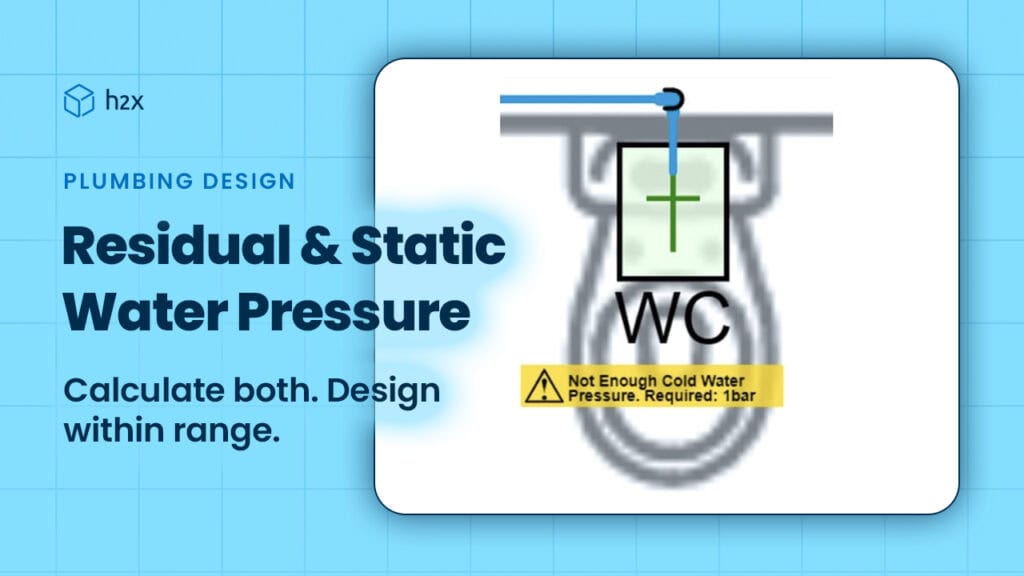
Download your free PDF of this article below.
To calculate residual and static pressure in a water system, you need to account for the available supply pressure, flow-dependent losses and changes in elevation. Water pressure is not constant throughout a plumbing system, so both operating conditions need to be checked.
That means a system needs to work at both ends of its operating range. Residual pressure tells you how much pressure remains while water is flowing under the design condition, while static pressure tells you the pressure present when there is no flow.
Calculating both is important because fixtures and components have minimum and maximum inlet pressure requirements. A system can therefore have too little pressure during peak demand, too much pressure when demand falls to zero, or both problems under different operating conditions.
Quick Answer: To calculate residual pressure, start with the available supply pressure while water is flowing and subtract pressure losses through pipes, valves, fittings and elevation. To calculate static pressure, start with the static supply pressure and account for elevation. Because there is no flow under static conditions, there are no friction losses through the pipes, valves or fittings.
Key Takeaways
- Residual pressure is the pressure available while water is flowing under the design condition.
- Static pressure is the pressure present when there is no water flow.
- Pipe, valve and fitting pressure losses reduce residual pressure because these losses occur when water is flowing.
- Elevation affects both residual and static pressure.
- For water, every 1 m (3.28 ft) increase in elevation reduces pressure by approximately 9.81 kPa (1.42 psi).
- If residual pressure is too low, the design may need lower system losses or additional pressure from a booster pump.
- If static pressure is too high, a pressure reducing valve (PRV) may be required.
- Always compare the calculated pressures with the minimum and maximum inlet pressure requirements of the fixture or component being served.
Pressure values in this guide are shown in both kilopascals (kPa) and pounds per square inch (psi). For unit conversion, the National Institute of Standards and Technology (NIST) gives 1 psi as 6.894757 kPa.
What Are Residual and Static Water Pressure?
What Is Residual Pressure?
Residual pressure is the pressure available at a point in the water system while water is flowing.
For design calculations, it is typically checked at the required or peak flow condition. As water flows through the system, pressure is lost through pipes, valves, fittings and other components. This leaves less pressure available at the fixture.
A simplified residual pressure calculation is:
Residual pressure at fixture = Supply residual pressure − Flow-dependent pressure losses ± Elevation pressure change
Flow-dependent pressure losses can include:
- Pipe friction
- Valves
- Fittings
- Other components through which water flows
The calculated residual pressure should then be compared with the minimum inlet pressure required by the fixture or component.
For a deeper explanation of the flowing condition, including what causes pressure to fall and how to address insufficient pressure, see our guide to why residual water pressure is important.
What Is Static Water Pressure?
Static pressure is the pressure present in the water system when there is no flow.
With no water moving through the system, there is no friction pressure loss through the pipes, valves or fittings. The main pressure change through the building is therefore caused by elevation.
Static pressure at fixture = Supply static pressure ± Elevation pressure change
A fixture positioned above the water supply connection will experience lower static pressure. A fixture positioned below it will experience higher static pressure.
For a closer look at why the zero-flow condition matters, how elevation affects pressure and what can happen when pressure becomes excessive, see our guide to why static water pressure is important in plumbing systems.
Static vs Residual Water Pressure
Static and residual pressure describe two different operating conditions.
| Comparison | Static Pressure | Residual Pressure |
|---|---|---|
| Flow condition | No flow | Water is flowing |
| Pipe, valve and fitting losses | No flow-dependent losses | Pressure losses occur |
| Main design concern | Maximum pressure experienced by components | Pressure available during operation |
| Elevation effect | Yes | Yes |
Is Water Static Pressure the Same as HVAC Static Pressure?
No. This article covers static pressure in water systems. In an air-side HVAC system, static pressure is used to describe pressure and resistance associated with airflow through ducts, filters, coils, fittings and other components.
If you are working with ductwork rather than water systems, see our guide on how to calculate static pressure in an HVAC system, including design-stage calculations, total external static pressure (TESP) measurement and a worked example.
Why Do You Need to Calculate Both Residual and Static Pressure?
A water system operates across a range of flow conditions.
When demand increases, more water moves through the system and pressure losses through the pipes, valves and fittings increase. This reduces the residual pressure available at the fixture.
When demand falls to zero, those flow-dependent pressure losses disappear and the system moves towards its static pressure condition.
As flow increases, the pressure available at the fixture decreases.
As flow decreases, the pressure available at the fixture increases.
This matters because fixtures and components need to operate within a defined pressure range.
For example, if a fixture requires an inlet pressure between 200 kPa (29.0 psi) and 500 kPa (72.5 psi):
- The residual pressure needs to remain above 200 kPa (29.0 psi).
- The static pressure needs to remain below 500 kPa (72.5 psi).
Checking only one condition can therefore miss a design problem.

What Inputs Affect the Water Pressure Calculation?
The starting point is the pressure available where the building connects to the water supply.
From there, the pressure available at a fixture can be affected by:
- Pipes: Water loses pressure as it moves through the pipes.
- Valves: Valves add resistance while water is flowing.
- Fittings: Elbows, tees and other fittings contribute additional pressure loss.
- Elevation: Pressure decreases as water rises through the building and increases as it moves downwards.
For water, the pressure change caused by elevation is approximately:
Elevation pressure change ≈ 9.81 kPa per m (0.433 psi per ft)
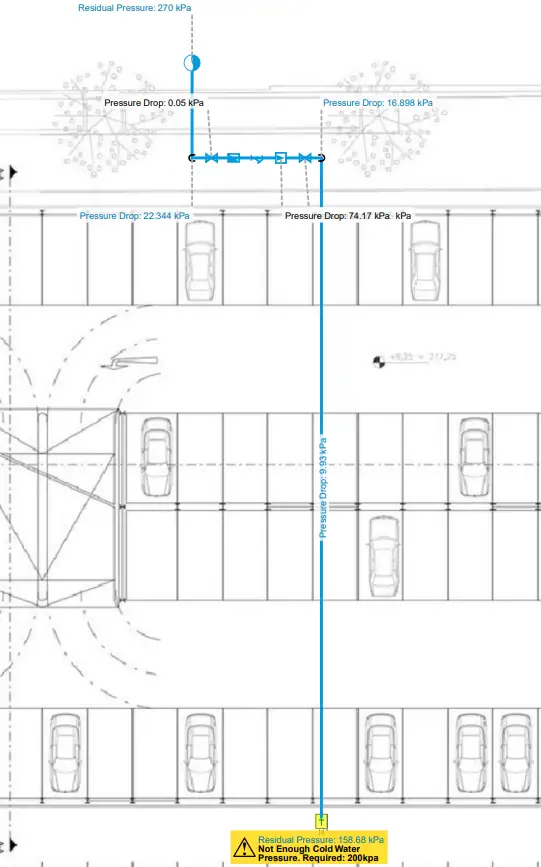
The pressure profile through a system can be seen in the h2x design example below.

How Do You Calculate Residual and Static Water Pressure?
How Do You Calculate Residual Pressure?
To calculate residual pressure, follow the flow path from the water supply to the fixture and calculate the pressure lost through each part of the system at the design flow rate.
A simplified pressure balance is:
Pfixture = Psupply − ΔPpipe − ΔPvalves − ΔPfittings − ΔPelevation
- Pfixture = residual pressure available at the fixture
- Psupply = residual pressure available from the water supply
- ΔPpipe = pressure loss through the pipes
- ΔPvalves = pressure loss through valves and other components
- ΔPfittings = pressure loss through fittings
- ΔPelevation = pressure change caused by elevation
You can calculate pipe pressure loss using the Darcy-Weisbach equation. You can also use our Pressure Drop Calculator to calculate pressure drop through a pipe.
Valve and fitting losses should be calculated using the relevant manufacturer data or resistance values for the calculation method being used.
How Do You Calculate Static Pressure?
Static pressure is simpler because the water flow rate is zero.
With no flow, there is no friction pressure loss through the pipes, valves or fittings:
ΔPpipe = ΔPvalves = ΔPfittings = 0
You therefore only need to account for the available static supply pressure and the change in elevation:
Pstatic, fixture = Pstatic, supply − ΔPelevation
For a fixture above the supply connection:
ΔPelevation = Height × 9.81 kPa/m
In imperial units:
ΔPelevation = Height × 0.433 psi/ft
Worked Example: Calculating Residual and Static Pressure
In this example, we will calculate the residual and static pressure available at a hose connection serving a parking area.
Project Information
| Input | Value |
|---|---|
| Supply residual pressure | 270 kPa (39.2 psi) |
| Supply static pressure | 620 kPa (89.9 psi) |
| Water main elevation | 14 m (45.9 ft) |
| Floor elevation | 15 m (49.2 ft) |
| Fixture height above floor | 0.5 m (1.64 ft) |
| Design flow rate | 0.5 L/s (6.6 imp gal/min; 7.9 US gal/min) |
| Pipe diameter | 25 mm (1.0 in) |
| Minimum fixture inlet pressure | 200 kPa (29.0 psi) |
| Maximum fixture inlet pressure | 500 kPa (72.5 psi) |
The fixture is positioned 1.5 m (4.92 ft) above the water main:
15 m (49.2 ft) + 0.5 m (1.64 ft) − 14 m (45.9 ft) = 1.5 m (4.92 ft)
Step 1: Calculate the Residual Pressure
At the design flow rate of 0.5 L/s (6.6 imp gal/min; 7.9 US gal/min), pressure is lost through the pipes, valves, fittings and elevation.
| Pressure item | Pressure loss |
|---|---|
| Pipe pressure loss | 17.43 kPa (2.53 psi) |
| Valve pressure loss | 76.52 kPa (11.10 psi) |
| Fitting pressure loss | 3.12 kPa (0.45 psi) |
| Elevation pressure loss | 14.72 kPa (2.13 psi) |
The pipe pressure loss in the original design is based on 20.5 m (67.3 ft) of pipe at 0.85 kPa/m (0.0376 psi/ft):
20.5 m × 0.85 kPa/m = 17.43 kPa
The fitting pressure loss is:
6 × 0.52 kPa (0.075 psi) = 3.12 kPa (0.45 psi)
The elevation pressure loss is:
1.5 m × 9.81 kPa/m = 14.72 kPa
Or, using imperial units:
4.92 ft × 0.433 psi/ft = 2.13 psi
Subtract each loss from the available residual supply pressure:
270 − 17.43 − 76.52 − 3.12 − 14.72 = 158.21 kPa
Fixture residual pressure = approximately 158 kPa (22.9 psi)
The fixture requires at least 200 kPa (29.0 psi), so the calculated residual pressure is approximately 42 kPa (6.1 psi) below its minimum inlet pressure.
The result is shown in the h2x design below. h2x reports approximately 158.7 kPa (23.0 psi). The small difference from the hand calculation comes from rounding in the simplified inputs above and the more detailed losses calculated in the h2x model.
Step 2: Calculate the Static Pressure
Because there is no water flow under static conditions, there is no friction pressure loss through the pipes, valves or fittings.
Only the elevation pressure change needs to be deducted from the supply static pressure:
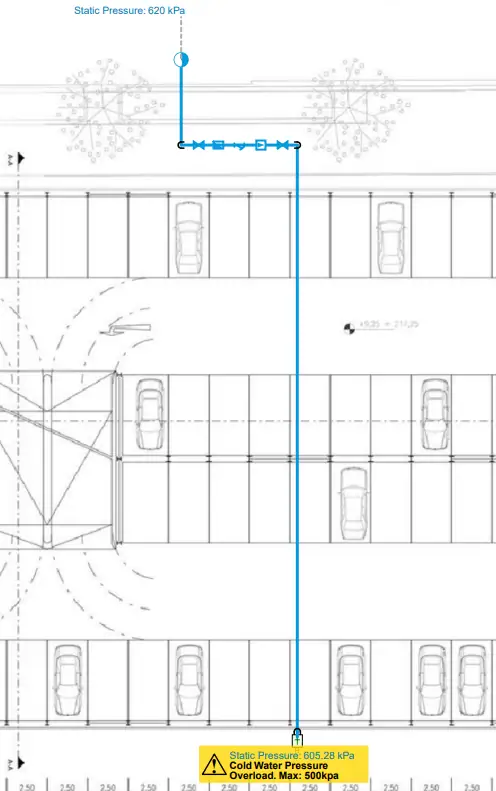
620 kPa (89.9 psi) − 14.72 kPa (2.13 psi) = 605.28 kPa (87.8 psi)
Fixture static pressure = approximately 605 kPa (87.8 psi)
The maximum inlet pressure for the fixture is 500 kPa (72.5 psi), so the calculated static pressure is approximately 105 kPa (15.2 psi) above its maximum inlet pressure.
The static pressure result is shown below.
What Happens When Water Pressure Falls Outside the Required Range?
What If There Is Not Enough Residual Pressure?
If the residual pressure at a fixture falls below its minimum required inlet pressure, the design needs to either reduce its pressure losses or provide additional pressure.
Depending on the system, this could include reviewing the pipe sizes, fittings and valve selections or adding a booster pump.
In this example, the residual pressure at the fixture is 158 kPa (22.9 psi), compared with a minimum requirement of 200 kPa (29.0 psi).
If a booster pump added 100 kPa (14.5 psi) at the relevant operating condition:
158 kPa (22.9 psi) + 100 kPa (14.5 psi) = 258 kPa (37.4 psi)
The resulting residual pressure would then be above the fixture’s minimum inlet pressure.
Adding a booster pump also means the pressure conditions downstream need to be checked again. Depending on the pump, its controls and the system arrangement, the pressure available at zero flow may also increase. In this example, the fixture already experiences static pressure approximately 105 kPa (15.2 psi) above its maximum inlet pressure, so the final design would need to address both the low residual pressure and the excessive static pressure.
What If There Is Too Much Static Pressure?
If static pressure exceeds the maximum inlet pressure allowed by a fixture or component, a pressure reducing valve (PRV) can be used to control the downstream pressure.
In this example, the calculated static pressure at the fixture is 605 kPa (87.8 psi), which is approximately 105 kPa (15.2 psi) above the maximum fixture pressure of 500 kPa (72.5 psi).
If a PRV is selected and configured to provide an appropriate downstream pressure, the fixture can be kept within its allowable pressure range.
For more detail, see our guide to designing pressure reducing valves.
Can Residual Pressure Be Too Low While Static Pressure Is Too High?
Yes. A system can have insufficient residual pressure during periods of high demand while also experiencing excessive static pressure when there is no flow.
This can occur where the water supply has a wide difference between its residual and static pressure or where the system experiences significant elevation changes and flow-dependent pressure losses.
In these situations, the design may need both pressure boosting and pressure reduction. The required arrangement depends on the pressure conditions throughout the individual system.
Common Mistakes When Calculating Residual and Static Pressure
- Using static supply pressure for the residual calculation. Residual pressure should be checked using the supply pressure available at the required flow condition.
- Including pipe friction in the static calculation. With zero flow, there is no friction pressure loss through the pipes, valves or fittings.
- Ignoring elevation. Elevation affects both residual and static pressure and can become particularly important in taller buildings.
- Checking only the minimum pressure. The system also needs to remain below the maximum inlet pressure under static conditions.
- Ignoring component pressure losses. Valves, fittings and other equipment can consume a significant part of the available residual pressure.
- Checking only one operating condition. A design that works at peak flow can still exceed pressure limits when flow stops.
How h2x Helps Calculate Residual and Static Pressure
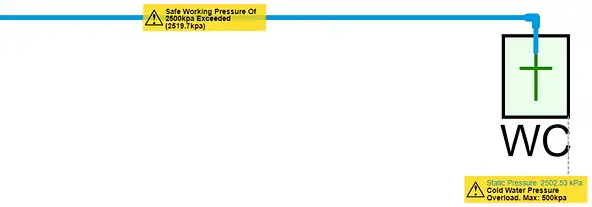
h2x design software automatically calculates residual and static pressure based on the system layout.
As the design changes, the pressure calculations update with it. If a pressure falls outside the required range, h2x can provide warnings so the issue can be identified before the system is installed.
Conclusion
Residual and static pressure describe the two ends of a water system’s operating range.
Residual pressure shows whether enough pressure remains while water is flowing, while static pressure shows the pressure components may experience when flow stops.
A complete design should check both conditions. Calculate the flow-dependent pressure losses and elevation change under the design flow condition, then check the zero-flow condition separately against the minimum and maximum pressure requirements of the fixtures and components being served.
Frequently Asked Questions
Where do supply static and residual pressure values come from?
Supply pressure values may come from the water provider, project design information or pressure and flow measurements taken at the supply point. Static pressure is measured with no flow, while residual pressure needs to represent the pressure available at the flow condition being used for design. For some projects, flow-test data may also provide both static and residual pressure values.
How do you convert water pressure to metres or feet of head?
For water, 1 m (3.28 ft) of head is approximately 9.81 kPa (1.42 psi), and 1 psi is approximately 2.31 ft (0.70 m) of head. To convert pressure to head, divide kPa by 9.81 to get metres, or multiply psi by 2.31 to get feet. Supply pressures are also often quoted in bar, where 1 bar equals 100 kPa (14.5 psi).
Does a booster pump affect static pressure?
It can. A booster pump is normally selected to increase pressure while the system is operating, but the pressure available at zero flow also depends on the pump, its controls and the system arrangement. After adding a booster, recheck the static condition as well as the residual condition to make sure downstream components remain within their allowable pressure range.
Calculate Water Pressure as You Design
h2x calculates pipe sizing and pressure throughout your water system as the layout changes, helping you identify pressure problems before installation.
Meet the author

Daniel Mousdell
Daniel Mousdell is the Founding Marketer at h2x, where he creates technical content and resources for HVAC and MEP engineers. Outside of work, he runs LilWayneHQ.
Article published: August 3, 2022
Last updated: October 8, 2026
Technically reviewed by: Jonathan Mousdell, Mechanical Engineer and Co-founder at h2x