
How to Eliminate Data Entry Errors in Plumbing Design
Why disconnected tools and manual data transfer create calculation errors in plumbing design, and how engineers can remove the risk.

Data entry errors in plumbing design occur when information is manually transferred between separate tools, platforms, or documents during the design process.
Each time data moves from a floor plan markup into a calculation spreadsheet, or from a spreadsheet back onto a drawing, mistakes can occur. In building services engineering, those mistakes can lead to undersized pipework, incorrect pump selections, failed design reviews, and costly rework on site.
This article explains why data entry errors are so common in plumbing design, what the consequences look like in practice, and how a unified design platform removes the risk entirely.
Key Takeaways:
- Manual data transfer between disconnected tools is the primary cause of calculation errors in plumbing design
- Each stage of the traditional design process – markup, calculation, and drafting – introduces a new opportunity for human error
- Errors in calculation inputs produce incorrect specifications, which can reach the construction site before anyone spots them and turn into costly system failures
- A unified design platform removes manual data entry and its potential for errors by keeping the design and calculations in a single connected model
- Automated calculations ensure every engineer on a team produces consistent, verifiable results to their chosen standards
What Exactly Are Data Entry Errors in Plumbing Design?
A data entry error in plumbing design is any mistake that occurs when the engineer manually copies, measures, or transfers information from one tool or document to another. In plumbing engineering, this most commonly happens when measuring pipework lengths from a PDF markup and typing them into a spreadsheet, or when manually transcribing calculated pipe sizes back onto a drawing.
In both scenarios, the engineer must accurately capture information and reproduce it in another document. The process itself is inherently risky, since every manual step is a potential point of failure. This includes every cell filled in by hand, every dimension measured with a scale ruler (or digital equivalent), and every result copied from one document to another.
In a scenario like this, the engineer who simply follows the process given to them becomes responsible for those errors.
The consequences are not always immediately obvious. A single incorrect value in a multi-layered calculation spreadsheet can propagate through multiple dependent calculations before the error surfaces. By that point, the design may already have been issued, further compounding the error.

Why Data Entry Errors Happen
The root cause is a fragmented design process that requires the same information to exist in multiple places at the same time and relies on the engineer to retain and reproduce it.
In a traditional plumbing engineering workflow, projects move through four distinct stages:
- Conceptual design: the engineer sketches a system layout on the architectural floor plan.
- Calculated design: fixture counts, pipe lengths, and flow rates are measured and entered into spreadsheets to size the system.
- Detailed design: calculated sizes are transferred back onto the mark-up for design review.
- Completed construction design: the final design is recreated in CAD or Revit.
Even in a straightforward project, the same piece of information – a pipe length, fixture count, flow rate – may be entered manually three or four times across these stages. On a large project, such as a multi-level residential block with hundreds of bathrooms, this involves thousands of individual entries. At that scale, the likelihood of every single one being correct is low.
Research published in the Journal of Construction Engineering and Management, drawing on data from industrial construction projects, found that rework costs can account for up to 12–15% of total project costs, with design errors and omissions responsible for the majority of that figure.
Adding client deadlines and project pressure into the picture makes errors even more likely. Speed and accuracy are difficult to maintain simultaneously when the process relies heavily on manual data input.
Why Errors Are So Difficult to Catch
Mistakes in data entry are not always visible on the page. A value that looks plausible is unlikely to trigger a review comment.
Typically, a senior engineer checks the calculation spreadsheet against the markup drawing side by side. This is a slow, manual process where it’s almost impossible to verify that every input was initially entered correctly.
As a result, the review process mostly works as a high-level check and does not function effectively as a line-by-line audit of every data point. Sometimes, errors that do not appear to be obviously wrong, such as a pipe length that is 15% too short, can pass through review and reach the construction drawing stage.
By the time an error is identified on site, the cost to rectify it is significantly higher than if it had been caught during design.
How a Unified Platform Eliminates Data Entry Errors in Plumbing
The most effective way to remove data entry errors from plumbing design is to limit data entry steps in the workflow.
A unified design platform combines markup, calculation, and output production in a single connected model. This means the design and the calculations are never separate documents.
A platform like this would effectively remove the transfer and manual input steps. The model holds all of the information in one platform, and the calculations run automatically against it.
h2x is built on this principle.
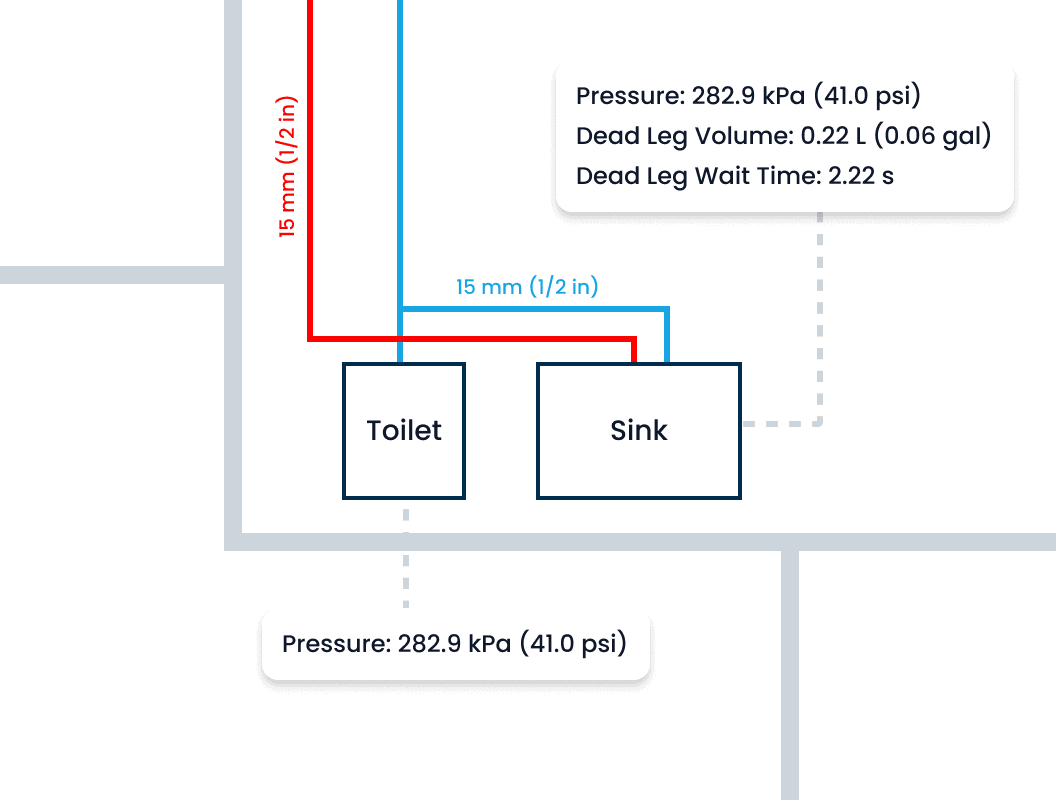
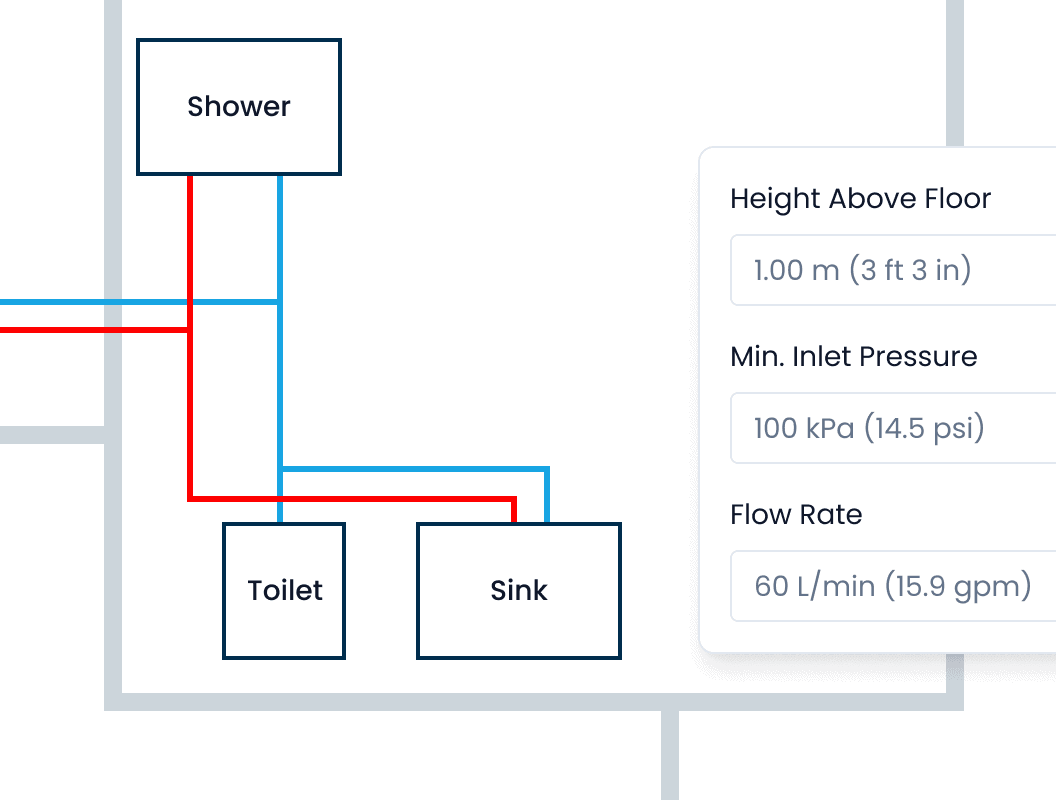
Engineers design their plumbing systems directly on the floor plan inside h2x. As they draw the system, h2x automatically counts fixture units, measures pipe lengths, calculates flow rates, and sizes pipework. This process takes place in real time, without any manual data entry.
When the engineer inputs a design change, every dependent calculation updates instantly. No spreadsheet to revise, no values to re-enter, and no risk of an old calculation persisting on an already-distributed drawing.
Watch the h2x demo below to see plumbing calculations running automatically in a live project, or book a 1:1 call to see it applied to your own designs.
Standard Calculations Across Every Engineer and Every Project
Removing manual data entry solves one part of the problem. But, in a design consultancy with multiple engineers across different offices, there is a second source of inconsistency. In this type of setting, the variations among how individual engineers carry out their calculations can easily cause discrepancies.
One engineer may apply a particular friction rate for cold water pipework. Another, trained at a different firm, may use a slightly different approach. Neither is necessarily wrong, but the inconsistency makes design review harder, audit trails less clear, and quality control more difficult to enforce.
h2x addresses this by applying a standard calculation method across the entire platform.
Every engineer using h2x applies the same verified calculation logic, based on CIBSE-verified and ASHRAE methodologies for:
- pipe sizing
- flow rates
- pressure drop
- and velocity.
It doesn’t matter whether a junior engineer or a senior designer carries out the work. The calculations always follow the same verified, consistent approach.
This is not about removing engineering judgement. Engineers still make design decisions. In support of those decisions, h2x ensures that the underlying mathematical process is accurate and uniform every time.
Example: Reducing Plumbing Calculation Errors on a Hotel Project
Consider a plumbing engineer designing the cold water distribution system for a large hotel.
Using a traditional workflow, the engineer would mark up the floor plans, measure every pipe run, count every fixture, and enter all data into a calculation spreadsheet. Then, they would size the pipes, and transfer the results back onto the drawing. On a project of this scale, that process might take a full working day and introduce dozens of opportunities for manual error.
However, when using h2x:
- The engineer draws the system directly onto the imported floor plan.
- h2x automatically counts the fixtures, measures the pipe routes, calculates the required flow rates, and sizes the pipework against CIBSE-verified standards.
- The engineer reviews the results directly on the model, exports a calculation report for QA sign-off, and pushes the final design to CAD or Revit via the h2x plugin.
No one re-enters data at any stage.
Best Practices for Reducing Calculation Errors in Plumbing Design
- Eliminate manual measurement: use software that calculates pipe lengths automatically as they’re drawn over a scaled PDF.
- Keep design and calculations in one place: avoid workflows that require results to be transferred between separate documents and platforms.
- Use design warnings: choose a platform that flags potential issues in real time, before the design reaches review.
- Apply standard calculation settings across your team: agree on friction rates, velocity limits, and sizing methods, and enforce them through software configuration rather than separate Excel-based workflows.
- Use live model-based results for design review: reviewers should be able to verify calculations directly against the model, not by cross-referencing a separate spreadsheet.
- Check compliance before issuing: ensure your platform uses calculation methods that align with chosen standards.

Conclusion
Data entry errors in plumbing design are the predictable outcome of a fragmented process that requires engineers to manually enter information at multiple stages.
Eliminating those errors means eliminating the transfer steps. And that requires a design platform where the model, calculations, and outputs are all connected in one place. When the drawing process allows the calculations to run automatically, the risk disappears with the process.
Data Entry Errors in Plumbing FAQs
What causes data entry errors in plumbing design?
The primary cause of data entry errors in plumbing design happen when engineers manually transfer information between disconnected tools. For example, typing pipe lengths from a PDF into a spreadsheet, or transcribing calculated sizes onto a drawing. Each transfer step introduces the risk of human error. On large projects involving hundreds of fixtures, even a small error rate across thousands of inputs can produce significant inaccuracies in the final design.
Why are calculation errors in building services so hard to find?
Calculation errors are difficult to detect because a plausible-looking value rarely triggers a review comment. Traditional design reviews compare a markup drawing against a spreadsheet at a high level. Unless a reviewer checks every individual input against the original measurement, an incorrect value can pass through unnoticed.
How does a unified design platform reduce errors?
A unified design platform reduces errors by eliminating the manual transfer steps where mistakes occur. Design and calculations exist in a single connected model, so there is no separate spreadsheet to populate and no values to re-enter between stages. When an engineer updates the design, all dependent calculations update automatically in real time.
What does CIBSE-verified mean for plumbing calculations?
CIBSE (Chartered Institution of Building Services Engineers) is the UK’s leading professional body for building services engineering. CIBSE-verified calculations mean the calculation methods in the software have been independently checked against CIBSE guidance documents for accuracy. This provides engineers and reviewers with confidence that the results meet industry standards.
How much does a plumbing design error cost to fix on site?
Errors identified on site cost significantly more to rectify than those caught during design. According to the Construction Industry Institute, the cost of fixing an error increases tenfold at each project phase — what costs £75 / $100 to correct during design can cost £750 / $1,000 to fix during construction, and £7,500 / $10,000 after occupancy. Rework typically involves not just revised drawings but also abortive labour, material waste, and programme delays.
What is the difference between a calculation error and a design error in plumbing engineering?
A calculation error refers specifically to an incorrect numerical input or output, such as a wrong pipe length or flow rate, usually caused by manual data entry. A design error is broader and may include incorrect system layout, wrong product selection, or non-compliance with standards. MEP calculation errors are a subset of design errors, and one of the most preventable.
Can h2x flag design errors automatically?
Yes. h2x includes design warnings that flag potential issues, such as undersized pipe sections or insufficient flow, in real time as the engineer designs. This means engineers identify and resolve problems during the design stage, before issuing the drawing for review.
Ready to eliminate data entry errors from your plumbing designs?
Check out how engineers design plumbing systems with automated pipe sizing, real-time CIBSE-verified calculations, and zero manual data transfer, all in one connected platform.
Meet the author

Michael Ainscough
Michael Ainscough is a Technical Engineer at h2x.
Article published: May 21, 2026
Last updated: June 11, 2026


